Why Hiring Fast Is Costing You More: The Case for Pre-Vetted Remote Talent
Speed-to-hire may feel like a competitive advantage, but replacement costs, productivity gaps, and re-hiring cycles show up on the balance sheet. Here's why...
Updated January 27, 2026

Talent acquisition for startups has shifted toward AI-driven, skills-based recruiting, as well as remote and hybrid work, helping young companies compete with larger tech firms for scarce talent.
Three-quarters of employers worldwide struggle to find skilled talent, a rate more than double that of a decade ago. For startups competing against tech giants with unlimited budgets, the odds seem impossibly stacked.
Now they use AI to streamline workflow.
Looking for a Human Resources agency?
Compare our list of top Human Resources companies near you
AI tools now cut hiring time by 50%. Skills-based hiring has replaced degree requirements, opening large talent pools. Companies leverage remote work to access global talent pools and use predictive analytics for employee retention.
This article explores the trends reshaping talent acquisition, outlines hiring strategies for each growth stage, and presents a framework for evaluating new hires within their first 90 days.
As of 2024-2025, 87-99% of companies report using AI for recruitment, and 99% of hiring managers report efficiency improvements in tasks associated with hiring.
Even in fields like fintech, where degrees used to be everything, companies now prioritize specific skills, such as blockchain development, cybersecurity, and AI. However, actual implementation lags behind stated policies. 85% of companies now report using skill-based hiring (up from 81%), while degree requirements have declined.
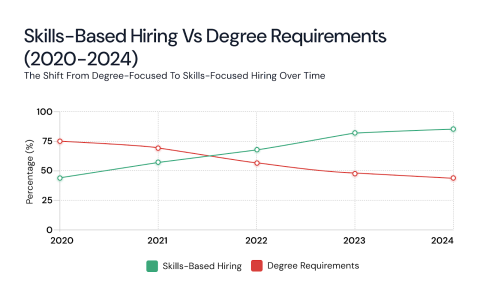
Sites like LinkedIn help recruiters find candidates based on their skills and abilities, not just their educational background. This opens up a lot and solves real problems immediately.
Tech giants now spend heavily on showcasing their workplace culture, even using virtual reality to let job seekers explore their offices from the comfort of their own homes. At the same time, diversity and inclusion efforts have become developing programs to attract individuals from underrepresented groups.
When you look closely at hiring trends in specific industries, you will see evidence of the above-discussed trends.
In fintech, for example, companies need experts in valuation and SEC rules. Instead of posting on general job sites, they now find people through specialized professional networks.
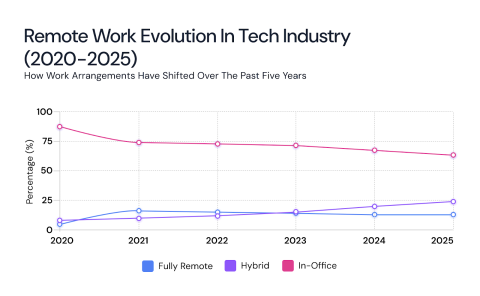
The tech industry leads in remote work adoption, with approximately 67% of tech employees working at least part of the time, though many are in hybrid rather than fully remote arrangements. Hybrid job postings have increased from 15% in 2023 to 24% by 2025, while fully remote positions account for approximately 12-13% of all postings.
Looking ahead, we believe that hiring alone won't be enough to maintain a strong workforce. Companies need to combine hiring with training programs to keep technology.
Here's how to make sure your hiring keeps up as your startup grows:
In the pre-seed and seed stages, look for individuals who are flexible and can perform various roles while excelling in key responsibilities. You need co-founders or first-team members who can build your initial product, test if it fits the market, and quickly update it based on customer feedback.
After securing seed funding, you can expand your team to enhance your MVP and begin generating revenue.
Once you've found product-market fit and are growing fast, you need to shift from hiring jacks-of-all-trades to hiring specialists who can create systems that work consistently and can grow with your startup.
Once you know your product fits the market, focus on accelerating revenue and fine-tuning your product. This can be achieved by hiring sales leaders, marketing professionals, and engineers. At this point, you should start building a management structure by adding team leads who can organize work and train newer employees.
If your product is really taking off and generating good revenue, consider expanding your sales and marketing capabilities and building a customer support team. This means hiring customer success teams to keep customers ensure things run smoothly, and HR staff to establish proper personnel systems. You also need to strengthen your technical side to meet growing customer needs by adding specialists in areas like security, data engineering, and infrastructure.
As you prepare to scale big, focus on becoming enterprise-ready by hiring executives who have grown companies before. Find heads of sales, marketing, and product who can manage large teams and handle complex sales strategies.
Successfully navigating these growth stages requires not just hiring the right people but also ensuring they blend effectively into your organization. A structured onboarding and evaluation process is critical to maximize the impact of each new hire.
At Series D and beyond, you must hire senior executives and ‘scaler’ leaders who have experience managing through hypergrowth. The following table outlines who exactly your business will need and why.
| Role | Key Responsibilities | Why Is It Critical for Scaling |
| Chief People Officer (CPO/CHRO) | Talent management, performance systems, DEI compliance, retention | Handles volume hiring and culture preservation amid rapid growth |
| CFO (or advanced finance lead) | Budgeting, fundraising, and compliance (e.g., SEC compliance for fintech) | Supports pre-IPO scrutiny, M&A tax planning |
| COO or Chief of Staff | Cross-functional operations, decision-making, and reducing strain on founder bandwidth | Frees CEO for strategy, coordinates scaling |
| VP Engineering/Scaler CTO | Managers of managers, robust tech infrastructure | Builds scalable systems for AI/fintech demands |
At this stage, utilizing an equity management platform enables finance and people teams to manage ESOPs, cap tables, and 409A valuations in a single location.
Here’s how you can utilize the probation period to effectively evaluate your new hires:
| Phase | Focus | Key Goals & Metrics |
| Days 1-30 | Learning & Integration |
|
| Days 31-60 | Contribution & Confidence |
|
| Days 61-90 | Ownership & Impact |
|
Goal: Finish all onboarding tasks
New hires should focus on learning and getting to know people. They need training, need to watch how teammates work, and need to learn the everyday tools. Track their progress by checking whether they've finished training and can use the tools well.
Goal: Handle 80% of their tasks on their own
In the second month, employees should begin working on small projects while getting to know people in other departments. They should feel comfortable sharing ideas based on their fresh perspectives, such as suggesting ways to utilize AI to enhance valuation processes.
Goal: Score above 4 out of 5 on retention review + Hit 90% of performance goals
By the third month, new hires should be delivering tangible results independently. This could involve conducting compliance audits or completing key projects that benefit the business.
Measure success by whether they hit 90% of their goals and score above 4 out of 5 on retention surveys. These numbers show that people are doing good work and feel happy with their job and how they fit into the company.
Hiring has evolved with the introduction of new AI tools, a shift toward focusing on skills rather than degrees, and remote work becoming the norm. These changes have made it easier for startups to compete with large companies for the same talented individuals, even without having the same resources.
To make the most of this, your hiring approach needs to grow as your company does. Early-stage startups thrive with flexible individuals who possess strong technical skills, while more established companies require specialists and experienced leaders who can develop systems, teams, and processes.
By focusing on hiring quality through screening, effective onboarding, and clear performance expectations, you can build a team that performs well.