
Why Hiring Fast Is Costing You More: The Case for Pre-Vetted Remote Talent
Speed-to-hire may feel like a competitive advantage, but replacement costs, productivity gaps, and re-hiring cycles show up on the balance sheet. Here's why...
Updated May 28, 2026

Analyze wage growth trends across industries and professions over the past five years, and examine effective strategies for attracting talent while controlling costs during a recession.
At early-stage startups, payroll is the largest burn rate driver, eating away at limited capital. As per 2025 figures, a company could spend around $4,000 to upwards of $20,000 just to hire new staff. This leads to a lot of pressure on startups who are weighing the importance of talent versus protecting their cash flow.
These challenges get worse during recessions. In such periods, businesses face low income and limited access to funding simultaneously.
Looking for a Human Resources agency?
Compare our list of top Human Resources companies near you
This article will explore solutions to this predicament; first, we will explore wage growth trends across industries. Then, we will list challenges that make it difficult for startups to attract job seekers. Finally, we will list practical strategies for attracting talent, such as equity incentives, without breaking the bank.
Wages in the US have climbed 27.35% over the past five years. Research suggests that job switchers saw even greater gains, with a 30.89% increase compared to 25.43% for those who stayed put. For employers, this underscores a critical insight: improving employee retention is essential for workforce stability and compensation costs management.
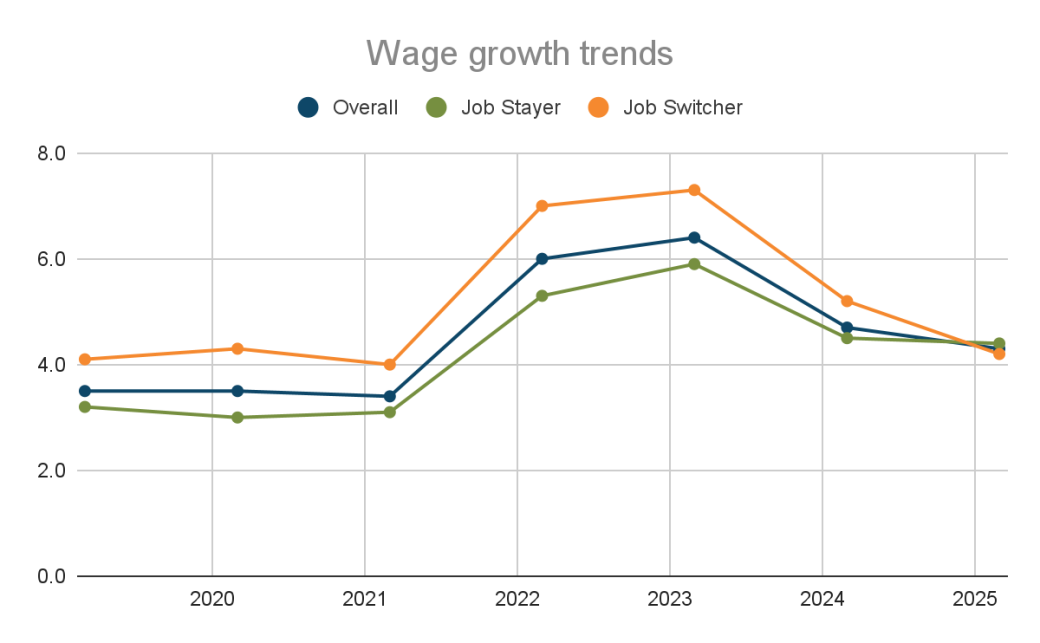
At present, wage growth seems to have stabilized around 4%, making it an opportune moment to expand your workforce. To fully leverage this opportunity, it is imperative for business owners and HR leaders to explore retention bonuses and clearer career development pathways
As of April 2025, the information industry saw the highest wage growth on a year-on-year basis.
The mining and logging industries paid the highest average hourly wage among goods-producing industries. Among service-producing industries and overall, the information industry paid the highest average hourly wage.
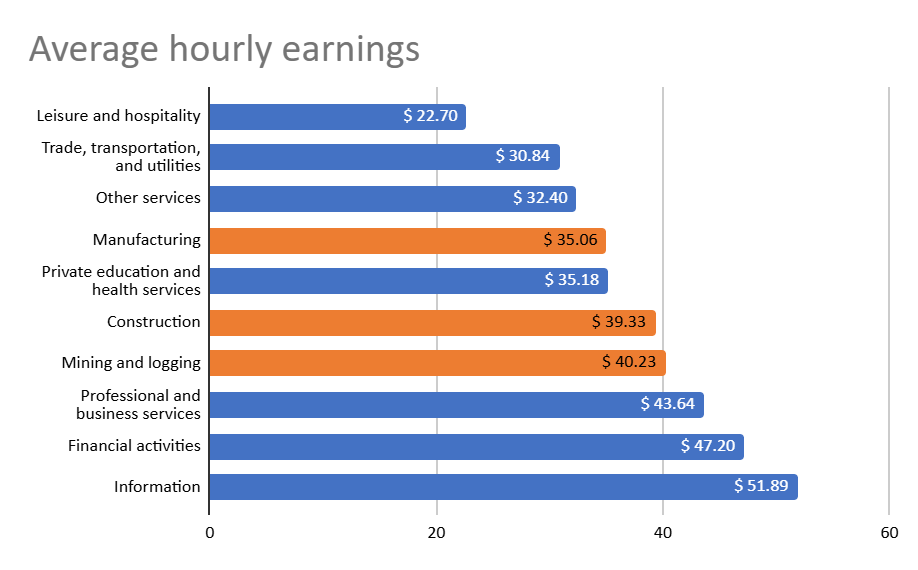
Since startups rely heavily on tech and professional services talent, they face significant cost pressures. Rising wages in these sectors make it increasingly difficult to attract and retain key personnel.
Our extensive research into employee expectations and industry trends reveals three key reasons why startups struggle to attract talent in recessions.
In recessions, the chances of businesses closing down or downsizing are heightened. Hence, just as investors want to move from high-risk, high-reward assets to risk-free assets, people would prefer moving from a startup to an established corporation or government agency. In such phases of economic cycles, a job-seeker is more likely to prefer job security over a high-growth environment.
Even if the recession is not severe, it can impair a person’s living standards. Such concerns are especially prevalent in present circumstances. While the figures reported by the Bureau of Labor Statistics (BLS) suggest an easing in inflation trends, about 29% of Americans feel that inflation is the biggest financial problem their families face. Hence, a person may overlook opportunities at startups, fearing possible pay cuts or income stagnation if a recession follows the present market conditions.
A startup has severe budget limitations compared to established corporations. An established corporation would see the high cost of hiring top talent as something that marginally shrinks its operating margins.
However, a startup would see this as the shortening of its runway. Hence, the scope for startups to attract employees through cash compensation is extremely limited.
In recessions, people adopt a more risk-averse mindset. This reflects in spending patterns as well as job choices. At the inception of the last US recession, in March and April 2020, the personal consumption expenditure (PCE) declined by 6.9% and 13.6%, respectively, on a month-on-month basis. A study by the Bureau of Labor Statistics observes that almost no net employment gains were made by high-wage firms through poaching in the Great Recession.[4]
As a result, only 0.19% of low-wage workers moved to high-wage jobs each quarter in this period. These statistics point to a lack of upward mobility in recessions as well as apprehension towards stepping into new work environments in challenging times.
These research-backed strategies offer startups practical insights for transforming their workplace into a talent magnet, especially during recessions.
During a recession, a startup’s survival depends on cost efficiency and access to talent. Stock-based compensation, such as stock options, addresses both these challenges effectively.
According to the 80-20 rule, 20% of the inputs are often responsible for 80% of the impact. For a cash-strapped startup looking to save costs, the 20% inputs would definitely include employee compensation.
Stock options directly reduce your cash outflow on employee compensation. At the very least, until the stock options vest and are exercised, you need not even worry about buyback demands. Thus, this approach can help you defer compensation by at least 4-5 years, i.e., the typical vesting period.
Beyond cost savings, stock options are also a powerful talent magnet. They represent a rare opportunity for most to participate in private equity, a high-growth asset class. Since recessions lead to drops in valuations, the potential capital gains through a startup’s stock options are enhanced. This makes your compensation packages even more competitive.
Not every potential employee may be ready to tolerate the financial burden of moving cities for a job opportunity during a recession. In challenging times, the pessimism that sets in can lead individuals to seek comfort in familiar, safer environments.
Furthermore, Americans prefer living away from big cities. Even before the pandemic, only 23% of US adults expressed a desire to live in an urban area. As a developed nation, the US can offer a comfortable living standard in almost all regions, and Americans are willing to take advantage of this fact. Companies could acknowledge these financial and psychological factors while also meeting their cost management needs by simply offering remote and contractual opportunities.
In your quest to increase your access to the top talents, you must not lose out on the employees you have already nurtured. One of the things that startups can offer, and established corporations cannot, is growth opportunities through exposure to new and challenging dimensions of a role.
If you've truly delivered on this promise, chances are that you have a pool of employees who are ready to take on bigger challenges. So, instead of only trying to poach top talent from outside, you should consider advancing the talent you already employ.
Being part of an exciting growth story is often a key motivator for high achievers. If we look at the psychological state of top talents, these people are likely to have already achieved satisfaction up to the self-esteem level. At this stage, they would now need to leave their mark on the world to meet their final level needs, i.e., self-actualization needs.
Without divulging sensitive information, you should help your candidate understand your company’s progress towards the goals relevant to their role and what you would expect from them. Specifically, you should list your strategic goals for the next year or two and what the candidate would need to meet these goals.
Top talents seek growth opportunities and challenges to meet self-actualization needs, so, without divulging sensitive information, communicate your company’s growth plans and their potential role in this journey.
During a recession, competing with established corporations for top talent requires offering not only flexibility and growth opportunities but also the reassurance of job stability. Achieving this balance calls for the enhancement of hiring and overall HR policies at a strategic level. Specifically, you must streamline the hiring process by focusing primarily on mission-critical roles and using various productivity tools to manage hybrid workplaces. Furthermore, it is equally important to give employees equity in your company’s growth.
Stock-based compensation is one of the most effective ways to do this. It not only reduces the burden on your cash reserves but also aligns employee incentives with long-term company success. Thus, it can be an effective tool to boost motivation and improve retention.