
Why Salesforce Staff Augmentation Is Becoming a Strategic Choice
Salesforce staff augmentation is no longer a stop-gap. Learn why more businesses now use external specialists to access expertise, move faster, and scale...
Updated July 22, 2025

Modernization trends show a clear pattern: Businesses that prioritize speed and efficiency retain more customers. With every second of delay, businesses lose customers – not because of bad products or poor service – but because their technology can’t keep up.
Speed has become an expectation, not a luxury. Whether it’s an e-commerce checkout, a banking app transaction, or a customer support request, people demand instant experiences. When systems lag, so does customer trust. And when trust erodes, customers don’t complain – they leave.
Companies often focus on improving UX/UI, reworking marketing strategies, or launching new customer engagement tools. But none of that matters if the core technology isn’t built for speed.
Looking for a IT Services agency?
Compare our list of top IT Services companies near you
Opinov8’s 2025 Modernization Report highlights the impact of modernization on customer experience, with real-world cases proving that faster systems lead to higher retention.
It’s not always obvious when slow systems are hurting business. A company may see lower conversions, increased drop-off rates, or customer frustration but not connect these issues to outdated infrastructure. The real impact becomes clear when looking at measurable losses such as:
These aren’t just isolated incidents. Our work with enterprises has seen companies lose millions in revenue due to preventable delays.
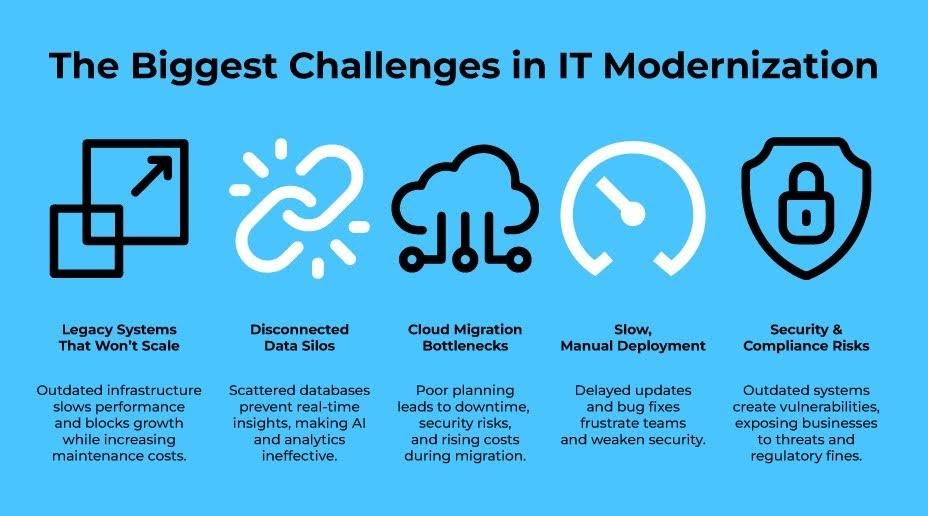
While many companies try to solve speed-related issues with UX improvements, the root cause is often hidden in the backend — factors such as the following can be overlooked:
Many enterprises still rely on aging platforms that weren’t built for today’s demands. These systems struggle to handle peak loads, slow down during high traffic periods, and create bottlenecks that affect the entire operation.
Customer data spread across multiple systems creates inefficiencies. When databases don’t communicate in real-time, personalized experiences become impossible, and decision-making slows down. IT modernization trends emphasize the need for unified data platforms that enable seamless integration, ensuring businesses can leverage real-time insights and deliver a frictionless customer experience.
Slow release cycles mean bug fixes take too long, security updates are delayed, and new features can’t be launched quickly. In contrast, companies using modern DevOps practices see near-instant updates and seamless performance improvements.
Companies that recognize these bottlenecks are investing in modernization – not just to fix slow systems but to create a foundation for long-term customer loyalty. Here’s what works:
A global eCommerce brand struggling with checkout lag moved to a microservices architecture on Azure. The result? Deployment times dropped from 2 hours to 5 minutes, and page load speeds improved significantly.
A FinTech firm dealing with slow transaction processing modernized its data workflows using Databricks. This cut transaction times by 50%, improving customer satisfaction and trust.
A cybersecurity company facing frequent platform downtime adopted CI/CD pipelines, enabling real-time updates without service interruptions. Their customer retention rates increased as a result.
Loyalty isn’t just about rewards programs or personalized emails – it’s about reliability. Customers who feel delays at any point in their journey look for alternatives. Enterprises that focus on performance see direct improvements in the following metrics:
Companies that fail to address slow systems are already losing customers. The good news? Fixing these issues is entirely possible. By investing in cloud, data modernization, and DevOps, businesses can eliminate lag, improve efficiency, and strengthen customer loyalty.
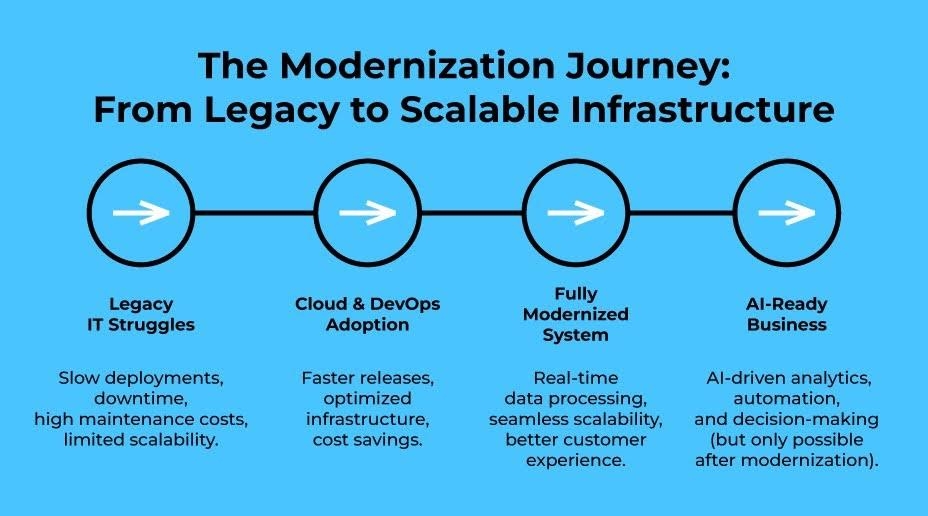
No article in 2025 is complete without mentioning AI, right? We get it – it’s everywhere. But here’s the thing – while AI is being hyped as the ultimate game-changer, most companies are missing one crucial detail: AI is only as good as the foundation it runs on.
Businesses racing to integrate AI into their operations often overlook the fact that slow, outdated systems can’t support AI properly. Machine learning models need real-time data, seamless system integration, and scalable cloud environments to work effectively. If an enterprise still relies on legacy infrastructure and scattered databases, AI won’t deliver better customer experiences – it will just expose inefficiencies faster.
AI isn’t a shortcut to better business performance. It needs a modern, high-speed, and scalable system to support it.
So before thinking about AI, think about your infrastructure. Is your system fast enough? Can it handle AI-driven decision-making in real-time? If not, modernization isn’t just an option – it’s the first step.
There are plenty of predictions about where IT modernization will go next. Everyone talks about AI automation, self-healing infrastructure, and the latest buzzworthy technologies. But here’s a different perspective: the biggest shift in modernization isn’t about technology at all. It’s about decision-making.
For years, companies approached modernization like a never-ending renovation project. They focus on patching up outdated systems, adding new features, and moving workloads to the cloud bit by bit. But that approach is too slow. The companies that will win in the next decade are the ones that stop thinking about upgrades and start thinking about overhauls.
The shift won’t come from another AI breakthrough or a new cloud computing model. It will come when businesses stop debating whether to modernize and start replacing decision-making bottlenecks with automation. Right now, companies still rely on long approval chains and outdated processes to decide how and when to modernize. That’s where the real delays come from – not just old servers or legacy databases, but hesitation, bureaucracy, and fear of breaking what still kind of works.
Here’s my prediction: in five years, we won’t just be talking about AI-powered tech operations. We’ll be talking about AI-powered decision-making. Automated systems that tell businesses exactly when, where, and how to modernize, with no room for debate. Companies that embrace this shift will move at an entirely different speed. The rest? They’ll still be stuck in endless planning cycles, watching their competitors surge ahead.