Global Fulfillment Trends Shaping E-Commerce in 2026
Explore how global trends influence the e-commerce industry. From AI-driven solutions to two-delivery goals, this article dives into how brands are keeping up.
Updated August 28, 2026

Intelligent systems are helping logistics teams move beyond fixed-rule automation by reviewing operational context, identifying exceptions, and recommending the next best action. By combining automation with human oversight and continuous learning, companies can improve freight processing, decision consistency, and operational efficiency.
Logistics teams make many decisions every day. They review shipments, check carrier charges, match invoices, handle delays, find errors, and decide which problems need attention first.
Looking for a Logistics & Supply Chain Consulting agency?
Compare our list of top Logistics & Supply Chain Consulting companies near you
In many companies, this work still depends on emails, spreadsheets, fixed rules, and manual checks across several systems. This may work when shipment volumes are low, but as the business grows, the process becomes slower and harder to manage.
Intelligent systems can make this work easier. They can review information, compare records, suggest the next step, and learn from past decisions.
Most traditional automation follows fixed instructions. An invoice may be sent for approval when the amount is above a set limit. A missing shipment number may cause the system to flag the invoice. A matching carrier name may allow the process to continue.
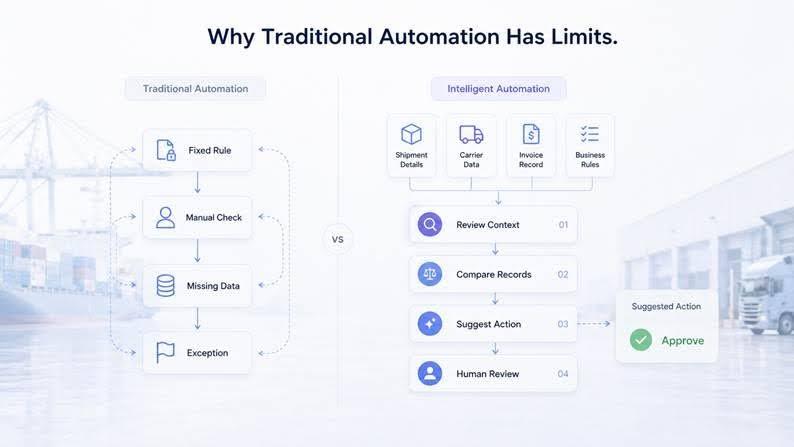
These rules are useful for simple, repetitive tasks. Logistics work, however, is not always predictable:
Companies often respond by adding more rules. Over time, the process becomes harder to maintain, and employees still need to step in because the system cannot understand the full situation.
An intelligent system does more than move information from one application to another. It reviews the available information and helps decide what should happen next.
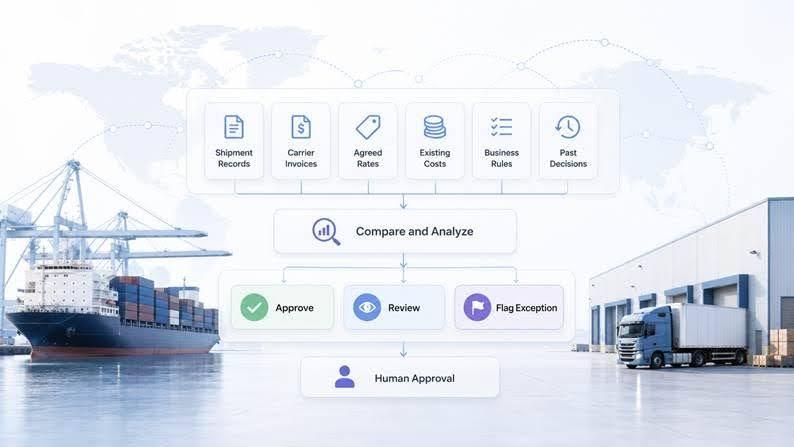
For example, it may review shipment details, carrier records, agreed rates, invoice amounts, existing costs, charge descriptions, past approvals, employee corrections, and internal business rules. The system then compares this information and suggests an action: approving a charge, finding a duplicate, correcting a code, requesting more information, or sending the case to an employee.
KEY DIFFERENCE
Traditional automation follows an instruction. An intelligent system reviews the situation before suggesting the next step.
Consider a logistics company that receives invoices from many carriers. An employee may need to open the email, review the invoice, find the shipment number, confirm the carrier, check the amount, match each charge with the correct code, check whether the cost already exists, and enter the approved amount into the company system. This process may involve several tools and a large amount of manual work.
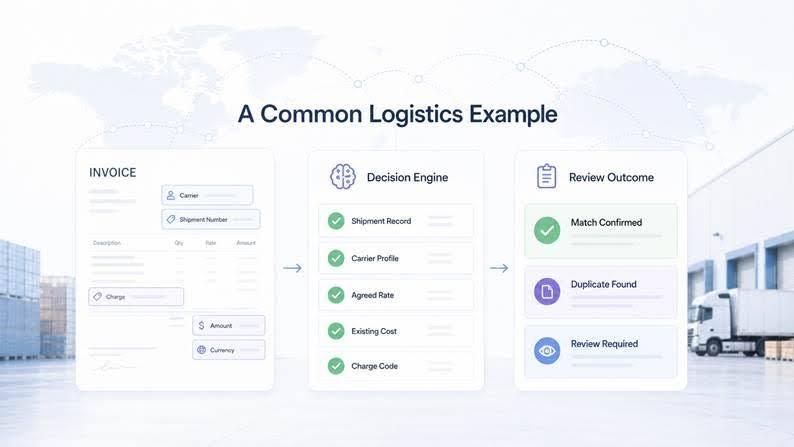
The work becomes more difficult when the invoice uses a new format, the shipment number is incomplete, the carrier name is written differently, or the charge description is unclear. Problems may also occur when the amount does not match the expected rate or when the same charge may already exist.
An intelligent system can consolidate these checks into a single process. It can review the email and invoice, identify the likely shipment, match the carrier, compare the charges, check for duplicates, and suggest the correct cost category.
The employee then receives a clear summary instead of having to search through several systems. Simple cases can move forward quickly, and unclear cases can be sent to the right person for review. Once the decision is approved, the cost can be added to the transport or business system.
The purpose of an intelligent system is not to remove employees from every decision. Many logistics cases still require human judgment. An employee may need to review a case when:
The most practical approach is to combine technology with human review. The system handles repeated checks and brings the right information together, while employees focus on cases that require experience, judgment, or approval.
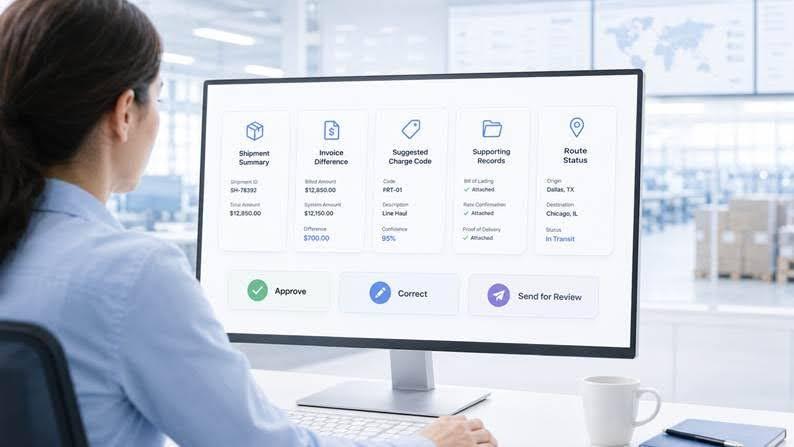
This can reduce manual effort while allowing the company to remain in control.
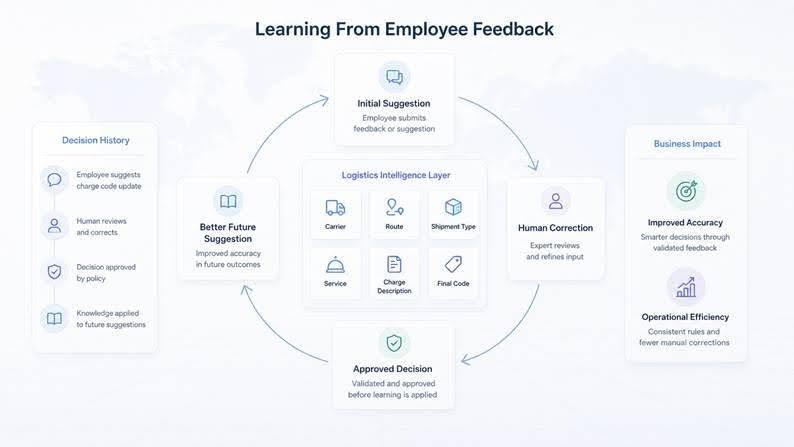
One of the main benefits of an intelligent system is that it can improve from feedback. For example, the system may suggest the wrong charge code, and an employee reviews the case and selects the correct one.
A basic workflow would treat this as a single correction. A learning system can save the details around the decision, including the carrier, route, shipment type, service, charge description, and final code. When a similar case appears again, the system can use the earlier correction to make a better suggestion. Over time, the company builds a useful record of real business decisions.
KEEPING LEARNING CONTROLLED
The system should not change important rules without approval. New patterns should be reviewed and tested before they are used in live operations.
Faster processing is useful, but it is not the only benefit. An intelligent system can also improve consistency. Two employees may review the same charge and make different choices; a shared system can show both employees the same data, rules, past decisions, and suggested action. This helps teams follow a more consistent process.
Managers can also get a clearer view of daily work. They can see which cases move quickly, which need review, where delays occur, which errors occur most often, and which carriers create the most exceptions.
The system may also reduce repeated checks, improve charge matching, find duplicate entries, create clearer approval records, and reduce dependence on a small number of employees.
THE REAL VALUE
The value is not only faster work. It is a clearer and more reliable way to make decisions.
Companies sometimes begin an artificial intelligence project by choosing a model or tool. A better starting point is to choose one clear business problem. The company may begin with a question such as:
Once the decision is clear, the company can identify the information, rules, systems, and people involved. This makes the project easier to plan and easier to measure.
Companies exploring similar systems can review how artificial intelligence can support business processes before selecting a suitable starting point.
The quality of an intelligent system depends on the quality of the business process around it.
Before building, the company should review the following areas.
The next stage of logistics automation will go beyond data entry and simple workflow rules. Intelligent systems will support freight checks, carrier management, cost review, shipment planning, delay handling, customer service, capacity planning, and operational forecasting.
The most useful systems will combine business rules, current information, past decisions, and human experience. They will not only show what happened. They will help teams understand what is happening, review possible actions, and decide what to do next.
Logistics companies do not need to automate everything at once. A better approach is to identify the decisions that create the most delays, errors, or manual work and improve them one at a time.
When built carefully, intelligent systems can help logistics teams reduce repeated work, make more consistent decisions, and respond faster to changing business needs.