How Intelligent Systems Are Changing Logistics and Freight Management
From fixed rules and manual checks to systems that review, suggest, and learn.
Updated April 24, 2026

When talking about brand identity, it is all too easy to fall into the trap of thinking everything somehow happens digitally, but in e-commerce, order fulfillment is a powerful factor that can’t be ignored. Some fulfillment tactics correlate with different aspects of brand promise, and the savvier companies are already capitalizing on this connection. This article explores how exactly e-commerce fulfillment tactics impact or reinforce brand identity, from a practical point of view.
E-commerce is a space where brand identities are quickly earned and lost even faster. With countless competitors operating on the same virtual shelves, the now-traditional discourse that CX revolves exclusively around the digital side of things is becoming obsolete. No matter how well you organize what’s happening on the screen, there are still physical touchpoints between the brand and the customer – and order fulfillment covers most of them.
This is becoming increasingly important as the online environment becomes saturated with personalization engines and the like. It’s all too easy to build a virtual brand identity, but without fulfillment, it might just become a bill your operations can’t fully pay.
Looking for a Logistics & Supply Chain Consulting agency?
Compare our list of top Logistics & Supply Chain Consulting companies near you
Meanwhile, companies are now recognizing how fulfillment is not just a “lamentable relic of the pre-digital age” but a true opportunity to endorse a brand image. When we talk about the fulfillment role in brand identity, it actually stretches much further than custom packaging and slapping logos on everything. Ahead, we’ll discuss what aspects of brand identity correlate with which fulfillment tactics.
Hard truth first. Today’s customers don’t separate the product itself from how it gets to them.
Your brand identity is how customers see and remember you. Fulfillment isn’t just logistics – it’s part of the customer experience, which shapes your brand reputation.
A report by PwC released in 2023 found that 73% of consumers say customer experience is a key factor in their purchasing decisions.
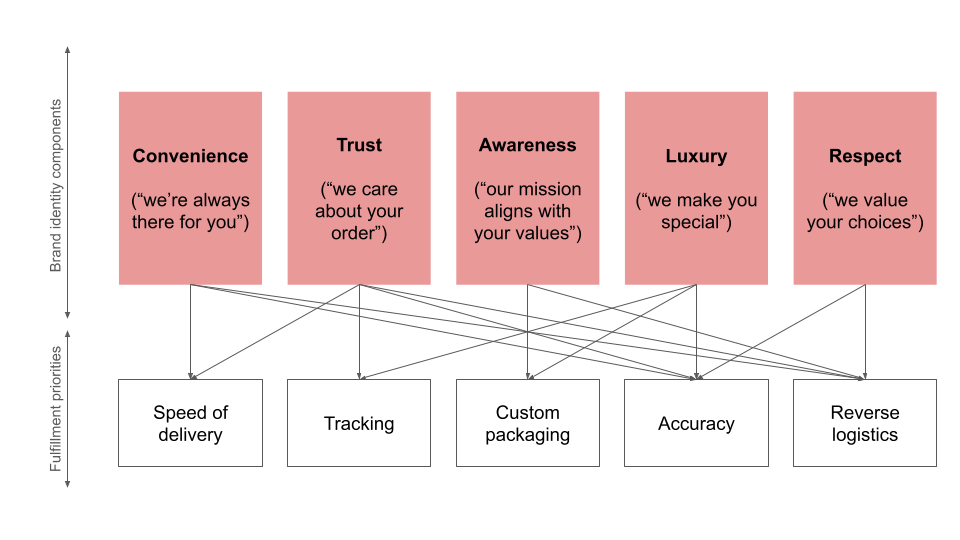
At the same time, 59% say CX has lost the “human element”. That’s because the general CX in e-commerce will obviously have an online and an offline side to it. It’s the offline side that really fixes things in here, so let’s break it down into components:
These are just the cornerstone factors, of course, and they come in no particular order here – in reality, businesses should take care of all of them while reprioritizing them as needed, depending on their brand promise. And that’s what brings us closer to the most interesting part: what exact aspects of fulfillment correlate with what components of brand identity?
Now, everyone seems to be thinking that the logistics part is somehow magically okay by default, and everything should be perfect here – and yes, everything should be perfect as far as fulfillment goes – but the thing is, the customers’ definition of “everything” actually varies depending on what your brand promise is. Plus, in some areas, yielding more than the measly 100% is necessary. Here are some key aspects of fulfillment linked with the closely associated parts of brand identities.
Depending on what you’re selling, delivery speed can be either a crucial factor or a good-to-have one. The likes of Amazon have raised the bar for everyone, but with a bit of strategy and software, this can be solved. Also, Amazon built its identity on convenience, while e-commerce leaves many more niches that require speed.
Some of these are:
The main component here is not just convenience but also trust in the narrowest sense: it’s like in those trainings where one is required to fall into someone else's hands and trust them to catch them in time.
There’s been mention of pizza trackers; if people are that concerned about a $30-something pizza, they are even more likely to want to track items that cost more, right? With order transparency, it’s peace of mind that’s sold alongside the product.
And that’s especially important for several types of brands:
Such transparency can be achieved with tech solutions and communication practices between the brand and the fulfillment provider – ideally, with integration between systems.
Interestingly, this is the most common association when it comes to our current topic, and yet it’s still a bit limited in real-world applications.
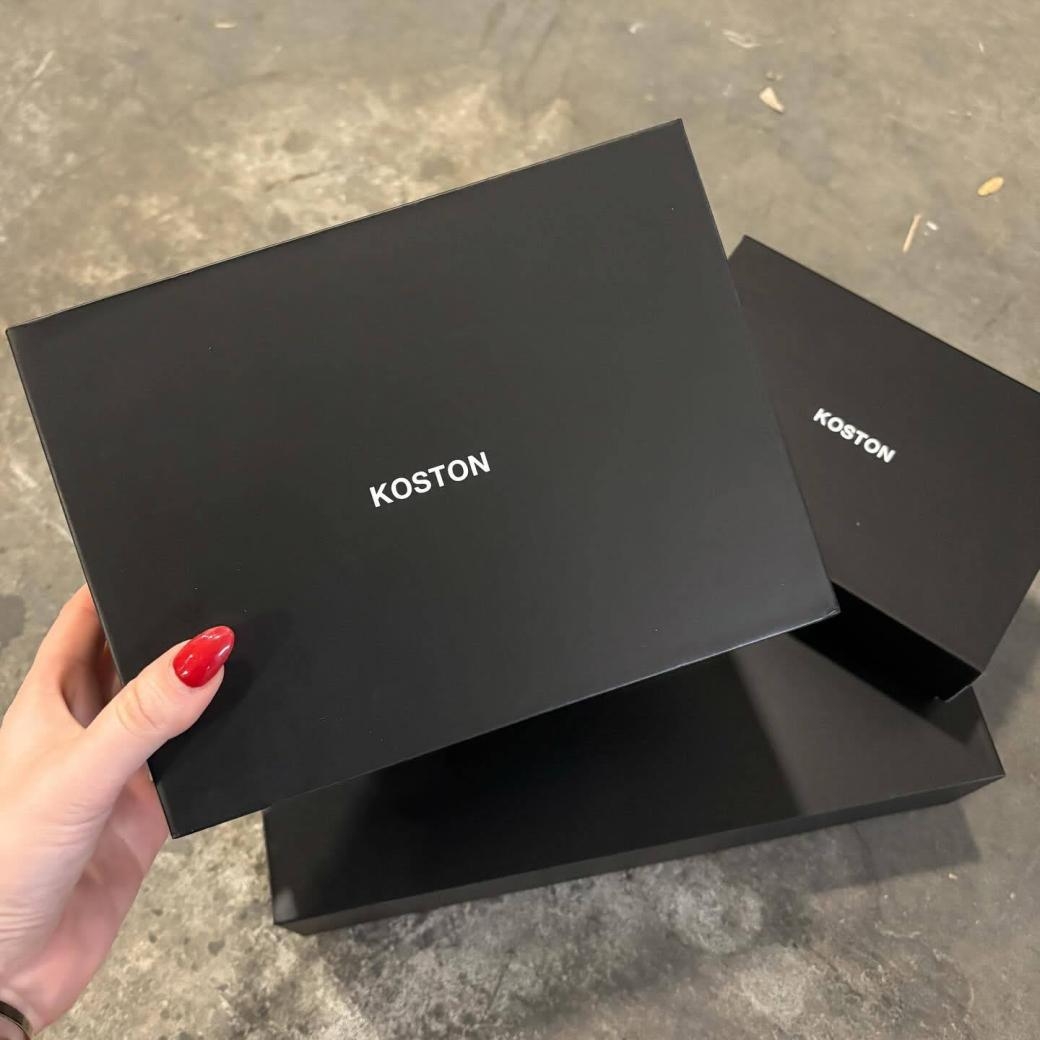
Package presentation, adding cards, logos, flavoring the box with fragrance – all these are valid ways to establish a brand identity, but what’s important, it all builds on the essentials – accuracy and speed – and only then starts to work, except in several cases:
Not only is this practice good for social media (unboxing videos and the like), but it also earns the brand extra points by defining it through associations.
On average, as many as one in five or one in seven orders has an issue – a wrong item, a missing part, or a delivery problem. This is where fulfillment strategies directly impact reverse logistics, which, in turn, influences brand perception.
What’s at stake is the “responsibility” badge, and in terms of e-commerce, that translates into more loyalty and general reinforcement of what your brand stands for. As cynical as that may sound, people are more likely to remember a brand that helped them solve a problem than a brand that caused them no problems whatsoever.
Which is the perfect endorsement for brand identities that involve:
To sum up, all aspects of order fulfillment are important, and a good business will naturally strive to keep them at a high level – but for brand identity, some will resonate more with the vision than others, and that’s where 100% is not enough; you will need 200% to make it work, and that’s the focus area.
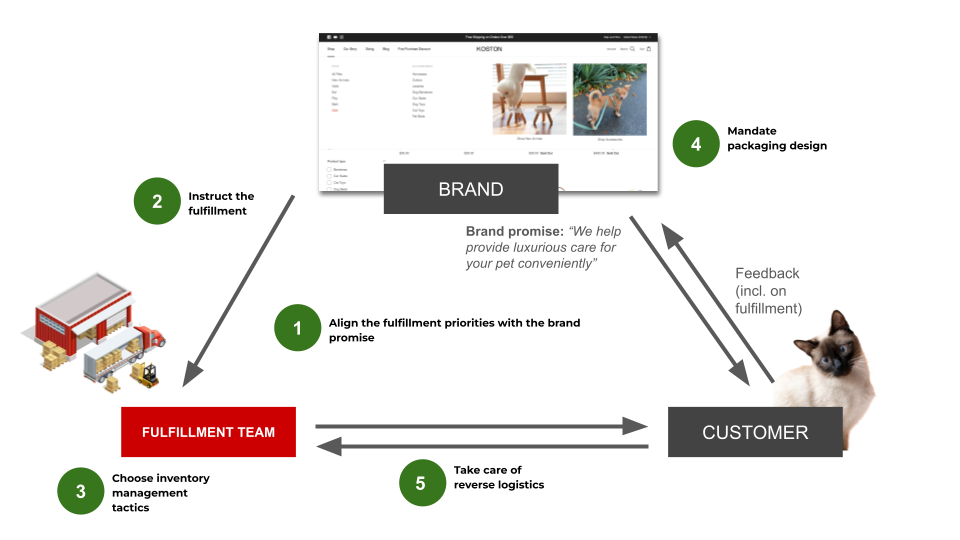
As an example from our own experience as a fulfillment company, we collaborate with KOSTON, which is a company positioning itself as a premium pet accessory retailer, with their brand promise being to make eco-friendly products more accessible. This, in fulfillment terms, translates to speed and accuracy above everything, and our mission was to help fulfill the promise of keeping the prices fair without compromising the quality.
As difficult as it is to write a guide for linking fulfillment practices with brand identities, simply because the latter are unpredictable, there are already companies that have mastered the approach. This doesn’t mean everyone should take their insights at face value and apply them to their own brand as-is (that would be a catastrophe) – these are merely examples of the thinking one needs to employ.
Amazon’s 2-day Prime delivery is more than just a premium feature; in reality, it encapsulates what Amazon is about: convenience. Unsure where to order from? Amazon. Want zero risks? Amazon. Wish for a digital substitute for grocery shopping? Amazon again. In fact, 65% of U.S. Amazon Prime users say fast, free shipping is the main reason they subscribe.
This is how Amazon forged its brand in a world where the marketers’ textbooks explicitly say to cut off everything that doesn’t fit into the main category of goods sold or target audiences catered to.
And that, incidentally, is why Amazon invests so much into advanced fulfillment centers: for want of a more specific brand identity and target audience, they’ve made it their promise to deliver with maximum trust and integrity.
Ultimately, footwear is about being comfortable, which is a problem for e-commerce: you can’t have good shoes without trying them on.
Another company would be intimidated by the returns regulations, but Zappos made it their “big game” of sorts. Their customer service, now legendary, includes 365-day free returns and frequent free shipping upgrades.
And that works well enough to cover their investment and give a return on it: in a study, 96% of shoppers say a positive returns experience influences their decision to buy again. This explains why Zappos consistently ranks in top brand loyalty surveys, largely driven by word-of-mouth trends.
Now, this is an example of the most obvious tactic: tailored, brand-specific packaging. And you can wait for good things, can’t you? Of course, you won’t. But this is one example where, even though speed of delivery matters a lot, it’s the unboxing experience that matters (and therefore builds the brand identity).
This is something Glossier does: while they take the effort to deliver in time, accurately, etc., they make a point in aesthetic packaging (pink bubbles, stickers, and the like). And that actually converts, seeing as how Glossier’s unboxing experiences are a common subject matter on social platforms, this saves them money on ad spend.
Finally, a drastically different example (even though, in many cases, marketing-wise, it’s for the same target audience segments): Patagonia. Since it’s a Californian outdoor recreational outfit/equipment brand, it’s popularly perceived as being about practicality and environmental awareness.
And that’s where minimal packaging, recycled materials, etc., get converted into benefits. After all, the main thing is that the customer is going on a journey.
Unpacking means little here; speed of delivery, slightly more; accuracy and quality, the whole world. Correspondence to values? More than the world itself. A 2023 report found that 73% of Gen Z consumers are willing to pay more for sustainable products.
There is no single way to do that, other than understanding the brand promise you want your company to deliver. We’ve covered the tactics, but tactics are a toolkit where you want or don’t take separate tools to set things the way you want them.
The ever-standing universal truths are these, though:
There’s a lot more to the story, though. The main takeaway is that fulfillment is progressing at its own pace, as fast as the digital part of e-commerce.
Returning to the KOSTON example, we focused on what matters most for their pet products – getting every order exactly right and delivering it fast. Pet owners want to receive the specific product they ordered, whether it's a particular color, size, or SKU. In practice, this meant that optimizing delivery and inventory was the first order of business, and that was our joint strategy.
At the same time, other brands have other paradigms, and that’s what matters. Let’s just not forget the physical aspect of e-commerce (a.k.a. fulfillment) matters as much as the digital one, and collaborating with the fulfillment service provider is much like having another marketing or customer service department within the company itself.