Mobile Apps vs. Web Apps vs. Websites: What Does Your Business Need?
Should you build a mobile app, web app, or website? Learn the key differences, costs, and use cases to choose the right platform for your product and users.
Updated June 16, 2026

Users are quick to uninstall apps if they believe their data is being misused, but companies that focus on building customer trust can retain users and boost app downloads. Industry experts weigh in on what to do — and what not to do — to maintain trust.
According to new Clutch data, only 9% of consumers believe that apps use their data exactly as they claim, and it's impacting which apps they download.
For app companies, that’s a business problem you can’t afford to ignore. Trust plays a critical role in both app adoption and retention. In an era when data privacy is already a huge concern, the companies users trust are those that understand the importance of treating privacy as a product decision rather than a box to check.
Looking for a Mobile App Development agency?
Compare our list of top Mobile App Development companies near you
In this guide, we’ll share practical strategies for building trust with customers, helping you reduce app uninstalls and give potential users the confidence to download your app
App fatigue and growing privacy concerns have made users quicker than ever to delete apps they don't trust.
This behavior has real business consequences. Every user who uninstalls your app shortly after downloading it represents marketing spend with little to no long-term return. As retention declines, lifetime value shrinks, making your cost-per-install harder to justify and sustainable growth more difficult to achieve.
Users frequently cite privacy concerns, unclear data collection practices, and aggressive permission requests as reasons for abandoning apps. After years of data breaches and high-profile cases of corporate data misuse, many consumers approach new apps with skepticism.
In an environment where users are ready to uninstall at the first sign of risk, earning trust is no longer a nice-to-have. It can be the difference between a long-term user and a deleted app.
Thanks to regulatory pressure from laws such as the General Data Protection Regulation (GDPR) and the California Consumer Privacy Act (CCPA), as well as an expanding list of state-level privacy laws, companies must document their data practices more carefully. However, compliance does not necessarily mean your data is secure.
Legal compliance is about meeting regulatory requirements, while security focuses on protecting consumers and their data. "The biggest gap is between 'we have compliance' and 'we're actually secure,’” says Ilya Budko, CEO at Weelorum. “GDPR, ISO 27001, and SOC 2 are about processes and documentation. They don't handle insecure storage, vulnerable SDKs, or misconfigured authentication. Compliance is the floor, not the ceiling."

An app may comply with privacy laws by obtaining user consent and documenting its data practices, yet still leave sensitive information vulnerable due to security flaws, weak code, or inadequate safeguards.
This is a common example of "checkbox security," where organizations focus on passing audits and meeting compliance standards without adequately addressing how cyberattacks actually occur.
It’s easy for consumers to mistake compliance for security. A consent banner can create the impression of transparency, and an audit certification can provide reassurance. Yet many data breaches have occurred at organizations that met compliance requirements, proving that real security depends on how well user data is actually protected.
Users are ultimately placing their personal information in your hands, and that trust depends on whether you can keep it secure, not whether you can pass an audit.
App companies with strong user retention rates use the same trust-building principles again and again. To build trust with customers, you first have to recognize that trust is earned. These principles make an app company genuinely trustworthy.
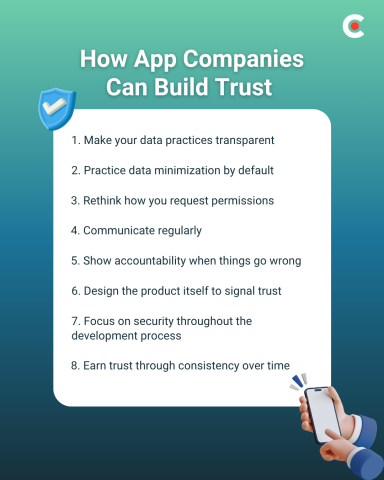
Boilerplate policies create legal cover, but they don’t build trust with users. Replace dense legalese with plain-language explanations of what you collect, why you collect it, and how long you keep it.
In-app disclosures mean more to users than clauses buried in a legal document. Show users at the moment of collection what’s happening with their data.
Matching your app store labels to your app’s actual behavior is critical. If your App Store or Google Play data labels don’t accurately reflect what your app actually does, users will quickly find out. Discrepancies like these destroy trust faster than any other single factor.
Publishing a transparency report is one of the best ways to demonstrate your company’s commitment to transparency. The report should include:
Those who actually read this report may represent a small share of your user base, but simply sharing this information also shows the broader public that you have nothing to hide.
Every data point your app collects beyond what it needs to function is a liability, not an asset. If your fitness app stores users’ GPS data indefinitely when it only strictly needs it during a workout, you’re carrying a risk that serves no product purpose. Audit your data flows through that lens: Assess what data you need and delete the rest. Ultimately, data minimization is a powerful security posture.
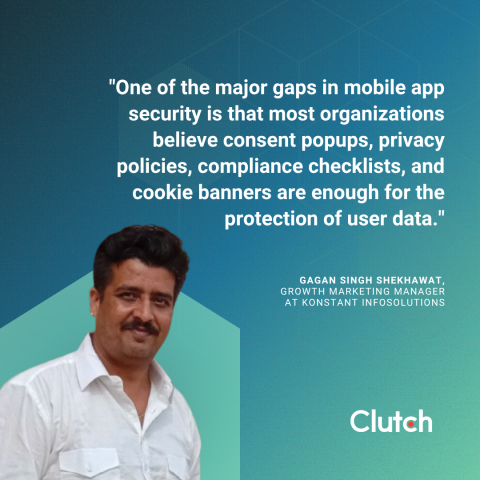
“One of the major gaps in mobile app security is that most organizations believe consent popups, privacy policies, compliance checklists, and cookie banners are enough for the protection of user data,” says Gagan Singh Shekhawat, Growth Marketing Manager at Konstant Infosolutions. “If an app collects more information than necessary, shares user information with advertising tools, and stores data for long periods, it could still expose sensitive information.”
App developers should build features that work without requiring sensitive permissions whenever possible. For example, offer a “skip” button for optional account fields. Let users experience your core value proposition before asking them to hand over information they’re not sure you need. When you do collect minimal data, do it transparently, and frame it as a feature rather than a limitation. Users notice, and it helps grow trust.
Permission walls at launch are one of the fastest ways to erode user confidence before you’ve provided any value. Instead, use contextual prompts, such as asking for camera access when a user wants to upload a photo for the first time, rather than when they first download an app.
Also, explain why each permission your app requests is needed. When a user understands why a request is happening, they’re more likely to grant it and to trust you while doing so. A one-sentence pre-prompt before the system dialog dramatically improves grant rates and user trust.
“The app should request permissions only when needed instead of asking for all the permissions during installation,” adds Shekhawat. “It is also important that businesses must make sure that sensitive data is always encrypted while in transition and at rest.”
That said, when a user denies permission, don’t block them from the app entirely. Locking core features because a user declined to provide location access punishes them for making a privacy decision.
Instead, default to the least intrusive permission setting whenever possible. For example, request location access only while the app is in use rather than granting continuous access at all times.”
Communication is key in any relationship, including the user relationship. We recommend:
Keeping users in the loop and defaulting to honesty goes a long way toward building user trust.
Every app company should have an incident response plan that includes an internal containment process and user-facing communication protocols. If you experience a breach or a bug that affects user data, remember that bad news doesn’t get better with time. Notify affected users immediately and without legal hedging.
It’s also critical to own your mistakes publicly. The companies that bounce back best from data-related incidents are those that explain what happened, what they’re doing about it, and what they’re changing to prevent it from happening again.
Trust is built through consistent follow-through. When you promise changes after an incident, make them quickly and keep users informed about the steps you've taken to address the issue.
User interface (UI) quality is its own trust signal. A polished, professional UI tells the user that the team behind the app takes both the product and its users seriously. A buggy, inconsistent interface raises questions like “If the design is bad, what do things look like behind the scenes?”
Inside the app, place trust signals where users actually look, like near conversion points and on heavily trafficked pages. Include signals like:
Steer clear of intrusive ads, surprise paywalls, and aggressive upsells, which signal that the company prioritizes revenue extraction over the user experience.
Build into the product features that put users in control of the experience, such as:
Learning how to build trust with customers at the product level entails designing a product that quells skepticism with honesty and transparency.
Security tacked on when the product is nearly complete often fails in avoidable ways.

“Security is typically bolted on late in the development cycle, after the architecture is set and the feature deadlines are locked,” says Anna Robaczewska-Arendt, Head of Growth Marketing & Partner at Nomtek. “74% of organizations report feeling increased pressure to accelerate development, and 71% admit that acceleration comes at the expense of security."
Best practice is to embed security review into app development from the beginning. By focusing on security earlier in the process, you can prevent many security issues in the long run and avoid unnecessary costs, both in dollars and in valuable user trust.
You can’t create trust with a single grand gesture. It accumulates in small moments repeated consistently, such as:
None of these alone creates your brand’s trustworthy reputation, but following the same pattern over time does. Reliability, proactive communication, and consistent experiences help build trust from a user's first interaction with your app onward.
Avoid bait-and-switch updates, too. Don’t introduce paid features that gate functionality that used to be free, and don’t quietly expand data collection over version updates.
Users have long memories, and they don’t forget underhanded tactics. Don’t surprise long-term users with downgrades; reward them with loyalty features and perks.
Trust leaves quantitative and qualitative traces, and if you learn to follow these, you’ll better understand how to build trust with customers in measurable ways.
Quantitative signals worth tracking include:
If fewer users are granting permissions, it may be an early sign that trust is declining, even before retention metrics show there’s a problem.
As for qualitative signals, consider tracking:
These metrics can provide texture and nuance that numbers alone can’t.
Benchmarking against competitors can also be useful. Clutch’s platform and app intelligence tools offer third-party benchmarking to help you understand where your app stands in its category.
In an environment where only 9% of users trust apps with their data, the companies that intentionally build trust hold a genuine competitive advantage. The ones that don’t will quietly lose users to the uninstall button.
Audit your own app against the framework we’ve provided here, starting with your data collection practices and permission flows. Knowing how to build trust with customers means making consistent decisions that treat user trust as the valuable asset it truly is.