Mobile Apps vs. Web Apps vs. Websites: What Does Your Business Need?
Should you build a mobile app, web app, or website? Learn the key differences, costs, and use cases to choose the right platform for your product and users.
Updated April 22, 2026

Known as app fatigue, users are increasingly annoyed by forced downloads and endless notifications. As a result, many are looking to limit their app usage. Clutch data dives into this trend to reveal what is driving it and what SMBs should do to keep users engaged.
Think about the last time you needed to download an app. Maybe it was to place an order, access a ticket, or unlock a discount. Did you feel excited? Or did you sigh, check your storage, and wonder if it was really worth it?
If you’re tired of having to download an app, you're not alone.
Looking for a Mobile App Development agency?
Compare our list of top Mobile App Development companies near you
People rely on their smartphones for nearly everything, yet the sheer number of apps on their devices has become a source of frustration in itself. Some smartphone owners have hundreds of apps installed, but realistically engage with only a handful each day.
For small businesses with their own app, standing out in that crowded space is both a challenge and a necessity. An app can be a powerful way to stay connected with customers, but only if it delivers a genuinely compelling experience worth returning to.
Clutch surveyed 476 consumers to understand how they use mobile apps and what makes them more likely to keep one.
Most smartphone users (64%) have between 10 and 50 apps installed, though the majority skew toward the higher end of that range, with 37% of respondents reporting 26–50 apps on their phone.
Yet despite those numbers, 46% of respondents say they use only 5-10 apps per day. That means most people are actively engaging with just a fraction of the apps on their home screen.
This is likely because daily app usage is driven by habit. People gravitate towards their favorites — social media platforms like Instagram and TikTok, a handful of games, and newer tools like ChatGPT. Everything else tends to fade into the background.
So why do people have so many apps they rarely open? In many cases, the downloads weren't entirely voluntary. Some apps serve a narrow, one-time purpose. Others are required to complete a purchase or interact with a brand.
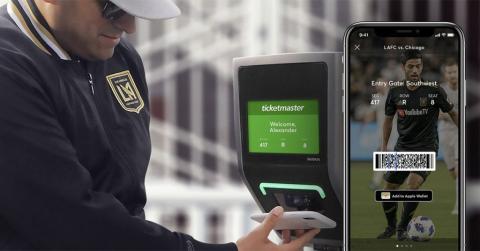
Ticketmaster is a prime example. Its SafeTix system uses rotating barcodes that refresh every 15 seconds to prevent fraud. However, this means that users need the app or mobile site to get through the door. This creates a seamless experience from buying tickets and finding event details to getting through security. But for most people, live events are occasional, not routine. Once the show is over, the app is either forgotten or deleted.
The same pattern plays out with apps downloaded for one-time discounts, loyalty programs, or other short-term perks.
Apps that don't earn repeated visits tend to get deleted, and the accumulation of these one-and-done downloads is fueling widespread app fatigue.
Additional reading: “How to Develop an App.”
App fatigue refers to the frustration and disengagement users experience when they have too many digital applications.
Constant notifications, updates, in-app messages, and a lack of storage space all contribute to this feeling. Similar to physical clutter, the accumulation of unused apps creates stress and can leave users feeling overwhelmed by the very brands they choose to engage with.
As a result, some users are hesitant to download new apps and are quick to delete them when they’re not used regularly.
This poses a huge challenge for businesses with mobile apps and raises key questions: how can they engage users, keep them coming back, and prevent them from deleting their apps without becoming part of the problem?
Largely because of growing app fatigue, users are becoming selective about the apps they download. Nearly half (45%) will only download an app when they truly need something, and 18% resist downloading altogether, especially if they can accomplish the same task in a browser or an app they already have.
That means businesses need a clear and unique value proposition to encourage users to download their app in the first place. In fact, users are most likely to download an app when it solves a problem that no other tool can (63%).
That looks different for every company, but ultimately, companies should only build apps that provide inherent value to their users. The most successful companies frame their apps around a specific problem.
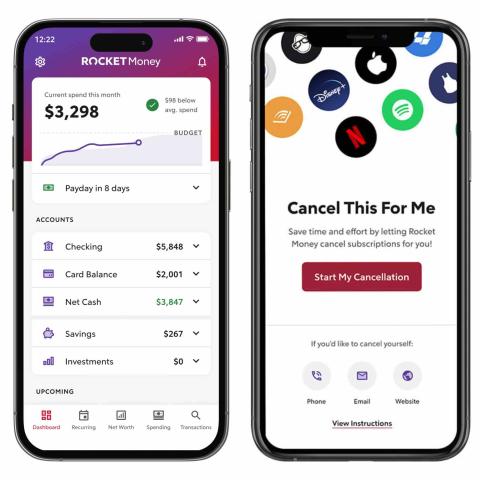
A great example of an app that provides a unique value proposition is Rocket Money, which competes with a ton of other finance management apps. However, it gained traction by specifically helping users find subscriptions they had forgotten about and cancel them. It’s a clear and common problem, but few companies are actively trying to solve.
Consumers are most likely to download an app if they can use it without tracking or personalization (52%), if it clearly states what data is being collected (43%), if it won't send push notifications without explicit opt-in (40%), and if it doesn’t require them to make an account (38%).
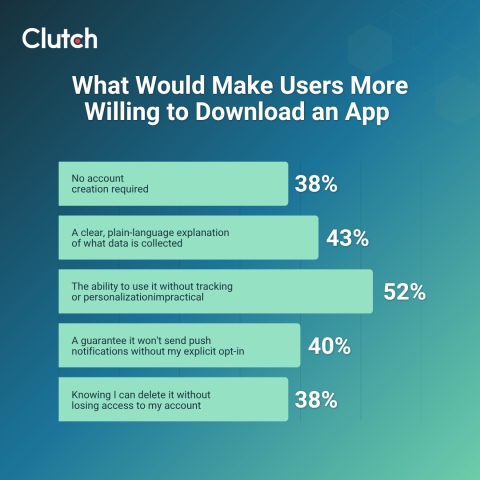
These results point to a broader pattern: growing app fatigue is compounded by deepening distrust around data practices.
This is consistent with Clutch data from earlier this year, which revealed that only 40% of consumers are comfortable with companies using their data to tailor experiences.
Apps collect a staggering amount of data, including:
Often, this data is then used to support a constant barrage of push notifications, promotional emails, and targeted ads.
As a result, users are genuinely concerned about how that data is being used, and they're increasingly looking to limit what they share.
With this in mind, coercing users to download an app will never truly win over consumers.
Four out of every five users (80%) recalled downloading an app because they had to, not because they wanted to, and 72% reported feeling annoyed, frustrated, or outright angry about the experience.
These feelings can erode brand loyalty and reduce retention. More often, this means users will be quick to delete an app, especially if it doesn’t provide value or they don’t use it often.
“We have been building apps for 17 years, and the single biggest mistake we see is founders treating downloads as a success metric,” says Joshua Davidson, Founder and CEO of Chop Dawg. “Downloads are not success. Retention is success. If someone downloads your app and never opens it again, you did not acquire a user. You acquired a statistic.”
That being said, a new download presents a unique opportunity. Businesses can turn reluctant downloaders into loyal users by engaging users in-app, providing a unique experience, and delivering real value.
To do that effectively, companies need to closely monitor early drop-off patterns to identify issues with onboarding, usability, or an unclear value proposition before they become retention problems.
“Some level of early drop‑off is inevitable,” explains Adam Grabek, the Lead Solution Consultant at Scalo. “What raises concern is a sharp or unusually high drop‑off after the first sessions. Teams tend to monitor this closely, as it often signals issues with onboarding, usability, or an unclear value proposition.”

Getting users to download your app is only half the battle. More than half (54%) say they'll delete an app once they're done with it, which means retention depends on giving people a reason to keep coming back.
Over three-quarters of users (77%) say they'll keep an app if it's part of their daily or weekly routine, making habitual engagement the single strongest protection against deletion. Beyond that, 44% will hold onto an app if it does something no other app or website does as well.
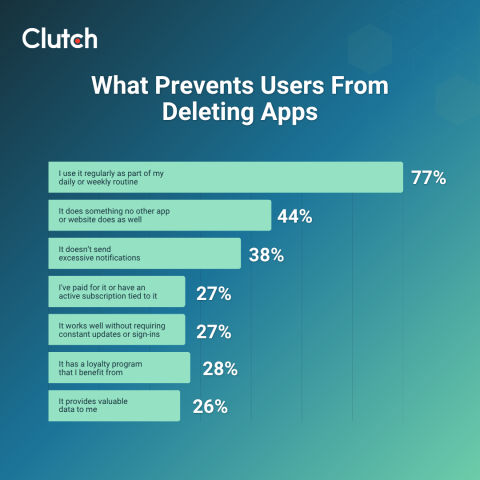
For app companies, that means that their apps need to deliver enough value that users keep coming back, and that value needs to be obvious from the moment they open it.
“From our experience working with clients, the most critical window is not even 30 days,” says Serhii Kholin, CEO of Onix-Systems. “It’s the first 5–10 minutes. If users don’t reach a “moment of value” immediately, they rarely come back.”
Mujtaba Sheikh, Digital Product Architect at Phaedra Solutions, echoes that point. "The biggest improvements in engagement typically come from reducing friction and accelerating value delivery, not adding more features," he said. "Apps that succeed are those that make it effortless for users to complete their primary task, and give them a clear reason to return."

According to Sheikh, key drivers of retention include:
That kind of immediate, lasting engagement doesn't happen by accident. The most successful apps start with a clear purpose. From there, companies need to build in reasons for users to return. That might look like features that improve with use, personalized content that feels relevant rather than invasive, or timely reminders that are actually helpful instead of nagging.
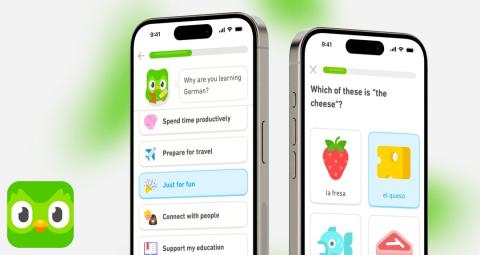
Take Duolingo, for example. The app hooks users with a simple, low-commitment first lesson, then keeps them coming back through streak tracking, daily reminders, and bite-sized progress that makes language learning feel like a game rather than a chore. It's a textbook case of providing value to users and building a routine.
While notifications are a major driver of app fatigue, they're also a significant engagement opportunity when used well. Our survey found that 63% of consumers default to allowing notifications, and 38% say they'll keep an app specifically because it doesn't send too many.
Users aren't opposed to notifications, as long as they provide value and aren’t overwhelming.
However, that line can be thin. Users are quick to turn off notifications or delete apps entirely when they feel bombarded, so companies need to be careful in how they use notifications to keep users engaged.
Companies that get this right tend to follow a few principles:
The companies that treat notifications as a tool for delivering value, rather than a channel for driving clicks, are the ones that will keep users engaged without pushing them away.
Despite widespread frustration with the sheer number of apps competing for space on their phones, 59% of users still prefer the mobile app experience over a mobile website.
This is because mobile apps do provide some clear advantages, such as:
Growing app fatigue shouldn't stop companies from building an app. But it should push them to be intentional about why they're building one in the first place and strategic about how they engage users once they've hit download.
Sometimes, though, many businesses don't need an app at all. Often, a well-built mobile website can handle most of what they're trying to accomplish,
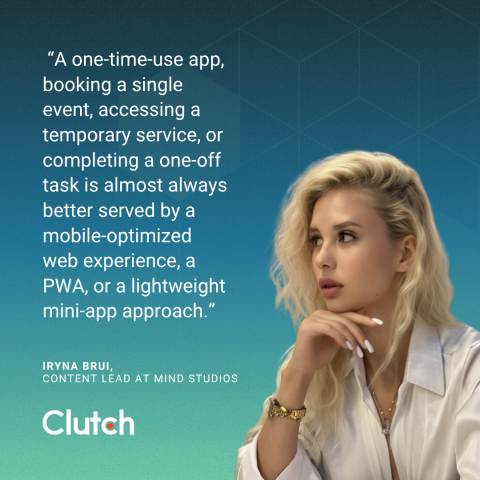
“Most projects still default to 'build a full app, ' even when the use case doesn't justify it,” explains Iryna Brui, a content lead at the software engineering company, Mind Studios. “A one-time-use app, booking a single event, accessing a temporary service, or completing a one-off task is almost always better served by a mobile-optimized web experience, a PWA, or a lightweight mini-app approach.”
A “better experience” isn’t enough to justify a download or keep users engaged. The app needs to offer something a browser genuinely can't — whether that's solving a problem no other tool addresses, building personalization that sharpens with every use, tapping into device hardware, or delivering time-sensitive alerts.
“The honest conversation we have with clients is, 'Do you need the user to install something, or do you need them to do something?’ Those are different problems. Installation adds friction.” said Bruy. “For transient use cases, that friction kills conversion before the user even sees the product.”
While retention is the priority for most apps, it isn't the goal for all of them. Some apps are designed to serve a specific, time-limited purpose, and that's perfectly fine. Not every app needs to become part of someone's daily routine to be successful.
Healthcare is a good example. Many health-related apps exist to solve a single problem at a specific moment, whether that's a telehealth consultation, a pre-surgical checklist, or a symptom assessment tool. Trying to force ongoing engagement out of something users only need once can actually backfire.
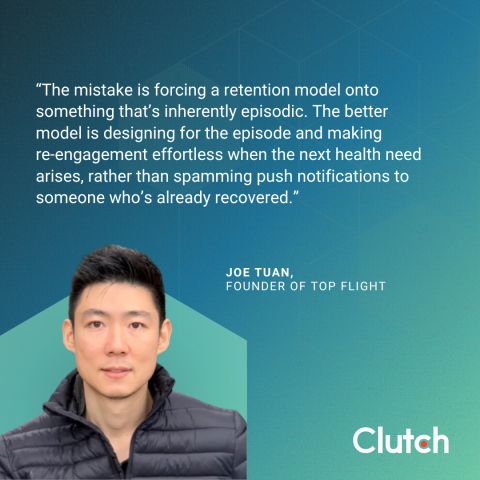
“In healthcare, some apps are supposed to be one-time-use — a second-opinion telehealth visit, a pre-surgical checklist, a symptom triage tool,” explains Joe Tuan, Founder of Top Flight. “The mistake is forcing a retention model onto something that’s inherently episodic. The better model is designing for the episode and making re-engagement effortless when the next health need arises, rather than spamming push notifications to someone who’s already recovered.”
The same logic applies beyond healthcare. Tax preparation apps, moving tools, event-specific guides, and travel planners all fall into this category. Users download them for a purpose, use them, and move on.
For these kinds of apps, the priority should be making the experience as smooth and intuitive as possible while it lasts, and making it easy for users to come back if and when they need it again. That means simple onboarding, minimal account friction, and resisting the urge to manufacture engagement where it doesn't naturally exist.
Users are selective, easily overwhelmed by incessant notifications, and are quick to delete apps that don’t live up to the hype. But when an app solves a genuine problem, they are excited and will return again and again.
With app fatigue only growing, businesses with an app need to be strategic in how they engage users. Based on our data, the apps that thrive will be those built around a clean onboarding experience, a thoughtful notification strategy, and a compelling reason to come back.
Ready to build an app that users actually want to keep? Connect with top-rated app developers on Clutch to create an experience your customers will keep coming back to.
This report is based on a survey conducted on March 25, 2026, using the online polling platform SurveyMonkey. We surveyed 476 adults in the United States between the ages 18-99 of all income levels. All survey respondents confirmed that they have a smartphone. The respondents were 48% male and 52% female.
Participants were asked a series of multiple-choice and single-selection questions about their usage of AI assistants. Quotas were applied to ensure a balanced distribution across demographic segments. All respondents were required to complete the survey in full to be included in the final analysis.