Mobile Apps vs. Web Apps vs. Websites: What Does Your Business Need?
Should you build a mobile app, web app, or website? Learn the key differences, costs, and use cases to choose the right platform for your product and users.
Updated May 29, 2026

Whether you're building an entirely new app or are looking to update your existing app, adding these product features can help you keep up with trends.
With modern users increasingly preferring to download an app rather than mess around with mobile browsers, developing an app can be vital for a small business. The best apps make browsing for products and paying for services a breeze by maximizing usability and functionality, while leaning into the areas users care about: privacy, sustainability, and personalization across app implementations.
According to Andreia Martins, CEO of Codepoint, "Ultimately, people seek technology that serves real human needs while creating memorable experiences that keep users coming back." Staying up to date on app development trends helps you stay competitive, so here are some of the most in-demand mobile app product features of 2025.
Looking for a Mobile App Development agency?
Compare our list of top Mobile App Development companies near you
Artificial intelligence is incredibly popular right now, but it goes way beyond chatbots or ChatGPT integration. AI can bring a whole host of beneficial mobile app features, including:
“AI-powered functionalities, such as contextual chatbots, personalized recommendations, and voice-based interactions, will dominate interest,” predicts Petar Lukić, CTO of Appify Digital. “Users will increasingly expect seamless, AI-enhanced navigation and intuitive, human-like communication experiences within apps.”
So, as AI-enhanced navigation becomes the new norm, more traditional forms of navigation may start to look dated in certain contexts. For example, having to search through menus and pages of information to find something will become a barrier to users if many other platforms have natural language-based search and navigation systems.
Duolingo, the famous language-learning app, was quick to integrate NLP into a new tier of its product. Debuting in 2023, Duolingo Max addressed a classic pain point for its users.
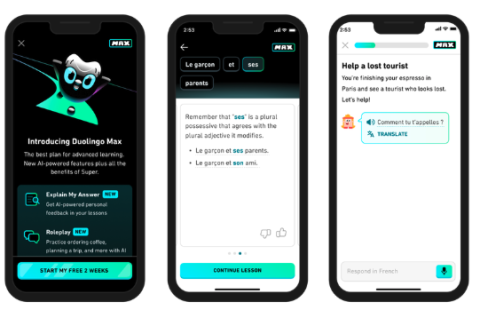
With the AI-powered Explain My Answer feature, users can learn more about the incorrect answer they gave and what they should have done instead. It's a brilliant way to add extra personalization to the experience and minimize a common frustration of learning from a self-study app rather than a human teacher.
Engaging your users is crucial for success, and a popular way to do this right now is through gamification, one of the top mobile app trends. This doesn't mean you need to add an Angry Birds clone to your app — it rather refers to app features that give your users a sense of progress, competition, or opportunity.
"Gamification is crucial for user retention and engagement," says Martins. Julia Boiadzhian, senior marketing manager of Devlight, agrees: “[it] will allow companies to win users’ time within their app, as the competition in the market is no longer about money, but about users’ attention.”
In other words, making your app a fun place to be is one of the best ways to win your customers' attention, and the time they spend in your app often yields numerous benefits for your company. It can strengthen brand loyalty, fuel advertising revenue, promote user-generated content, and encourage spending.
AliExpress, one of the biggest e-commerce platforms in the world, incentivizes users to make purchases on its app through a coin system.
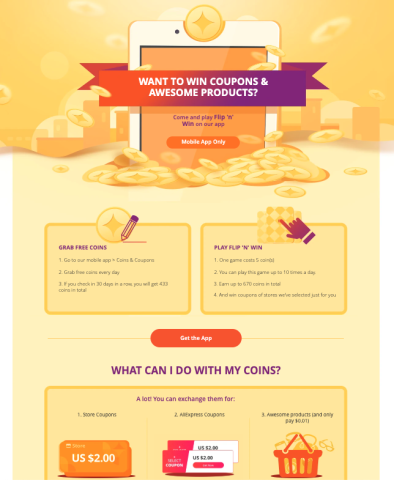
By doing a daily check-in, playing games, or completing tasks, users can earn coins that they can exchange for coupons or use to pay for products. The coin system directly helps users save money, so it's extremely compelling.
Sending out emails with personalized content based on past purchases has been a core marketing strategy for a long time now, but newer AI tools take personalization to a much higher level.
According to Abhijith HK, founder and CEO of Codewave Technologies, “Extreme personalisation is going to be loved by users. As AI can now deeply understand the user based on past interactions with the brand, user’s frequent interactions, location, language, profession and many other preferences and details — and simplify the digital interactions, by putting together highly personalized recommendations for the user, lowering the cognitive load and increasing engagement."
He went on to give an example related to travel: If an AI system knows you're a frequent traveler and prefer certain kinds of food, it could generate a selection of appropriate cafes and restaurants for you to check out when you visit a new city.
This kind of hyper-personalization removes barriers and makes it easier than ever for users to discover new products. Beauty brand Sephora, for example, collects a range of information about its customers — skin type, skin problems, favorite colors and scents, frequently bought products, and much more.
This allows for making highly effective and tailored product recommendations in an industry where there are no "one-size-fits-all" solutions and specialized knowledge is often needed to pinpoint the best products. Sephora's personalized recommendations are all the more valuable to users and keep them coming back.
Not all users are concerned about data privacy, but for those who are, an insufficient privacy policy can be a deal breaker. This can be problematic for businesses relying on revenue from data collection, as it becomes difficult to find a middle ground that keeps these revenue streams open while meeting the needs of more data-focused users.
If you take the effort to level up the privacy and security of your app, however, this can become a powerful angle for promotion. Users who reject less privacy-aware apps and services need to find replacements, and the more common data collection is in your industry, the more success you could have in scooping up data-savvy users from your competitors.
An added bonus is that users who are passionate about data privacy tend to be vocal when they find a product they like — they want their friends and family to be protected as well, so they actively try to convert those around them.
For example, Swiss company Proton has gained attention and users by offering an encrypted and privacy-focused email service to users who are concerned about Google scanning their emails.
There are also browsers like Vivaldi that store most of the data connected to your activity in an encrypted file on your computer, so only you can access it. Apple also leans into the privacy-first angle to distinguish itself from data-gobbling rivals like Google and Meta.
People often have more than one device in their lives, accessing brands and products from PCs, tablets, and phones. Cross-platform integrations ensure your users get a consistent experience no matter which device they use.
For instance, it enables a user to search for a product on a PC and then seamlessly complete the sale on mobile, or to start watching a video on mobile and finish it on a PC.
“We see growing demand for seamless cross-platform integration capabilities that create consistent experiences regardless of device or environment,” said Vishal Bhatia, CEO and Founder of Dedicated Developers.
This is a no-brainer when you think about it — if you're logged into the same account across multiple devices, it feels natural for them to be in sync. On the other hand, having to re-add items to your shopping cart or re-find your place in a video, just because you switched devices, can become a significant barrier.
Many social media and streaming platforms are notable examples of cross-platform integration. Users can be signed into apps like Instagram or Netflix across their iPhone, Android tablet, and Windows PC — three completely different devices and operating systems — yet still experience fluid synchronization across all three.
If your brand focuses on sustainability, there are ways to bring that attitude to your app as well. Reducing your digital carbon footprint can be achieved through multiple small changes and product features that you can make optional for those who want to participate. Here are a few examples:
You can offer all of these options separately or roll them all up into an "energy saving mode" for users to toggle on and off. Bhatia says she "expect[s] sustainability-focused features to gain traction as organizations prioritize reducing digital carbon footprints," so it's a good time to get ahead of the curve.
There's no such thing as too many good app features, and you can likely fit all of these ideas into your own app without overdoing it. Stay up to date with mobile app trends by incorporating AI automation, personalization, and gamification features, and keep users happy with privacy-focused initiatives, cross-platform capabilities, and sustainable development.
eWith the right app implementation, users will find interacting with your small business to feel as effortless and engaging as with a global brand — and that's exactly where you want to be.