![How to Make a Budget for Print Design [With Template]](https://img.shgstatic.com/clutch-static-prod/image/resize/715x400/s3fs-public/article/d593c4d0f16292c1f26270424626b50f.png)
How to Make a Budget for Print Design [With Template]
Discover how to prepare an effective budget for your print design needs through this piece.
Updated March 10, 2026

In 2026, the graphic design industry sits at the center of one of the most debated questions in business: Will AI replace creative professionals? Here’s what the data reveals…
From AI-generated Coca-Cola video ads to fashion brands experimenting with AI imagery on Instagram, visual content powered by automation is becoming more visible — and more sophisticated. As image generators and AI design tools, like Canva’s Magic Studio and Adobe Firefly, become widely accessible, many designers and business leaders alike are questioning what the future of the graphic design industry really looks like.
However, while AI adoption is accelerating, the data paints a nuanced picture that offers hope for the graphic design industry.
Looking for a Graphic Design agency?
Compare our list of top Graphic Design companies near you
This report explores how businesses are investing in the graphic design industry in 2026, covering hiring models, budget trends, AI adoption, collaboration challenges, and how design is shaping brand growth and marketing performance.
Drawing on original survey data, it highlights where opportunity is expanding, how expectations are evolving, and what both businesses and designers should understand about the industry’s next chapter.
For most companies, graphic design functions as an ongoing operational necessity that supports marketing execution, brand consistency, and growth initiatives.
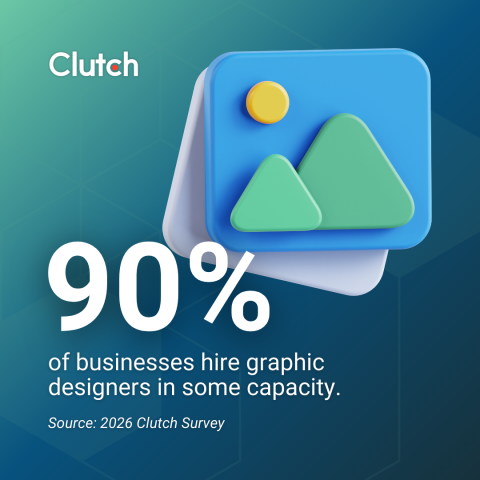
In fact, 90% of businesses use graphic designers in some capacity, underscoring how deeply design is integrated into modern business strategy.
More than a quarter (26%) of businesses report having in-house designers, indicating that many organizations prioritize consistent, dedicated internal creative oversight.
However, many businesses rely on freelancers, agency partners, or a hybrid model, depending on project scope and internal capacity. Nearly two-thirds (65%) hire external graphic design support at least quarterly, commonly hiring through:
Ultimately, regardless of the hiring model, graphic designers play a recurring role in driving business outcomes, which is a reality reinforced by how companies are allocating their budgets in 2026.
Despite concerns that AI tools would significantly reduce the need for professional creative services, businesses are not pulling back on graphic design investment. In fact, most are either maintaining their existing budget or expanding it.
Over the past year, 47% of businesses surveyed reported increasing their design budgets, while another 32% said their budgets remained roughly the same. Only 12% report a decrease in their design budget.
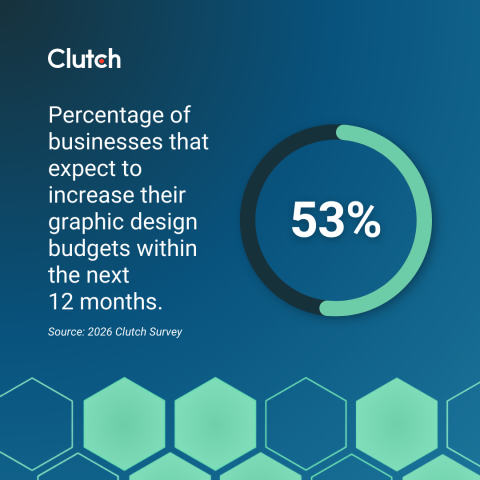
Looking ahead to the next 12 months, this trend appears to continue. Over half (53%) of businesses expect to increase their investment in graphic design, while 33% anticipate maintaining current spending levels. Just 10% expect budgets to decline.
Spending levels vary, but most businesses (54%) report investing between $1,000 and $15,000 annually in outsourced graphic design services. Notably, 14% report spending $15,000 to $50,000 per year, and 5% exceed $50,000 annually, demonstrating that for many organizations, creative support represents a meaningful financial commitment.
Learn about the factors that influence costs in this graphic design pricing guide. Consider agency size, location, and experience when interviewing potential service providers.
Together, these figures suggest that the graphic design industry in 2026 is supported by sustained and growing business investment. Rather than replacing designers outright, companies appear to be integrating AI tools while continuing to allocate budget toward professional creative expertise.
Businesses are clearly investing in graphic design, but what are they prioritizing when choosing creative partners?
While hiring frequency and budgets signal demand, expectations ultimately determine who gets retained and who does not. Survey data reveals that companies are seeking more than just production support. They are hiring designers for creative and strategic value while being equally attentive to how collaboration unfolds.
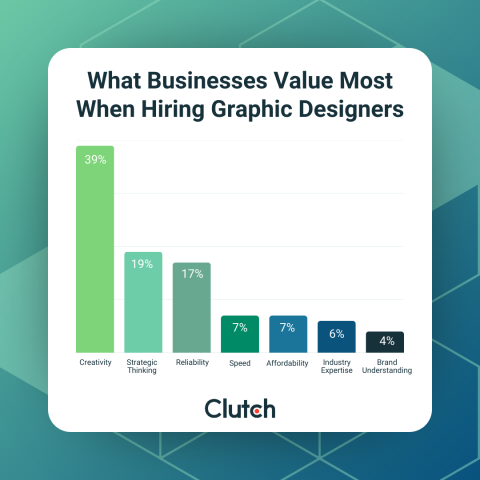
Creativity stands out as the single most important quality businesses seek in a graphic designer. In fact, 39% rank creativity as the most valued trait when working with designers.
Strategic thinking (19%) and reliability (17%) follow, reinforcing that businesses expect creative partners to contribute thoughtfully and consistently.
Notably, factors often associated with transactional work rank significantly lower. Speed (7%), affordability (7%), industry expertise (6%), and brand understanding (4%) trail far behind creativity and strategic input.
While efficiency and cost matter, businesses are not primarily hiring designers for rapid or inexpensive output. They are seeking original thinking, creative problem-solving, and strategic contributions that extend beyond execution alone.
At the same time, collaboration with even the most creative of designers can sometimes come with friction.
When asked about their biggest challenges working with graphic designers, businesses point to alignment and communication as the most common breakdowns.
Brand misalignment ranks highest at 19%, followed closely by unclear communication (17%) and slow turnaround times (17%).
Additional concerns include inconsistent quality (15%) and missed deadlines (14%).
These findings suggest that while creativity drives hiring decisions, clarity and alignment drive long-term success. Businesses want designers who not only produce strong creative work but also understand brand positioning, communicate expectations clearly, and deliver reliably.
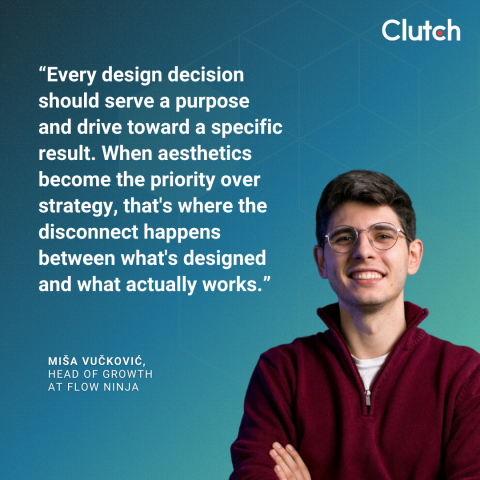
Miša Vučković, Head of Growth at Flow Ninja, explains, “Every design decision should serve a purpose and drive toward a specific result. When aesthetics become the priority over strategy, that's where the disconnect happens between what's designed and what actually works.”
In short, creativity may open the door, but communication and consistency determine whether partnerships endure.
Graphic design investment is evaluated based on its impact on measurable outcomes. When asked where graphic design has the biggest business impact, respondents pointed overwhelmingly to performance-driven channels:
In other words, creative work is most valued where it directly influences reach, conversions, and revenue-generating activity.
Demand trends reinforce this connection. The fastest-growing design need over the past year is social media content, with 50% of businesses reporting increased demand. Marketing assets such as flyers, ads, and banners follow at 42%.
Investment patterns further support this shift toward growth-focused design efforts. Businesses report increasing design budgets most often when:
In each scenario, design supports expansion, repositioning, differentiation, and market entry. The types of graphic design projects businesses hire for most often align closely with these initiatives:
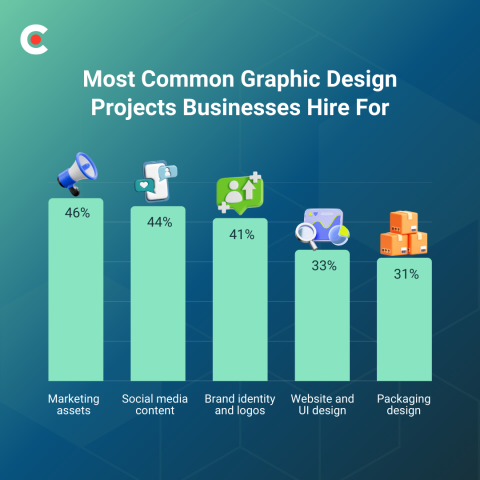
Smaller but still significant categories include email graphics (17%), presentation decks (17%), event and trade show materials (12%), and sales collateral (12%).
While the types of projects and their goals may vary, businesses are investing in creative work that strengthens audience engagement, improves campaign performance, and supports measurable growth.
So far, the data makes one thing clear: businesses are hiring designers, increasing budgets, and tying creative work directly to performance.
But this brings us back to the question that everyone in the graphic design industry needs an answer to: Is AI replacing graphic designers?
The short answer is no.
The longer answer is that AI is shifting what graphic designers handle.

AI adoption in design is already widespread. In fact, 88% of businesses report using AI design tools in some capacity, and 61% say they use them regularly or occasionally. Tools such as Canva Magic Studio, Adobe Firefly, and image generators like Midjourney and DALL·E have quickly become integrated into everyday workflows.
However, AI usage does not equate to designer replacement.
When asked how AI has changed hiring behavior, 32% of businesses say it has replaced only simple design tasks. Another 18% report that AI has reduced their need for designers. Yet 25% say AI has actually increased their design output needs, and 17% report no change at all. An additional 8% say it’s too early to tell.
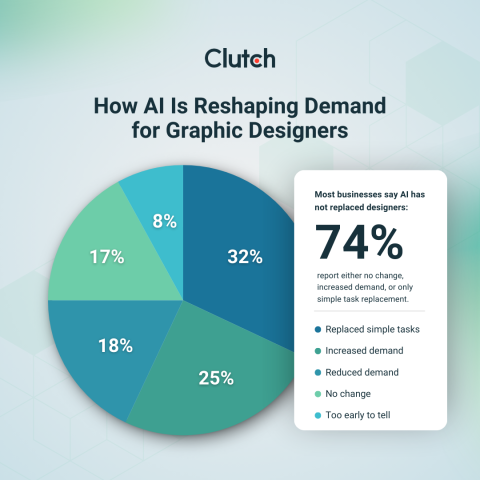
The mixed results point to a complex reality in which AI is influencing hiring behavior, but not in a single, uniform direction.
Similarly, there are mixed views on the quality of AI-generated designs. Thirty percent of businesses say AI-generated designs are lower in quality overall. Meanwhile, 23% believe it is comparable for simple assets, and another 23% say it can be higher quality in certain cases. Seventeen percent say quality depends on the project.
In practice, companies are most comfortable using AI for production-level tasks, including:
Notably absent from this list of tasks is foundational brand work. Businesses appear willing to automate tactical outputs, but higher-level strategy, brand positioning, and core identity development remain largely human-led.
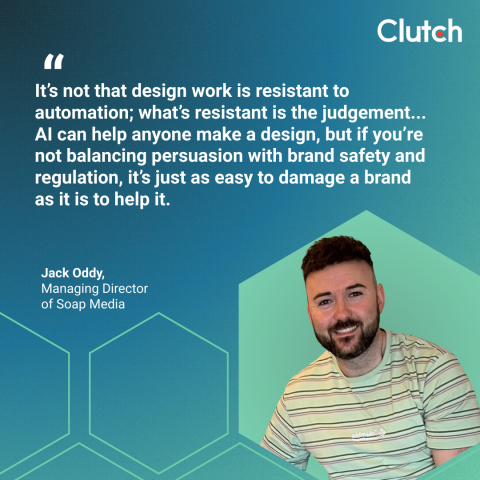
Jack Oddy, Managing Director of Soap Media, explains, “It’s not that design work is resistant to automation; what’s resistant is the judgement.” He continues, “You are designing for an outcome, and often designing for a funnel, not a single impression. AI can help anyone make a design, but if you’re not balancing persuasion with brand safety and regulation, it’s just as easy to damage a brand as it is to help it.”
Overall, the data suggests that AI is taking on simpler production tasks, while higher-level, brand-critical work continues to be handed off to professional graphic designers.
The data suggests the graphic design industry is adapting to the world of AI, but not declining.
Opportunity still exists, but it increasingly favors creative designers who understand how businesses operate, grow, and measure success.
Five key trends emerge from the data that graphic designers should pay close attention to:
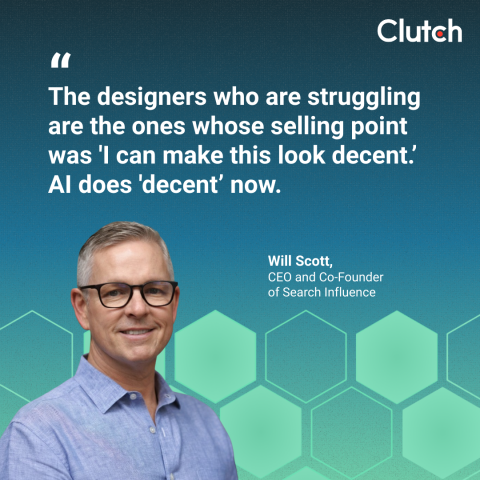
Taken together, these signals suggest that some designers need to change their positioning. Designers who operate purely as executors may feel increasing pressure from automation. As Will Scott, CEO and Co-Founder of Search Influence, explains, “The designers who are struggling are the ones whose selling point was 'I can make this look decent.’ AI does 'decent’ now.”
However, those who position themselves as:
will align more closely with where business investment is heading.
In 2026, the most resilient graphic designers will not simply produce assets. They will contribute insight, support growth initiatives, and integrate their creative work seamlessly into broader business strategy.
As the graphic design industry evolves, one thing remains consistent: businesses continue to invest in creative expertise that drives results.
While AI tools are widely adopted, they are primarily being used for simple production tasks. Strategic, brand-level, and performance-driven creative work continues to be led by professional designers.
Businesses are prioritizing creativity, strategic thinking, and reliability, especially during high-growth moments such as product launches, market expansion, and rebrands.
For companies looking to scale, improve marketing performance, or strengthen brand alignment, partnering with a graphic design agency can provide both the strategic direction and executional consistency required to compete effectively in 2026.
This report is based on a survey conducted on February 11, 2026, using the online polling platform SurveyMonkey. We surveyed 403 professionals in the United States between the ages 18-99 of all income levels. The respondents were 46% male and 54% female.
Participants were asked a series of multiple-choice and single-selection questions about graphic design. Quotas were applied to ensure a balanced distribution across demographic segments. All respondents were required to complete the survey in full to be included in the final analysis.