
Why Searching for a Specialized Dev Agency Takes Longer Than It Should — And What to Do About It
Looking for a niche software development agency? Learn how to define your requirements, find specialized providers, and vet their experience.
Updated March 17, 2026

In 2026, AR and VR technology is creating new opportunities for businesses to connect with buyers and drive conversions. Clutch surveyed 400 consumers to uncover what actually works and how businesses can use these tools more effectively.
Have you recently tried buying furniture online? Browsed homes in your dream city? Used a Snapchat filter? Or trained to operate machinery at work?
If so, there’s a good chance you used augmented (AR) or virtual reality (VR) to do it.
Looking for a Software Development agency?
Compare our list of top Software Development companies near you
More companies are turning to immersive technology to engage customers and create more interactive everyday digital experiences.
To better understand how companies can leverage this technology to engage with their audiences, we surveyed 400 consumers about their experiences with AR/VR, including how often they use it, what they find most valuable, and what challenges still exist.
The results offer insight into how companies can more effectively incorporate immersive technology into their 2026 strategies.
Key Takeaways:
Augmented reality is proving to be a powerful driver of purchase decisions, with 58% of consumers having made a purchase after using AR features.
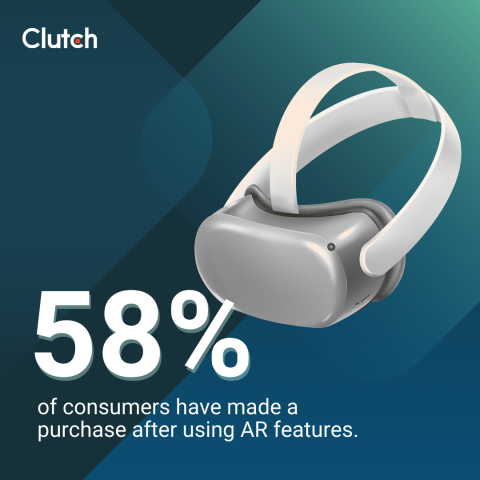
The truth is that AR features are helping overcome some of the biggest hurdles for online shoppers: the inability to see, try, or experience a product before buying.
By overlaying digital objects onto the real world — either through a smartphone or laptop camera — AR gives consumers a more interactive way to evaluate products.
For instance, Warby Parker has AR features on both their website and app that allows customers to virtually try on eyeglasses using their smartphone camera. The technology maps a user’s face and overlays frames in real time, helping shoppers see how different styles fit their face shape and personal style.
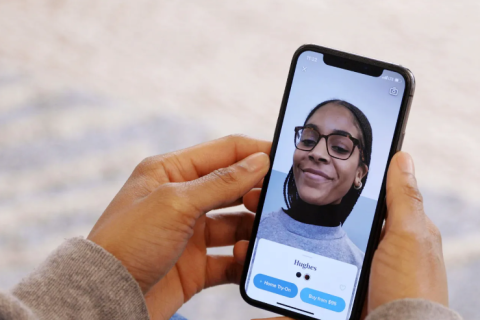
The ability to visualize a product in a space or try something on virtually helps shoppers feel more confident about what they’re purchasing, which can improve conversion rates and reduce costly returns for businesses.
Particularly when shopping for something like eyewear, which is both functional and fashion-driven, the ability to preview frames dramatically improves buyer confidence. Buyers can feel assured that they will look good in the glasses that they purchase without having to go to the store to try them on.
Warby Parker isn’t the only brand leveraging AR features to enhance the shopping experience. Consumers are also familiar with AR tools from brands like Wayfair (23%), Nike (23%), IKEA (22%), and Sephora (21%), all of which use augmented reality to help shoppers visualize products, test fit, or experiment with different styles before making a purchase.
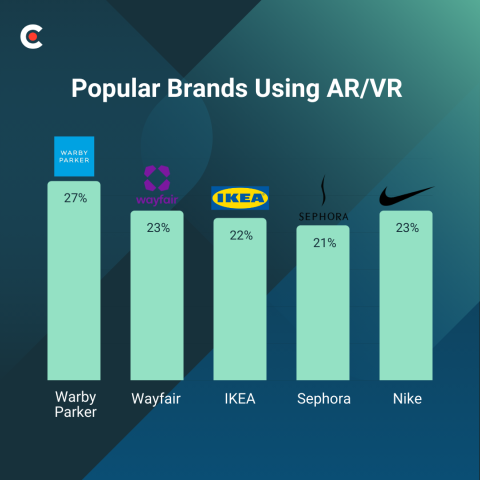
These brands are particularly well-suited for AR/VR because their products often require customers to see or test them before feeling confident enough to buy.
Whether it’s visualizing how furniture fits in a room, trying on glasses, testing makeup shades, or checking shoe sizes, shoppers frequently hesitate when they can’t evaluate these details online.
AR features help close that gap by enabling real-time visualization, personalization, and virtual try-ons, giving consumers a clearer sense of how a product will look, fit, or function in the real world.
AR/VR technology is still relatively new to most people, with only 35% of consumers currently using AR/VR technology regularly.
However, adoption is expected to grow significantly, with 54% of consumers saying they’re likely to increase their use of AR/VR within the next two years. This suggests that immersive technologies are quickly moving from novelty features to more mainstream digital experiences.
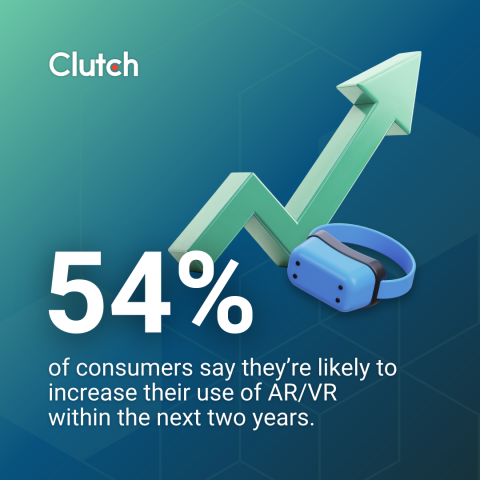
Naturally, younger generations are driving adoption. More than 8 in 10 (81%) of those under the age of 45 have used AR/VR technology, compared to 42% of older generations.
As younger, more tech-native users gain more purchasing power and familiarity with AR/VR technology continues to grow, businesses that embrace these technologies will have greater opportunities to engage and convert customers.
“For leaders evaluating AR investment, three questions matter most,” Explains Virendra Sharma, CEO of EmizenTech. “First, is there a clear use case tied to a business outcome, not just a technology demonstration? Second, does your customer base have the devices and connectivity to support it reliably? Third, what does the total cost look like, including iteration and support post-launch?”

Outside of gaming, retail leads the way in AR/VR, but many other industries are leveraging it as well. Real estate uses VR for virtual property tours and design visualization, while automotive companies offer virtual showrooms and AR-based technician training. Healthcare leverages AR/VR for surgical planning, training, and patient education, while industrial companies use it for maintenance, repairs, and safety simulations. Even tourism companies can use AR/VR to provide virtual previews of destinations or hotel rooms.
“AR implemented correctly creates genuine competitive differentiation. Implemented poorly, it becomes a distraction from more pressing digital priorities,” says Sharma. “The decision should be driven by customer insight, not enthusiasm for the technology itself.”
Across industries, the goal of leveraging AR/VR technology is largely the same: to reduce uncertainty, increase engagement, and allow customers to experience products or services in realistic ways, ultimately supporting higher conversion rates and stronger brand loyalty.
Learn more about how much it costs to hire an AR/VR company in Clutch’s ‘AR/VR Services Pricing Guide.’
Gaming is the most popular reason consumers use both AR (63%) and VR (61%). Outside of that, the ways people use these technologies diverge.
AR tends to support practical, mobile-first interactions that integrate into everyday digital behavior, while VR is more closely tied to immersive and entertainment-focused experiences.
Since AR layers digital elements onto the real world through a smartphone camera, it’s commonly used for activities like social media filters and content creation (32%), online shopping and virtual try-ons (30%), and navigation or map features (18%).
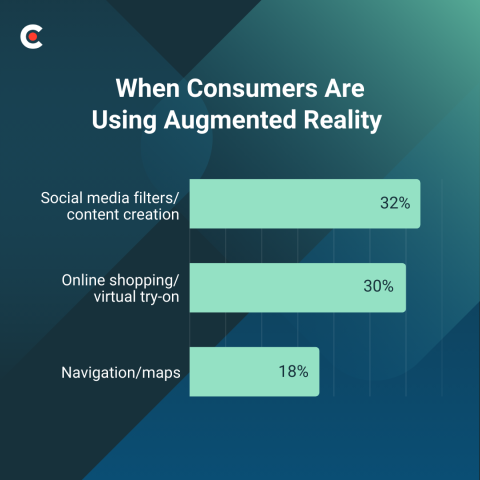
These use cases highlight AR’s strength as a lightweight tool that enhances real-world experiences rather than replacing them.
In contrast, VR performs particularly well in media and experiential content. For example, 43% of users report watching movies or videos in VR, while 25% attend virtual events or concerts and 18% use VR for social experiences.
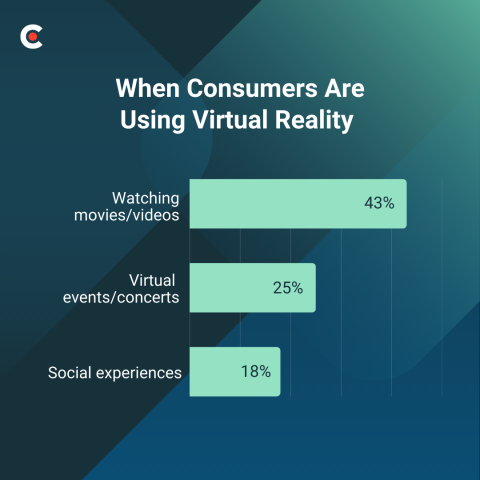
For companies looking to invest more in either AR or VR, this means aligning the technology with the intended experience. They should use AR to improve practical, mobile-first customer interactions and VR to create deeper, more immersive brand experiences.
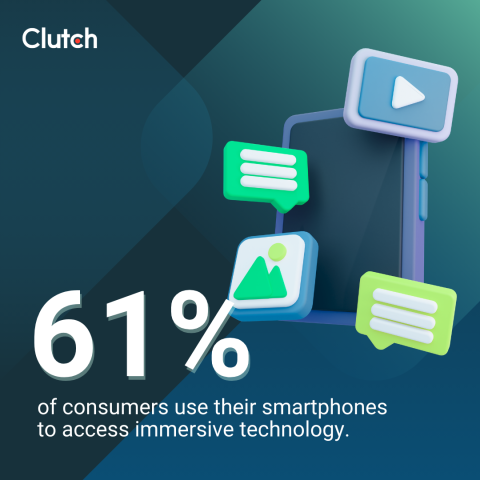
Consumers can access immersive AR/VR content through a range of devices, from smartphones they already own to dedicated VR headsets. However, mobile devices remain the most common entry point with almost two-thirds (61%) of consumers using their smartphones to access immersive technology.
The good news is that consumers prefer smartphones for immersive experiences (29%), ranking them even higher than standalone VR headsets (26%).
This preference is largely driven by accessibility and convenience. Most consumers already own a smartphone capable of supporting AR features, while dedicated VR hardware requires an additional purchase and setup. Cost is already a major barrier to adoption, with 51% of consumers saying the price of VR headsets is the main reason they choose not to use them.
With this in mind, businesses looking to use AR/VR to convert customers may want to prioritize adding AR features to their existing mobile apps or websites, where consumers are already comfortable engaging with the brand.
“In our view, the best AR/VR experiences are the ones that feel simple and intuitive.” said a member of the Brights team. “Users shouldn’t need instructions to understand what to do; they should be able to open the feature and start interacting with it almost immediately.”
Whether it’s on a web browser or a mobile app, great AR/VR experiences are simple and genuinely useful for the user. Getting started should be easy, with minimal setup and clear instructions to help people jump right in.
According to the Brights team, “Good AR UX usually comes down to a few things: fast loading, clear interaction cues, and realistic visualization. If the object placement, scale, or lighting feels off, users quickly lose trust in the experience.”
Just like a well-designed website, your AR/VR features need to perform seamlessly. That means smooth, responsive experiences with realistic visuals, intuitive interactions using gestures or controls people already know, and an interface that feels consistent no matter what platform your users are on.
While more and more people are beginning to use AR and VR technologies, adoption is still growing. The biggest barrier preventing users from adopting AR/VR technology is the high cost of devices (51%), followed by the lack of useful content (32%), motion sickness or discomfort (26%), and privacy concerns (26%).
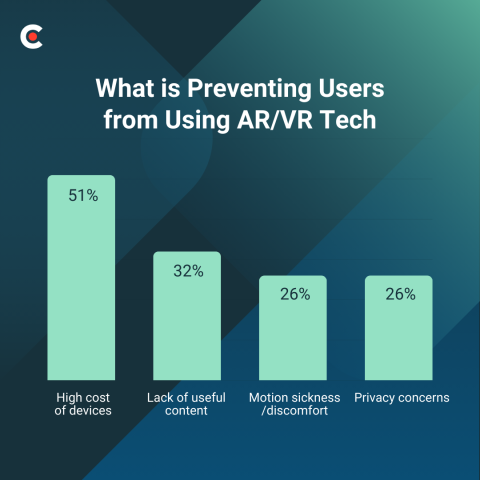
These barriers tend to affect VR adoption more heavily, since VR often requires specialized hardware, while many AR experiences can run on smartphones that consumers already own.
If companies want immersive features to truly perform and be embraced by consumers, they need to address the key barriers that are holding many people back from regular use.
While investing in AR features on devices that customers already have is one way to address cost concerns, the lack of useful content provides a great opportunity for many businesses.
Consumers will participate in immersive experiences if it provides a value, whether it’s because it’s entertaining or practical. For companies willing to experiment, this gap means there is still plenty of room to create meaningful, differentiated experiences that stand out.
Beyond that, both AR and VR experiences need to feel seamless, otherwise users with feel sick or uncomfortable. High latency is the primary cause of motion sickness in AR and VR experiences.
Abhijith HK, CEO and founder of Codewave, provides more insight into how lag can impact retention, saying, “[T]he brain is brutal. The moment there’s lag or misalignment, it rejects the experience before the user can even articulate why. Latency above 20ms is felt, not seen. Most teams ship above that threshold and wonder why retention drops.”

Even small delays can break immersion, which is why optimizing performance and minimizing latency is essential for keeping users engaged with immersive experiences.
Although it isn’t a primary barrier to adoption, data privacy remains the top concern among AR/VR users (44%). This reflects broader consumer anxiety around how personal data is collected, stored, and used. In fact, another Clutch survey found that 90% of consumers say that data security and privacy is either very or extremely important to them.
Similar to mobile devices, online platforms and wearable technology, AR/VR technology collects sensitive user information like:
For example, VR headsets can collect eye-tracking data, such as where a user is looking, pupil dilation, blink rate, and gaze patterns. At the same time, AR experiences can generate detailed 3D maps of rooms or surrounding environments.
Consumers are right to be concerned: this information can be used to infer personal habits or daily routines, and even identify individual users, significantly impacting their personal data privacy.
To successfully adopt immersive technologies, companies must proactively address these concerns by prioritizing transparency, responsible data practices, and strong privacy protections.
As consumers grow more comfortable using AR and VR in their daily lives, immersive experiences are emerging as a powerful opportunity for businesses.
By integrating AR features into their existing tools, companies can answer key customer questions, like whether a product will fit in a space or look good on them, helping drive conversions. At the same time, VR can be used to craft fully immersive brand experiences that engage audiences, strengthen connections, and build lasting brand loyalty.
Business leaders looking to integrate immersive technology into their strategy must focus on creating content that delivers the greatest impact for their audiences while aligning with their company’s needs and goals.
Interested in creating a custom AR/VR experience for your customers but don’t know where to start? Search for industry-leading AR/VR development companies on Clutch.