Micro SaaS: How Solo Developers Build Profitable Products
Solo developers now make up 35% of startups. Discover how micro SaaS lets individuals build and launch profitable products without a big team.
Updated April 28, 2026

Vibe coding is gaining attention as a faster, more intuitive way to build software with the help of AI. Supporters call it the future of development, while skeptics warn it might sacrifice quality for speed. Let’s look closer at what vibe coding really means, whether it’s a breakthrough or a hidden danger for businesses.
A recent Clutch survey of 800 software professionals found that 59% of developers say they use AI-generated code they do not fully understand, a striking signal of a growing trend: vibe coding.
Vibe coding is when developers describe what they want in plain language and let an AI model like ChatGPT, Claude, or GitHub Copilot generate the code for them, rather than writing it line by line.
Looking for a Software Development agency?
Compare our list of top Software Development companies near you
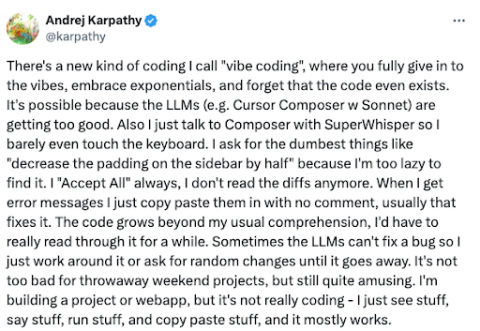
The term was coined by Andrej Karpathy, former Tesla AI lead and one of the most influential figures in machine learning. In practice, vibe coding feels less like traditional engineering and more like collaborating with an AI partner. You describe your vision, refine your prompts, and the model handles the rest, from boilerplate logic to UI components.
For many developers and startup founders, that sounds like a dream. But it comes with real tradeoffs. Among many things, code that no one fully understands can introduce serious security vulnerabilities, create bugs, and be difficult to maintain.
However, when used properly, vibe coding can save time, spark creativity, and accelerate early development. The trick is knowing when vibe coding suffices and when engineers should be writing or at least closely reviewing the code.
If you want to show investors or stakeholders an idea quickly, vibe coding is a perfect option. You can describe your vision, let the AI build the basic layout, and get something visual within a short period of time. For quick validation or a demo, it will probably be hard to beat that speed. However, you need to remember that this kind of code is just a sketch, which can be great for learning and feedback.
Vibe coding also makes sense for simple automation or internal tools. You can simplify the processes of report generation, script writing, or dashboard creation. When the stakes are low and precision isn’t critical, AI can handle a lot of the routine work. It allows engineers to focus on more complicated and important tasks instead of repetitive setups.
Vibe coding can become a great opportunity for new developers or engineers who are exploring new frameworks. You can ask, “How would this API work?” or “Show me an example in React,” and get answers in seconds. It’s great for understanding how things work before learning more in detail.
Paired with professional review, AI-assisted coding can be surprisingly effective. A startup team, for instance, could mock up UI flows or build a data dashboard in a single afternoon — as long as someone experienced double-checks the code before it goes live.
Simon Greenman, co-founder of MapQuest and AI strategy advisor, documented a project in which he used Replit, Claude Code, and Cursor to build a design search application using vector similarity (React frontend, Express backend, PostgreSQL + Pinecone databases, full API layer).
The prototype came together in about 20 minutes, but once he moved toward production, he had to personally fix a series of architectural flaws. Some of the biggest coding problems included:
AI models are great at writing snippets, but they don’t think in systems. They don’t map out data flow, plan scalability, or consider how one feature will affect another down the line. Real engineering requires strict structuring, knowing how modules work with each other, and where the bottlenecks can appear. On the contrary, vibe coding skips that features entirely. As a result, apps that may work today are likely to collapse under real-world traffic tomorrow.
One of the biggest threats to AI-generated code is security. The model cannot understand business context, doesn’t access levels, and cannot handle sensitive data. It can pull in outdated libraries or copy patterns that look fine but leave open doors for attackers. If a developer doesn’t review every line, you’re trusting an algorithm with your users’ data. And that’s definitely a dangerous game.
Even when AI writes code, it often lacks structure, consistency, and documentation. Over time, those weaknesses accumulate and result in considerable technical problems. Besides, messy code is hard to debug, scale, or hand off to another team.
Software engineering has always had a built-in safety net based on human responsibility. When things break, someone has to fix them. However, when using vibe coding, accountability faces considerable risks. The AI doesn’t “remember” decisions, justify trade-offs, or track why something was built a certain way. As a result, the lack of ownership makes debugging, auditing, or improving the product much harder.
AI tools usually rely on public data that may be months or years old. They can easily suggest deprecated functions, insecure libraries, or mismatched dependencies. Developers know how to verify these details; on the contrary, the AI doesn’t. When you trust it blindly, you risk getting into a huge problem.
Vibe coding is a fast solution, but real software definitely lives longer than a demo. In case your project doesn’t have proper architecture, security, and human oversight, a quick win can turn into an expensive rebuild later. In software, speed matters — but control matters more.
So, if vibe coding isn’t the best solution, what to do and how to benefit from AI development?
The best option is when software developers and AI work together. AI helps engineers with the routine tasks of development, including generating snippets, suggesting functions, or quickly testing an idea. 82% of developers use AI for writing code, and 67.5% of them apply artificial intelligence for searching answers. It definitely saves time and helps teams move faster.
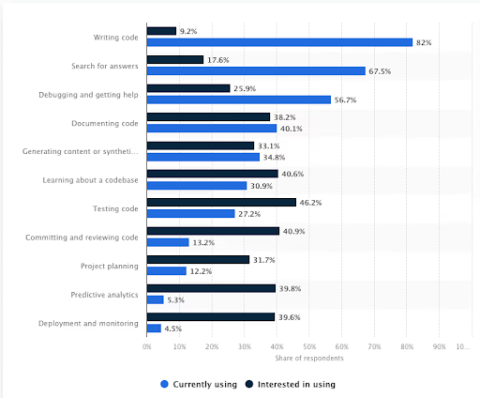
Most popular uses of AI in the development workflow among developers worldwide as of 2024.
Source: Statista
However, you need to remember that AI still doesn’t understand how real products work in the long run. You cannot delegate things like scaling, user load, or security. These are spheres where human engineers are still essential.
On the contrary, a smart strategy is to let AI handle the first stage, which includes drafting the logic, setting up basic components, and outlining the structure. Then let developers refine and improve it. Engineers need to review, optimize, and make sure everything connects properly. They can see the whole picture, namely, how the system grows, how data moves, and how to keep things safe.
The leading development agencies have already recognized this shift and even created a new role called the AI developer. They know how to use generative tools to speed up delivery. At the same time, they also understand the core of software engineering principles, including architecture, performance, and reliability.
In practice, AI software development companies use advanced AI technologies to help businesses move from idea to product launch faster. AI can generate prototypes in several days, test the logic, and support engineers with important insights. But most importantly, every piece of code goes through precise human review to ensure software quality and compliance with modern standards.
To wrap up, when people and AI work together, it’s a huge bonus for development. It not only moves faster but also becomes smarter. Teams can test ideas, try new things, and keep their products stable and reliable.