
What 25 Years of Design Projects Taught Us About What Clients Actually Need
That moment changed the way we ask questions at the start of a project. Twenty-five years in, the work has touched organizations of every kind: enterprise...
Updated April 23, 2026

Augmented reality has become a powerful tool for bridging the gap between digital content and real-world interaction.
It’s helping brands drive conversions through new styles of engagement, from virtual product try-ons to gamified marketing campaigns.
Consumers value AR experiences because they’re highly personalized, interactive, and more memorable than digital alternatives like social posts. As the technology improves, brands can leverage it in new ways to stand out in crowded markets. Your company may want to explore doing the same.
This guide to augmented reality marketing will help you get started. It takes an in-depth look at the benefits of AR strategies, showing how brands across diverse industries use the technology to deliver new experiences to consumers.
Companies that use AR in marketing tend to achieve stronger outcomes. DigiTrends is a digital services provider who offers AR development services to clients. Their Branding and Digital Marketing Manager, Muzna Arif, says, “[AR] client testimonials highlight positive outcomes such as increased user engagement, improved brand recall, and enhanced customer satisfaction.”
Arif’s view is borne out in the data. Shopify found that products advertised with VR and AR content achieve a 94% higher conversion rate. Companies also use AR to increase dwell time on apps and websites, while encouraging more social sharing.
Marketing leaders are taking notice of these benefits. Brands like IKEA, Nike, and Sephora are embedding AR in mobile apps to support virtual try-ons, enhance storytelling, and reduce friction in the purchase process. They’re tracking performance through metrics like:
According to Arif, “AR activations that offer personalized, immersive, and interactive experiences tend to perform well.” But what does that look like in practice? Here are four AR design strategies marketing teams use to leverage augmented reality for increased sales.
One of the most common uses of AR in marketing is interactive product visualizations. These allow customers to try on things like clothes and jewelry virtually. Companies like Wayfair use the same technology to show consumers how different pieces of furniture would look in their home.
This is like a personalized product trial that happens entirely virtually. It helps customers find the right product before ordering to reduce return rates and improve buyer satisfaction. It also gives customers a special reason to buy from your brand, since it could be the only one they’ve tried in this way.
You can also leverage augmented reality services to create memorable digital customer experiences. These form deeper connections between your brand and consumer, while giving the community a reason to get excited about limited-time offers and events.
For example, American Express recently created a special AR experience for Coachella attendees. Users could download the American Express app and use an AR camera around the festival to unlock special merchandise.
The New York Times has also used AR technology to deliver more immersive experiences. The Times app recently shared an AR-enabled article covering the Winter Olympics, which revealed 3D images of athletes placed in the room where the story was being read.
Learn more: "Why You Should Use Augmented Reality in Your App"
The same technology that some brands use to engage customers can also help students learn. Education companies use AR to transform static lessons into dynamic, hands-on experiences. For example, Merge EDU is a platform that uses AR to help students visualize planets, human organs, and chemical compounds. These kinds of experiences can increase student engagement and retention.
Companies also use immersive AR to train employees. This is especially useful in the healthcare industry. For example, FundamentalVR provides AR surgical training simulations to help surgeons develop their skills in a safe training environment.
Sometimes AR even helps healthcare teams support patients directly. For example, AccuVein uses AR to project a map of a patient’s veins onto their skin, which helps nurses locate injection sites more accurately.
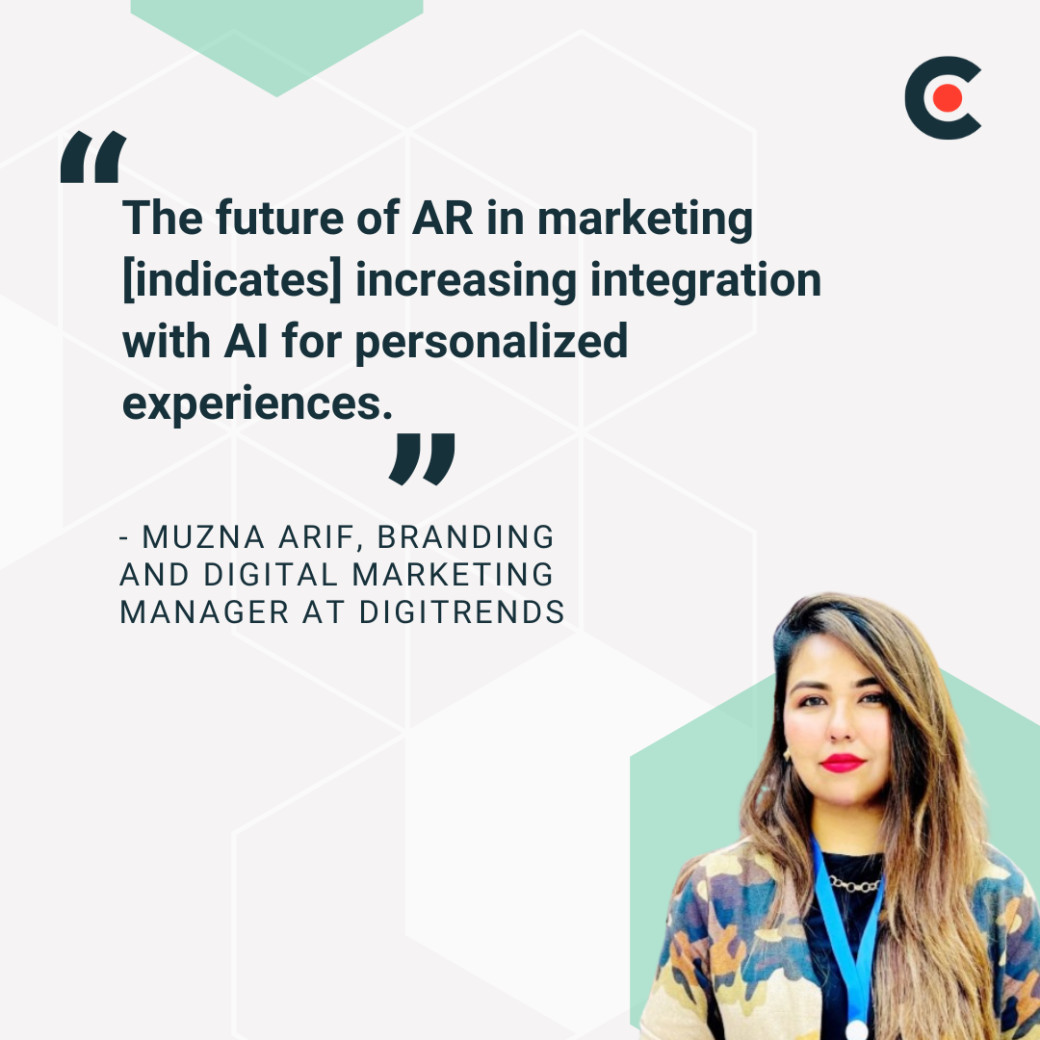
Arif also sees augmented reality in business supported by AI. She says, “The future of AR in marketing [indicates] increasing integration with AI for personalized experiences.” It does so by creating tailored experiences, which increase purchase intent.
For example, Sephora’s app provides personalized AI product recommendations based on skin tone, preferences, and previous purchases. It then lets users “try on” these recommendations with an AR visualization tool.
This is a method of reshaping the customer journey. Instead of simply listing products, the Sephora app guides users to exactly what they need. The user appreciates the convenience and novelty of the experience, while the company sells more products.
Finally, many companies have also launched AR filter campaigns on social media sites like Instagram, Snapchat, and TikTok. These encourage social sharing by giving users a fun way to generate unique content and connect with friends.
Vojtech Lambert, Executive Director at LCG New Media, uses these campaigns often. He says, “Most of them are very successful... AR filters are mostly about the activation of communities. [W]e put it in the center of campaigns to increase sharing.” You can track the performance of your campaigns with metrics like impressions, engagement rates, and conversions.
For example, Coca-Cola recently created an AR filter for the winter holiday season. It allowed users to take selfies with animated Santa hats, shoot pictures with snow effects, and share videos with Coke-branded virtual glasses. This helped the soft-drink maker increase its reach on social media platforms like Instagram and TikTok without investing in paid ads.
However, Lambert notes that these filter campaigns aren’t the right fit for every marketing strategy. He says, “For direct conversions, I would recommend different formats. Here, we can mostly see post conversions and brand awareness impact.” In other words, AR filter campaigns increase awareness, but aren’t as effective at driving direct sales.
The industries that benefit most from AR marketing are those that have a natural fit with the technology. Some examples include:
You don’t necessarily need to operate in one of these industries to get value from an augmented reality specialist. These marketing experts help companies in many sectors stand out with AR strategic AR campaigns.
Launching an AR campaign can help your company stand out online, increase awareness, and connect with more customers. But you’ll need the right approach to achieve these goals on time and within budget. The following three tips are a great place to start.
Before starting development, you should outline the objectives of the campaign. Lambert stresses the importance of thinking deeply here: “You need more than just an idea — you need a well-thought-out campaign from concept to execution.”
For most companies, that means integrating the new AR campaign with existing digital marketing strategies. For example, you could announce a new AR try-on feature on your social pages or through email marketing campaigns. You might also use AR as a tool for improving a KPI you’re already tracking, like conversions or brand engagement.
The key is setting clear, measurable goals for the AR experience. This will help you develop a purposeful campaign, not just an experiment with new tech.
The next step will be finding an augmented reality specialist to develop your ideas. You should prioritize vendors that have a proven track record of helping brands with AR marketing content. You’ll also want to search for partners that are easy to work with.
According to Arif, “Effective collaboration involves clear communication of objectives, understanding the technical capabilities of AR, and aligning the experience with the brand’s goals.” So, you’ll need to work closely with whatever partner you choose to get the best results.
Pricing is another important factor to consider when choosing a development partner. You can review our article on how much augmented reality projects cost for more information.
Once you’ve hired a development partner, you’ll work together to iterate on design and features until you are ready to launch. Here are some tips for a successful one:
AR has grown into a powerful tool for digital marketing, helping companies deliver immersive experiences, build awareness, and drive sales. From augmented reality for sales to filter campaigns that spread awareness, it’s a tool your business may be able to leverage in more than one way.