
How to Define Brand Values That Guide Every Business Decision
Brand values are the principles that guide company decisions, define what a brand stands for, and shape how it treats customers, employees, and partners.
Updated September 16, 2026

Brand perception is what your customers believe your brand represents — not what you say it represents. It's shaped by every news story, social media post, and consumer review they encounter. And once it shifts, it moves fast.
A Clutch survey of 1,000 consumers found that 46% of people who were aware of negative press coverage about United Airlines also developed a negative perception of the brand. That's not a one-off. It's how brand perception works: media shapes consumer opinion at scale, and PR teams are on the front line of managing it.
This article covers what brand perception is, what drives it, how to measure it, and what PR teams can do to protect and improve it.
Looking for a Public Relations agency?
Compare our list of top Public Relations companies near you
Brand perception is the sum of what consumers think, feel, and believe about your brand — based on their direct experiences, media coverage, word of mouth, and cultural signals. It's distinct from brand identity, which is what a company consciously projects. Brand perception is what lands.
It encompasses:
Brand perception can take years to build and days to lose. It's one of the most volatile and consequential assets a business manages.
Brand perception directly influences purchase decisions — particularly for high-cost items.
When consumers evaluate a major purchase (a car, a laptop, a software platform), they factor in more than product specs. According to Clutch's survey, 18% of consumers consider recent company news when making a high-cost purchase, compared to just 9% for low-cost items. The stakes of a bad reputation are higher when the check is bigger.
Nearly 20% of consumers hesitate to make high-cost purchases from brands with recent negative coverage. That's not a niche segment. For a B2B brand selling a $50,000 software contract or a consumer brand selling a car, one sustained PR misstep can translate directly into lost revenue.
The flip side is also true: brands that maintain a strong, authentic perception hold onto customers even when controversy hits. Pepsi's massive brand loyalty meant that 77% of consumers felt unaffected by their 2017 ad controversy. Chick-fil-A's transparent stand on its values led 25% of consumers to actually purchase more.
Perception is not a soft metric. It's a revenue driver.
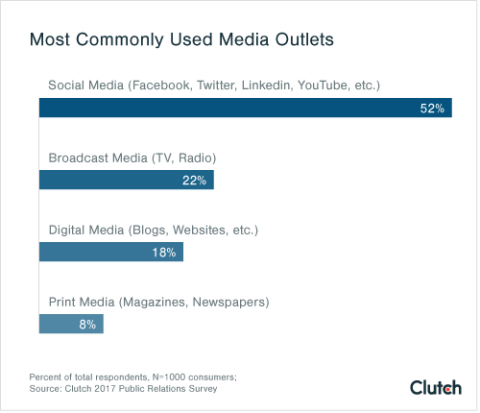
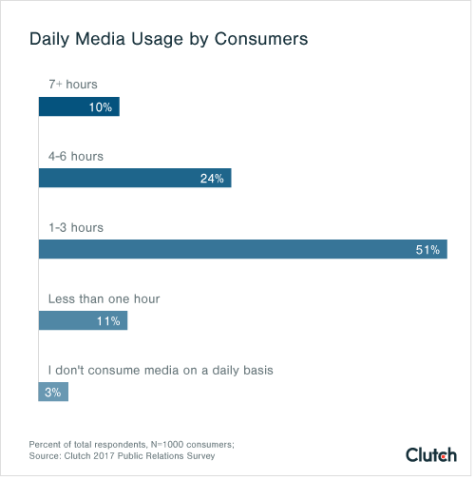
The speed at which brand perception can shift has accelerated sharply. Social media now dominates media consumption — 52% of consumers said social is their primary source of information, and 75% said they consume media between one and six hours a day. That's a constant stream of commentary, coverage, and reaction.
“Social media has dramatically shortened the window of time that organizations have to respond to reputation issues. At the heart of good public relations management is getting out in front of good events fast, and getting out in front of bad events even faster.”
— David Kippen, CEO, Evviva Brands
The practical effect: a single viral video, a poorly timed press release, or a controversial statement can move consumer opinion within hours. PR teams no longer have days to craft a response. They have hours — sometimes less.
This compressed news cycle creates two distinct reputation risks:
1. Crisis events — a specific incident (product recall, executive misconduct, policy controversy) that generates immediate negative coverage
2. Drift — slow erosion of brand perception through inconsistent messaging, weak social presence, or failure to respond to emerging narratives
Both require different PR approaches. Crisis events need rapid, public response. Drift requires proactive reputation monitoring and consistent content.
As salient news is brought to consumers’ attention, opinions of those brands change.
To measure the correlation between press coverage and consumer brand perceptions, we provided a list of 10 brands to survey respondents, 6 of which have been featured negatively in the news recently. After asking respondents to identify the brands with the negative press, we also asked them to select those of which they perceive in a negative light.
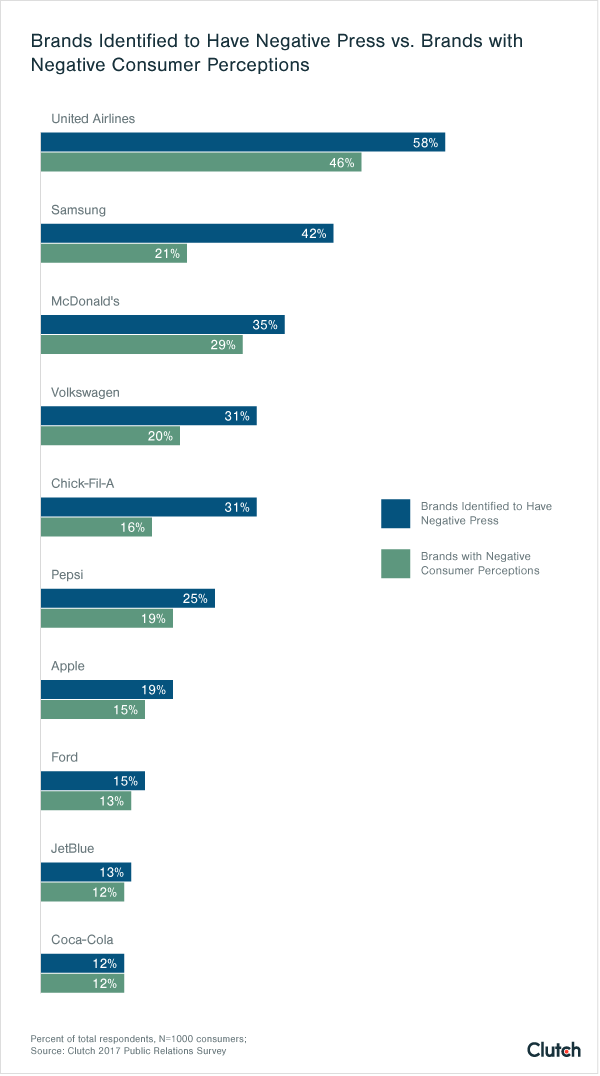
The results indicate that the top brands that are negatively perceived in consumers’ minds are all of the brands that have recently had negative press coverage.
Perceptions of a brand also feed directly into consumers’ likelihood to purchase that company’s products. The way these opinions change is conducive to many factors, and it even varies between low and high cost purchases.
While simple word-of-mouth referrals suffice in convincing consumers to make low cost purchases, high cost purchases require a bit more research, including an awareness of any news stories about the brand.
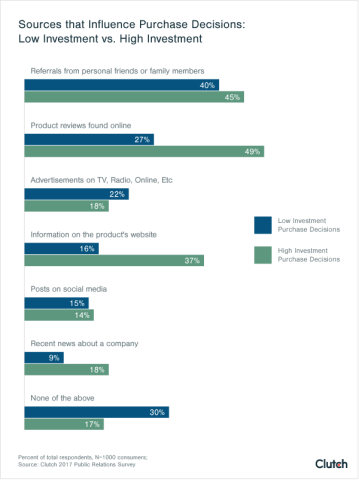
When considering a low investment purchase, like a meal or an article of clothing, consumers rely the most on referrals from friends and family members, online product reviews, and advertisements on TV.
The recent news about a company only has an impact on 9% of consumers, indicating a slightly lesser influence of recent press coverage on consumer purchase decisions of cheap, single-use products.
Conversely, double the amount (18%) of consumers indicated that the recent news about a company has an influence on their decision to make a high investment purchase, like a car or a computer. Upon making a more serious purchase decision, a larger amount of consumers admit to being influenced by the recent news about the brand in question.
David Kippen supports the notion that high-risk purchases increase the amount of concern a consumer has with a company.
“The bottom line is, if I’m making a high-cost investment as a consumer, I’m generally buying a durable consumer good or investing in a future event. If that’s the case, then I’m going to be much more concerned about the future status of a company in which I’m making the investment.”
— David Kippen, Evviva Brands
Even the slightest indication that a company is at risk of downfall can dissuade consumers from investing their money in that brand.
This data is significant because it points to the importance of PR in repairing a brand’s image after its reputation has been damaged in the news. If the press features a company as appearing weak or at risk of failure, then consumers will be dissuaded from purchasing its products or services. With a solid PR team, companies can avoid the negative press exposure and will thus avoid the risk of losing any potential customers.
Real-world examples show just how differently brands weather reputation events — and what drives the outcome.
United Airlines serves as an example of the direct relationship between a brands’ presence in the media and its perception by consumers.
As recently as this year, United Airlines has experienced a wide range of PR mishaps, landing them in the press in an extremely negative light. Their greatest failure pertains to the mishandling of their security team in taking an unwilling passenger off of an aircraft after refusing to give up their seat to a United crewmember.
The negative news has had a direct impact on the perception consumers have of United, 53% of which say they are less likely to purchase United plane tickets in response.
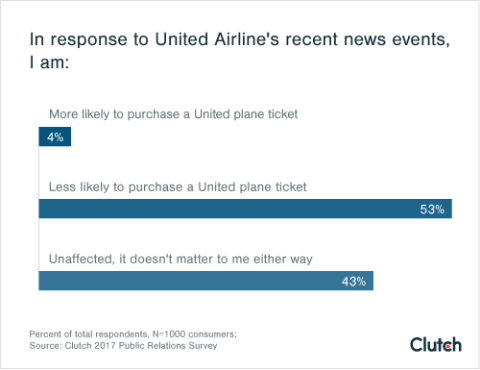
People are now changing their behavior when purchasing plane flights because they are aware of United’s actions and react in disagreement with their policies.
When asked to select a reason why they are less likely to buy United plane tickets, 52% of consumers say it’s because they believe United did not handle the situation correctly.
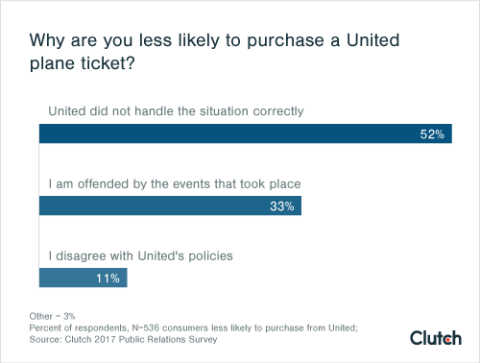
Due to their failure to implement an appropriate policy, United has lost a significant portion of their consumer base, according to our survey findings.
From a PR standpoint, United has quickly taken tangible actions to remedy the situation by changing their policies and increasing the amount of money they will reimburse passengers who may need to be relocated in the future.
But, the communications team at United still has some long-term work to do to rebuild their brand reputation. Buck Banks, the Vice President of NewmanPR, a public relations agency representing some of the country’s largest luxury cruise lines, points to the longevity of the public relations industry as the most stable method of ensuring a solid brand image.
“The thing about public relations, especially in the case of United, is that it’s a long game and not a short-term fix. You have to look at how, over time, you can continually put out positive messaging that addresses consumer concerns, tells them that you are listening, you care about what they think and feel, and that you’re responding to that.”
— Buck Banks, Vice President, NewmanPR
Investing in a long-term PR plan to maintain the reputation of a brand is the most secure way to ensure a company’s success.
The United case study shows that their immediate PR strategy to address consumer concerns is smart, but that they must also be vigilant about maintaining concern for their consumers and consistent positive messaging in order to regain the trust from individuals who may have lost respect for the brand.
Pepsi’s latest PR crisis is very different from that of United. Although Pepsi suffered from a negative news event, consumers were generally unaffected by the news about the company.
In Pepsi’s case, their marketing team made an error by issuing a commercial about police brutality that many viewed as insensitive.
In response, 77% of consumers indicated that they felt “unaffected” by their commercial and are not swayed to change their behavior in purchasing Pepsi products.
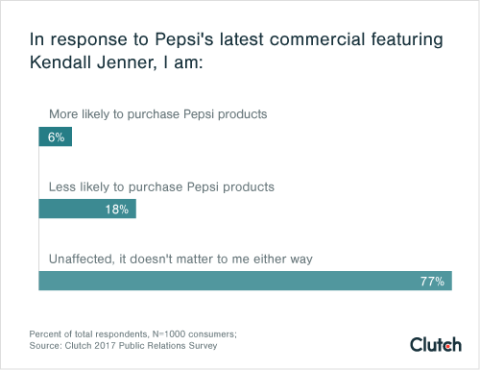
Buying habits did not change dramatically in response to Pepsi’s negative press coverage. The reason, however, is that consumers’ brand loyalty to Pepsi outweighs the brand’s marketing mistake.
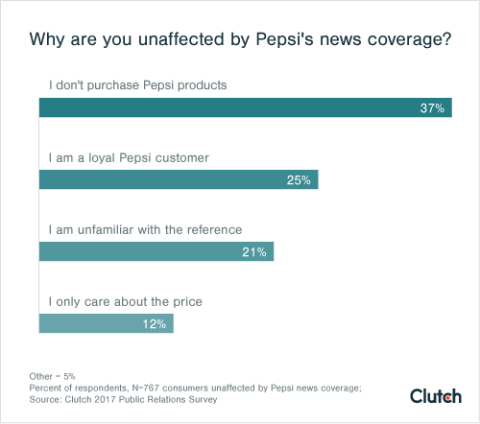
25% of consumers who said they were unaffected by Pepsi’s latest commercial say it’s because they are a loyal Pepsi customer.
The concept of brand loyalty as it pertains to PR is a curious relationship. Brand loyalty directly contributes to the value of a brand, which is the ultimate responsibility for a PR team to manage and grow. To do this, PR teams must voice brands in a way that emphasizes their values, positively and confidently.
However, when an event occurs that threatens to weaken a brand’s customer loyalty, PR teams are required to step up and admit that what they did was wrong. David Kippen explains:
“When things go dramatically wrong, the job of the PR team is to get out in front of them. Often, the message the PR team have to give is, ‘I’m sorry. We were wrong. We’re going to fix it.’ That’s a terrifying message because that goes straight to the heart of brand trust and brand loyalty.”
— David Kippen, Evviva Brands
Admitting to wrongdoing seemingly could weaken the trust customers have in a company. However, the ability to concede to such a downfall is actually what makes a good PR team and is what drives a company’s success.
By quickly and openly admitting that their marketing tactic was a mistake, Pepsi still saw an overwhelming negative response from consumers who disagreed with the message of their commercial. Yet, the perception of their brand remained firmly positive in the minds of consumers who are too loyal to the brand to change their buying behavior.
The case of Chick-Fil-A is different from that of both United and Pepsi. Their negative coverage in the news actually generated a positive response from consumers.
Chick-Fil-A’s press coverage has transpired over time now, making it the least recent case study out of the three selected brands. However, their reason for being featured negatively in the news is possibly the most controversial as it pertains to their conflict with the LGBTQ community.
In response to their openly religious values, 25% of consumers say they are more likely to buy a meal from Chick-Fil-A.
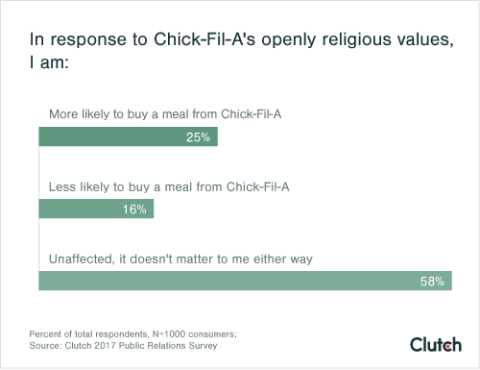
Though the news has instilled a change in consumers’ buying habits, it did so in a positive way for the Chick-Fil-A brand.
The reason, according to 45% of consumers, is that people respect Chick-fil-A’s right to express its values.
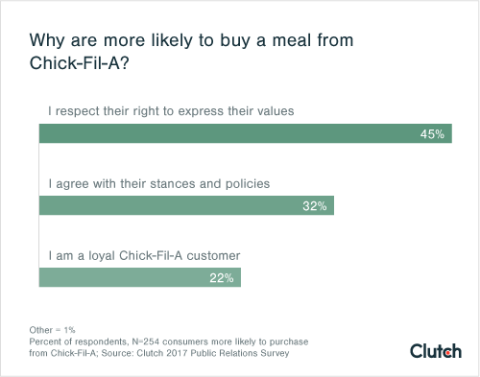
Despite Chick-Fil-A having a strong, public opinion on gay marriage and other LGBTQ issues, their overt and transparent messaging tactic actually worked in favor of the brand.
The reason why this behavior makes sense is that the communications teams at Chick-Fil-A had a strong PR strategy, taking a clear and transparent approach to standing up for their beliefs, no matter how much disagreement it sparked.
Just as how brand loyalty directly contributes to brand value, the commitment Chick-Fil-A has as a brand to remain true to their values is what not only maintains their brand loyalty, but has even driven an increase in consumers’ likelihood to buy their products.
Most brands don't measure brand perception systematically — they find out about a perception problem when it's already a revenue problem. These four methods give PR and marketing teams a continuous read on where they stand.
Surveys are the most direct measurement tool. They let you ask consumers specific questions about how they perceive your brand on specific dimensions — quality, trustworthiness, innovation, value.
Best practice: run surveys on a consistent cadence (quarterly or biannual) with a consistent question set so you can track movement over time. Use a mix of Likert scale questions ("How trustworthy do you find [brand]?") and open-ended questions ("What three words describe [brand]?") to capture both quantitative trends and qualitative texture.
Platforms like SurveyMonkey, Typeform, or Qualtrics can handle distribution. For more robust sampling, a market research partner can provide a representative consumer panel.
Social listening tools — Brandwatch, Sprout Social, Mention — track brand mentions across social platforms in real time. They surface sentiment (positive/negative/neutral), volume trends, which topics are driving conversation, and which influencers or publications are amplifying coverage.
Set up alerts for your brand name, common misspellings, executive names, and flagship product names. A sudden spike in negative mentions is often the earliest signal that a perception problem is developing.
Google Reviews, G2, Trustpilot, and industry-specific review platforms like Clutch hold structured consumer opinion at scale. Analyzing review text — not just star ratings — reveals recurring themes in how customers describe your brand.
Look for: words customers use to describe the experience, complaints that appear repeatedly, and gaps between how you describe your brand and how customers describe it.
Tools like Meltwater, Cision, or Google Alerts track press mentions, analyst coverage, and blog references. Beyond volume, measure sentiment and topic — is coverage about your product, your leadership, your culture, your controversy?
Track your share of voice against competitors: if they're getting twice the coverage on topics where you want to lead, that's a gap in your PR strategy.
PR has always been reputation management. What's changed is the speed, the scale, and the permanence of coverage. A story that would have faded in 48 hours in 2005 now lives forever in search results.
For advice on what PR teams can do to keep up with the changing media environment, Clutch looked to the experts to weigh in.
According to Buck Banks, the rise of social media has changed the way PR teams need to approach brand messaging.
“When we do social media for our clients, there’s a certain tone and sensibility to it that reflects the brand. It’s a certain voice, and if that voice is authoritative, contains the brand, and expresses the brand in a positive light, then it’s effective.”
— Buck Banks, NewmanPR
Containing the voice of a brand is key in public relations, especially when managing social media because those platforms are where consumers are most likely to build their strongest familiarity with a brand.
Additionally, responding quickly to negative press is vital for PR teams to maintain the reputation of the firms they represent.
Brianne Miller, Director and New Business Manager at Landis Communications, an award-winning public relations firm in San Francisco, weighs in on the significance of a brand’s reaction to being featured in the news.
“If you’re a brand and you’re in the news, whether it’s good or bad, it’s going to have some sort of influence on your brand image. In a lot of ways, how quickly you react to a bad situation can raise your brand awareness if it’s done properly. If you have good news associated with your brand, you hope that glow persists and allows consumers to think highly of your product and services.”
— Brianne Miller, Director and New Business Manager, Landis Communications
When a brand is featured in the press, its image will inevitably be altered in the eyes of the consumer. To ensure that the image remains intact, PR teams serve as an invaluable support system for any brand.
Speed matters, but channel selection matters just as much. If a story breaks on social media, your first response needs to meet consumers there — not in a press release that goes to journalists 12 hours later.
Establish a crisis response protocol before you need it: who approves messaging, what channels get covered, what the escalation ladder looks like. Brands that fumble crisis response often do so not because they don't know what to say, but because they don't know who's in charge of saying it.
A crisis is a battle for the narrative. Brands that win it don't just defend against the negative — they actively reinforce their core story.
That means continuing to publish positive content, amplifying good customer outcomes, and making sure your brand's authentic voice is present in conversations even when the news cycle is noisy. The goal is to ensure the brand's story doesn't default to whatever criticism is loudest.
Consumer trust research consistently shows that honesty outperforms spin. When United Airlines' crisis unfolded, the initial response was defensive — and 52% of consumers specifically attributed their negative perception to the crisis handling, not the incident.
Acknowledging an error directly, taking responsibility, and stating clearly what will change is more effective at perception recovery than deflecting or minimizing.
Short-term fixes — a one-off press statement, a discount offer, a crisis PR firm hired for one incident — address symptoms. They don't build the brand equity that makes Pepsi weather controversies while smaller brands collapse.
Long-term brand perception is built through consistent investment in authentic content, genuine community engagement, visible leadership, and a clear, lived set of brand values. The brands that are resilient in a crisis are the ones that did the work before one hit.
Clutch surveyed 1,000 consumers above the age of 18 and located in the United States.

Jenna Seter is a marketer and content developer at Clutch, a B2B research firm in the heart of Washington, DC. Connect with her on LinkedIn, or feel free to reach out with any questions, comments, or concerns at jenna@clutch.co or (202) 888-5181.
Subscribe to Clutch’s Newsletter