
Why Salesforce Staff Augmentation Is Becoming a Strategic Choice
Salesforce staff augmentation is no longer a stop-gap. Learn why more businesses now use external specialists to access expertise, move faster, and scale...
Updated October 16, 2026

Service providers often build their pitch around the buyer they think they’re selling to, only to find out later that the decision-maker may be someone else entirely.
To better understand who is actually buying B2B services, Clutch analyzed 23,346 verified reviews submitted between January and October 2026 across 3 main service lines: digital marketing, software development, and web development.
Across all three, 55% of reviewers who hired a provider held an owner, founder, partner, or C-suite title. Nearly half of all reviews (47%) came from companies with 1 to 10 employees, where owners often play a direct role in choosing providers. As companies grow, managers and directors become more likely to lead the search for outsourced services.
While most buyer data is collected through surveys that show who intends to buy, Clutch reviews reveal who followed through and worked with a provider, making them a much better indicator of who you should target in your marketing strategy.
This article breaks down who buys B2B services by seniority, department, and company size, so you can focus your outreach on the people most likely to hire you.
Across the reviews we analyzed, the person who hires B2B services often holds a senior role. Owners, founders, and partners made up the largest group at 29%, followed by C-suite executives and presidents at 26%.
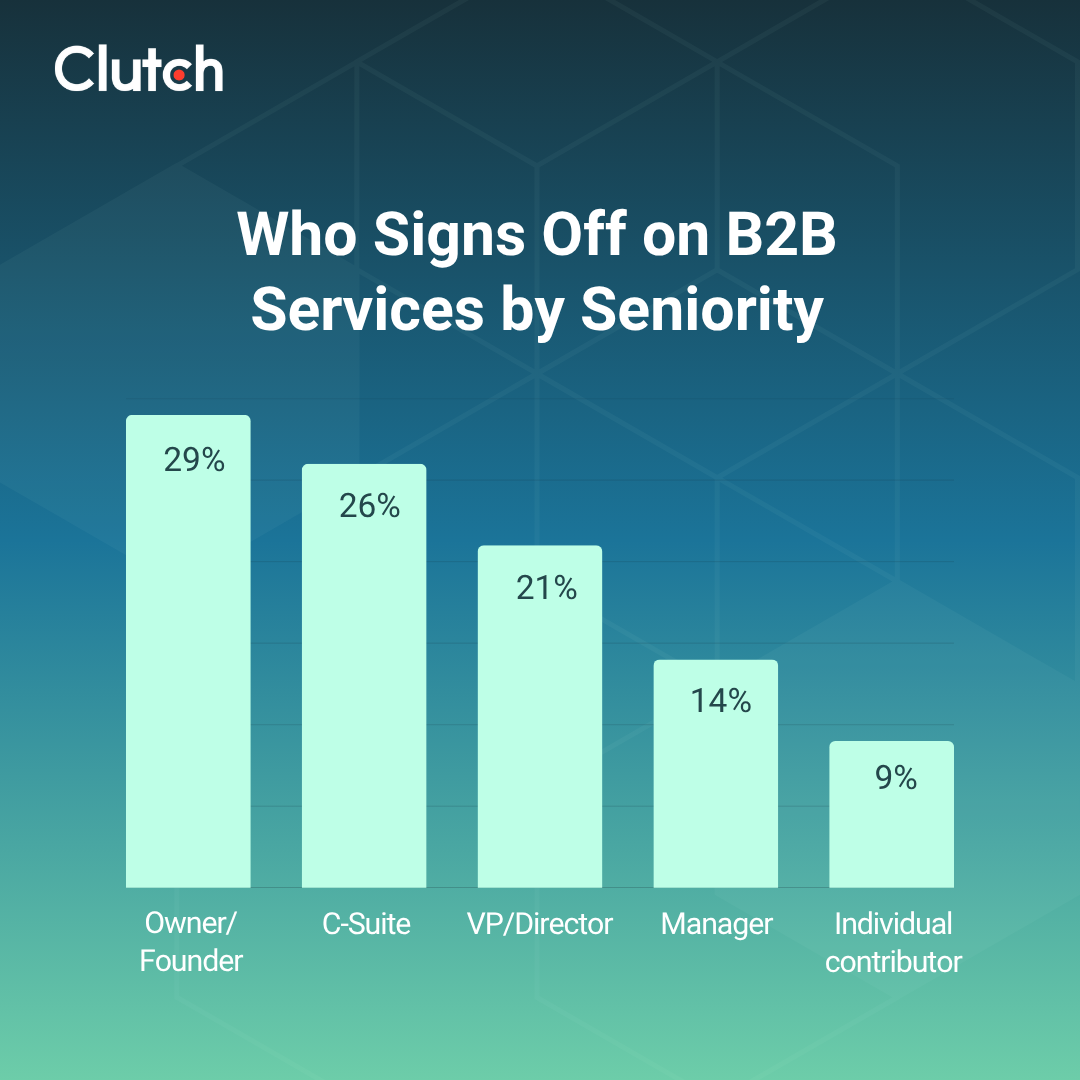
However, the decision-maker changes as companies grow. At businesses with 1 to 10 employees, owners and founders accounted for 46% of reviewers, while C-suite executives accounted for another 30%. Together, roughly three-quarters of reviewers at the smallest companies also lead the company.
In contrast, owners’ share fell to 21% in companies with 11 to 50 employees, while the share of VPs and directors rose to 24%.

That pattern continues as companies grow. At companies with 51 to 200 employees, VPs and directors become the largest group of reviewers at 36%, rising to 40% at companies with 201 to 1,000 employees. At companies with more than 1,000 employees, managers take the lead at 38%, while owners and C-suite executives together make up just 7%.
A company’s size can change who evaluates your services, what they need, and who controls the budget. Tailor your outreach, proposals, and case studies to those differences. At companies with fewer than 50 employees, the reviewer is usually the budget holder, but that changes as companies scale. Above 200 employees, the reviewer is more often a director or manager leading the project who needs to make the case to someone else.
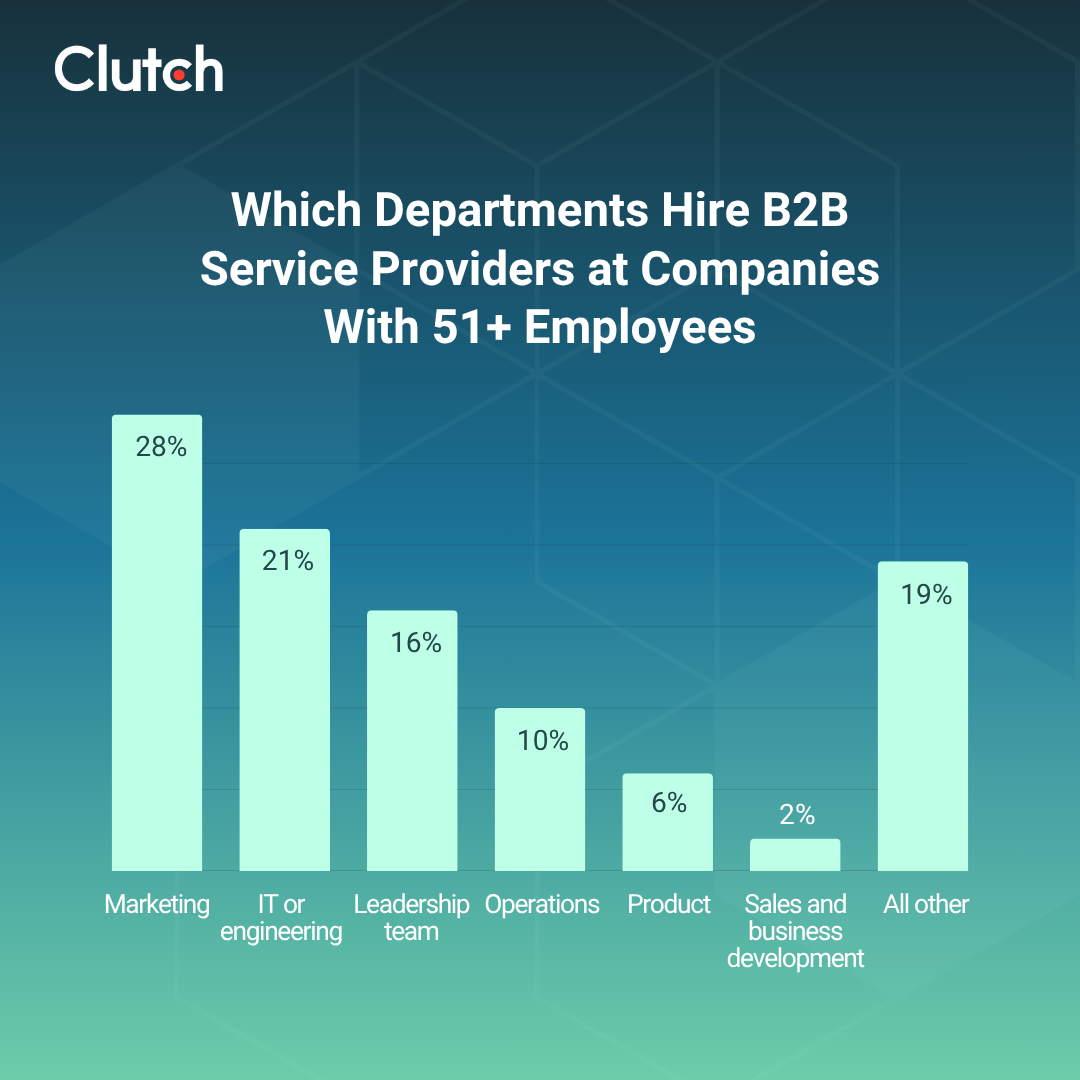
Across all reviews, leadership teams account for 51% of all reviewers, far more than marketing (12%) or IT and engineering (11%). However, these numbers are heavily skewed by small businesses, where executives often handle provider selection. At companies with 51 or more employees, executive leadership drops to 16% of reviewers.
For service providers, knowing which departments lead purchases at larger companies makes it easier to target the right buyers with bigger budgets. At companies with 51 or more employees, marketing (28%) and IT/engineering (21%) teams are driving buying decisions.
The reviewer is usually the project owner, but is not the only voice in the decision-making process. Many companies rely on a committee to make B2B purchase decisions, usually with 6 to 10 stakeholders. This means that a marketing director hiring a web developer likely still needs sign-off from IT, finance, or leadership.
This means service providers should be targeting founders or CEOs at small companies. However, when reaching out to companies with more than 50 employees, they should pitch to the department that owns the project while still preparing materials for other stakeholders who will likely weigh in.
The department leading the search depends on the service a company needs, so how B2B companies pitch their services should change. In the sections below, we compare each service line by its leading seniority tier, department, and most common job titles, along with one standout finding.
Naturally, software development buyers are the most technically focused of the three service lines. C-suite executives and presidents are the most common reviewers, making up 32%. That leadership presence is especially strong at smaller companies, where CEOs account for 23% of software development reviewers, the highest share for that title across the data.
As companies grow, technical expertise becomes a bigger part of the buying decision, while decision-making remains at the C-suite level. At companies with 51 to 200 employees, CTOs are the most common reviewers at 7%, and engineering and technology accounts for the largest share of reviewers at 24%. At companies with 201 to 1,000 employees, 28% of reviewers work in engineering or technology.
That’s a notable difference from service lines such as digital marketing, where buying decisions more often sit with directors and managers. In software development, the CTO can remain a key decision-maker while also bringing technical expertise to the choice.
The takeaway for providers is to lead with business outcomes when speaking to smaller companies, where CEOs and founders often drive the decision. As companies grow, bring technical depth to the conversation. A CTO may be evaluating both whether the solution fits the business and whether it will work technically.
Web development has the most small-business buyers of any service line in our data. Half of web development reviews (51%) come from companies with 1 to 10 employees, compared with 42% for software development and 39% for digital marketing.
Because of that, owners do most of the hiring. Owners, founders, and partners make up 31% of web development reviewers, followed by C-suite executives at 24%. More than half of reviewers (52%) sit in executive leadership.
Outside the executive suite, marketing departments hire web developers more often than technical teams do. Marketing makes up 13% of web development reviewers, compared with 9% for engineering and IT.
Marketing may be leading these projects because a website directly supports its work to attract, engage, and convert customers. At the same time, companies with robust technical teams may rely on their in-house teams to make changes to their websites and therefore need to hire web developers less often.
That gap widens as companies grow. Marketing becomes the top department at companies with 51 to 200 employees (32%), led by directors of marketing and marketing managers. It stays on top at companies with 201 to 1,000 employees (35%) and more than 1,000 employees (30%).
For web development providers, the buyer is usually an owner or a marketer. To target them effectively, lead with business outcomes like leads, conversions, and brand credibility, and save the technical specs for later conversations with IT.
Leadership teams hold the most buying power for digital marketing services as well, making up 48% of digital marketing reviews, followed by marketing teams (28%).
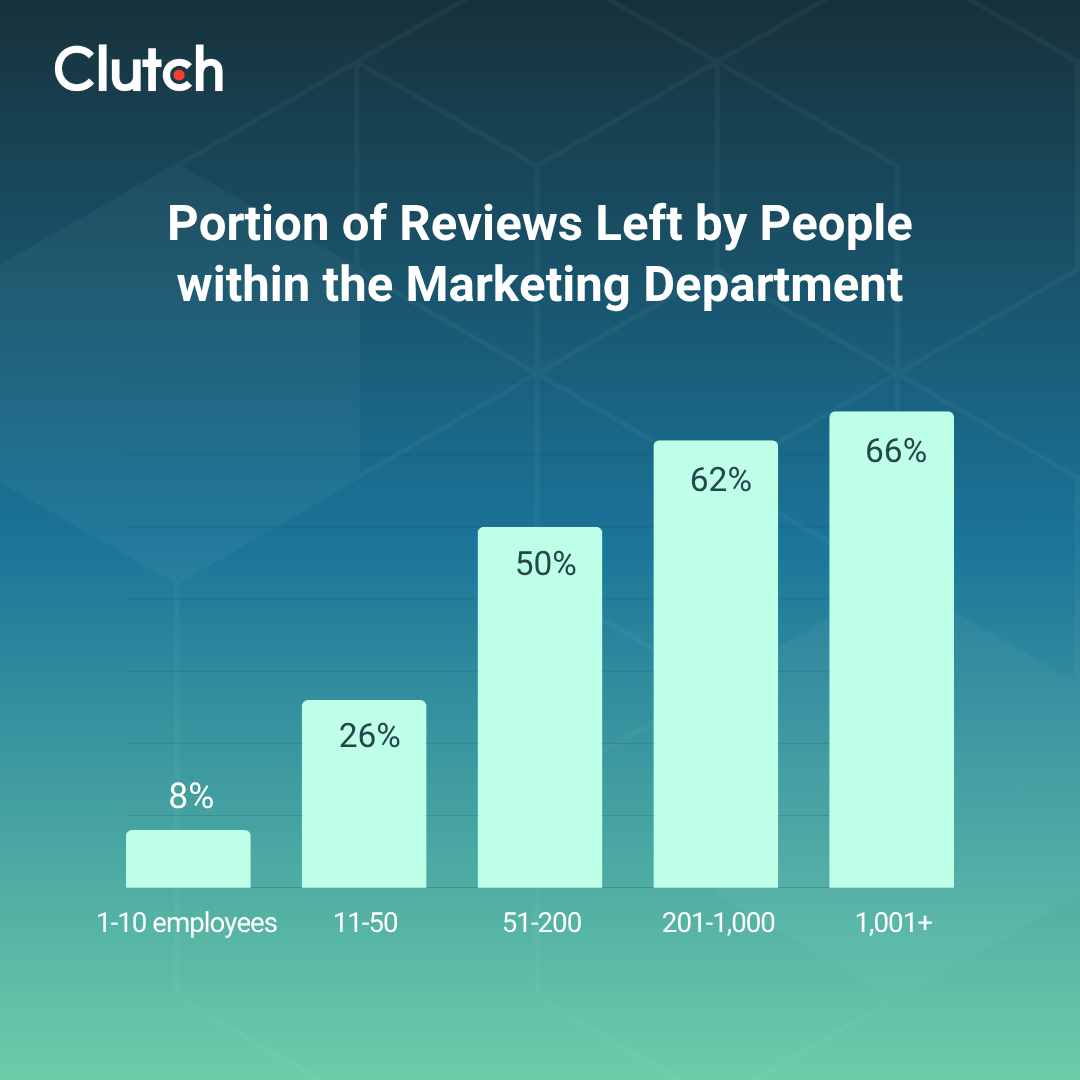
But company size makes a big difference over who actually manages the project. At businesses with 1-10 employees, only 8% of reviews work within the marketing department. That share climbs to 66% of companies with more than 1,000 employees.
More importantly, the most common job titles move down the organization chart as companies grow. Owners lead at the smallest companies (22%), and CEOs take over at companies with 11 to 50 employees (12%). Notably, though, directors of marketing become the most common title at companies with 11 to 50 employees (9%) and companies with 201 to 1,000 employees (11%). Their seniority is even lower at companies with 1,000+ employees, and most are marketing managers (6%).
That means that digital marketing buyers have the most mid-level buyers of the three service lines we examined. For providers, that means pitching to what marketing leaders report on. You should tie your work to the results they’re measured on, such as leads, conversions, and revenue.
| Service line | Reviews Analyzed | Top seniority tier | Owner + C-suite | VP + Director | Top dept (after exec leadership) | #1 title | #1 title at 51+ employees |
| Custom Software Development | 6,475 | C-suite (32%) | 57% | 20% | Engineering & Tech (16%) | CEO (15%) | CTO |
| Web Development | 13,564 | Owner / Founder (31%) | 55% | 10% | Marketing (13.0%) | CEO (12%) | Director of Marketing |
| Digital Marketing | 3,307 | Owner / Founder (27%) | 49% | 25% | Marketing (28%) | Owner (12%) | Director of Marketing |
Your messaging should depend on who you’re trying to reach. The better you understand the people who actually hire providers, the more precisely you can shape your outreach, case studies, and sales materials.
Knowing that owners and C-suite executives make up 55% of reviewers overall, VPs, directors, and managers become more common at companies with 51 or more employees, you can tailor your message to the buyer’s actual role, not the title you assume is making the decision.
To do this, make your case studies speak to the people evaluating the work. For web development and digital marketing, show marketers at mid-size and larger companies how your work supports their goals. For software development, highlight results that matter to CTOs and engineering leaders.
If you offer several services, give each one its own sales story. Software buyers tend to be more technical and senior. At larger companies, digital marketing buyers are more often marketing directors or managers.
Then back up your pitch with proof. Feature Clutch reviews from clients with titles and responsibilities similar to your prospective buyers. That helps them see how your work could solve problems they recognize.
The better you understand who hires providers, the easier it is to shape your outreach around the people making the decision. Clutch review data offers a useful starting point, but your own client reviews can reveal which titles, departments, and company sizes are most likely to choose your services.
Track who reviews your work on your Clutch profile and use those insights to sharpen your targeting, strengthen your case studies, and give future buyers proof that speaks to them.
Clutch analyzed 23,346 verified reviews submitted between January and October 2026 across 3 main service lines: digital marketing, software development, and web development.