Lead Quality vs. Lead Quantity: Why B2B Teams Are Rethinking Their Funnel in 2026
Bigger buying committees and tighter budgets are forcing B2B teams to rethink lead quality vs. quantity. Here's how top teams rebalance the tradeoff in 2026.
Updated June 26, 2026

A website portfolio is a dedicated section of your agency's website — or a standalone site — that showcases completed projects, case studies, and measurable client outcomes. For B2B agencies, it's not just a showcase; it's a lead generation tool that works around the clock.
A well-crafted portfolio differentiates your agency at the exact moment B2B buyers are comparing you to competitors. Following best practices can improve online visibility and cultivate credibility to capture the interest of B2B clients.
A website portfolio is an organized, publicly accessible collection of your agency's best work — published online so potential clients can evaluate your capabilities before making contact. Unlike a homepage or a capabilities deck, a portfolio goes deep: it shows specific deliverables, real client names (where permitted), industries served, and measurable outcomes.
Looking for a Digital Marketing agency?
Compare our list of top Digital Marketing companies near you
The term applies to individual creatives and agencies alike, but the stakes are especially high in B2B. When a business is evaluating agencies for a significant engagement, they want proof — not promises.
A strong agency portfolio typically includes:
Source: Marketing Desk
For a more effective content strategy, aim to position your agency as uniquely equipped to solve B2B consumers’ problems.
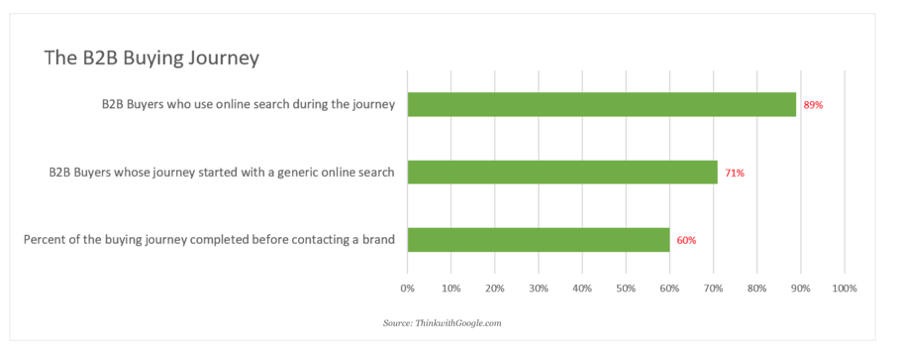
Consider a few statistics on B2B buyer behavior:
As you plan your next outreach strategy, think about how these insights apply to your efforts in the past. Accounting for B2B buyers’ needs and preferences will help you incorporate best-practice techniques that position your brand as a valuable and reliable service.
Rethinking your approach can make your portfolio one of the most powerful lead conversion tools in your marketing arsenal.
As you plan your new strategy to structure past projects, keep the following outcomes in mind to target.
B2B clients usually have key criteria in mind for an agency to hire for projects and services. Most look for quantifiable proof that you can deliver on or exceed their desired outcomes.
Nothing serves as solid proof of your capabilities and credentials like a portfolio with a full range of projects. Use your portfolio to solidify your reputation as a reliable and highly skilled vendor.
A great portfolio is more than a laundry list of campaigns. How your deliverables have grown and evolved is just as notable.
Alongside websites and brands that have come to life under your agency’s wings, showcase your team’s diverse talents and technical skill sets, scalability, and design prowess.
Whether you’re just starting to set up your portfolio or need to revisit an existing one that could use a little upgrade or revamp, here are a few things to consider when curating and showcasing your best work:
Before clients can hire you, they have to find you first.
Buyers look for products and services using specific keywords such as “web design agency for manufacturers,” so you want to be at the top of those search results.
A project portfolio full of relevant content and examples will create visibility and establish a rock-solid reputation for your agency.
According to Search Engine Land: “[T]he best content marketing option for small and local businesses is the creation of portfolio content that widens the search terms you will be found for and demonstrates your credibility in completing jobs for your local customers. When executed well, your portfolio content [… will] attract more local search engine users while simultaneously demonstrating your credibility for an SEO and marketing win-win.”
Providing a deep explanation of your projects, including industry vertical, type, and geographic location will increase your chances of being found when a client is targeting those search terms. Customers looking for a creative firm that specializes in biotechnology might type in the search term “creative agencies for biotech in Houston.” If that’s you, specific content about your projects in biotech will improve your ranking for those keywords.
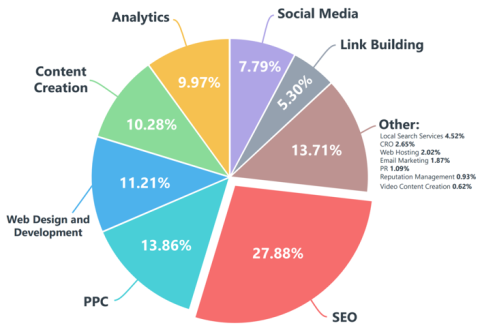
The graph below breaks down the most sought-after skill sets on the market. Which ones apply to you? Include relevant search terms that elevate your web presence as a market leader in one of these industry niches.
Source: Advanced Web Ranking, 2017
For example, professional SEO services are requested by almost 30% of all B2B consumers.
Keywords and other inbound marketing tactics might get prospects to your door, but the quality of your portfolio will ultimately convince them to cross the threshold and choose you over competitors.
When buyers can see your projects match their criteria for a vendor with specific experience, you know that a lead is going to be more qualified by the time they contact you.
In fact, once a B2B buyer reaches out and engages with your website, they’re already more than halfway through their buying journey. At this point, the sale is basically yours to lose.
Since most consumers have done their due diligence in spades before reaching out, hitting them with a hard sell or generic sales pitch is a waste of their already-limited time. Irrelevant marketing is a proven way to encourage them to move along and keep looking.
Cut to the chase with a targeted portfolio. When clients see you’ve done the types of projects and deliverables they’re looking for, they’ll know they’ve found the right partner.
If you’re struggling to find content to promote your products and services, use examples and case studies from your portfolio to create relevant and actionable content that matches your target audience’s needs.
Quotes, pain points, ROI rates, and testimonials can all power social media, blog posts, videos, and podcasts. Your portfolio contains countless digital assets to attract the ideal customers to your brand.
According to Salesforce: “B2B buyers are more empowered and informed and have higher expectations than ever before, and traditional sales strategies will continue to decline in effectiveness.”
Buyers want to feel comfortable with and informed about the companies they consider hiring. A plain, simple overview of who you are and what you do just doesn’t cut it anymore. In-depth case studies, examples and content will put consumers at ease with your agency when they’re making a sales decision.
Use your portfolio to cut through the noise on the internet. As the saying goes, show potential buyers your strengths and abilities instead of “telling” them.
Last but not least, make sure your portfolio aligns with your brand goals.
To brand yourself as the best digital agency for inbound marketing, center your portfolio around past projects that prove that you can deliver in this niche.
Use the power of your portfolio to boost your brand. You’ll close deals more decisively than a generic and vague sales pitch ever could.
The ideal portfolio showcases your best work and tells a compelling story that differentiates your agency from the competition.
As you look over your portfolio with fresh eyes and a new perspective, show prospective B2B buyers how your products and services are uniquely positioned and equipped to address their pain points, solve a specific problem, and deliver a significant return on their investment.
A website portfolio is a dedicated section of an agency's or professional's website that showcases completed projects, client outcomes, and work samples. It serves as publicly accessible proof of capabilities, allowing potential clients to evaluate your work before making contact. For B2B agencies, it functions as an always-on lead generation tool.
A regular website explains who you are and what you offer. A portfolio website goes further by showing what you've actually delivered — with specific projects, measurable results, and client testimonials. For agencies, the portfolio is often the most persuasive part of the site because it replaces claims with evidence.
A strong agency portfolio includes case studies with quantified results, industry tags, testimonials tied to specific projects, team and capability context, and a range of project types. The goal is to give B2B buyers enough evidence to self-qualify before they reach out.
Yes — and the research bears this out. B2B buyers conduct extensive research before contacting any vendor, and most are well into their decision process by the time they reach out. A portfolio is often the deciding factor between your agency and a competitor. Without one, you're asking buyers to take your word for it.