
12 Years With Clutch: How Intuz Builds on a Partnership That Delivers
A Relationship That Has Stood the Test of Time Intuz is an AI consulting and development company established in 2008, with operations in Silicon Valley...
Updated February 4, 2026

Wearable technology continues to shape consumer health, as more people rely on these devices. In 2026, consumer expectations for wearable devices are evolving from basic fitness monitoring to more robust personalized health intelligence. This has important implications for manufacturers, developers, and anyone interested in purchasing a new wearable.
Emerging technology is driving this shift. AI and machine learning generate more predictive insights than earlier models to help with:
At the same time, consumers today are more aware and concerned than ever about how their wearables collect and use data. This sets up an important tension shaping the industry: balancing innovation against trust, with accuracy, battery life, and data privacy all playing central roles. Here's a closer look at the top wearable technology trends shaping the market in 2026.
Search for wearable app developers on Clutch.
Despite emerging technology and rapid innovation, health tracking remains the main reason consumers use wearable technology today. According to a survey of 379 wearable tech users, 64% own wearables mainly to track steps and workouts, reinforcing the product’s primary role as a daily fitness companion.
Beyond activity metrics, people also use their devices to monitor biometrics like heart rate data (52%) and sleep patterns (45%). These health insights allow users to adjust their behaviors in real time, whether that means increasing training intensity, improving recovery, or going to bed a little earlier.
The survey also reveals an expansion into holistic wellness. For example, 22% of respondents now use their wearables for stress and mood tracking, while 18% use them to track nutrition data. Although still secondary to activity tracking, these features and their adoption reflect a growing demand for health visibility that extends beyond fitness alone.
Users expect wearable technology to support both their physical performance and overall well-being. The core value proposition remains health intelligence that’s accurate, relevant to everyday life, and easy to act on.
For manufacturers, this signals that long-term adoption depends on trust in the fundamentals. New features only matter if people believe the data behind them and feel confident relying on it.
AI-powered features are becoming more common across wearable platforms, but real-world adoption is still limited. According to the Clutch survey, just 11% of users say they regularly look for personalized insights or recommendations, which is generally driven by AI. This suggests a sizable gap between technological capability and real-world impact.
In many cases, AI insights feel disconnected from the user’s daily routine. Recommendations may be vague, overly technical, or difficult to act on, which makes people less likely to rely on them day to day.
Users show more interest in structured guidance, as 15% of respondents regularly use goal-setting and progress-reporting features. This suggests developers should focus on integrating AI that doesn’t just surface patterns but also explains why they matter and how to act on them.
Social and community-driven features remain largely untapped. Just 6% of users participate in community challenges, which reinforces the idea that wearables are still mainly personal tools.
Though developers and manufacturers are rapidly adding AI features to wearables, the data shows consumer use still lags behind. Adoption, then, is less about adding novel features and more about aligning AI-powered insights with actionable takeaways.
Health insights may be the primary driver of wearable adoption, but consumers still value utility features that support everyday life. In fact, 38% of users rely on their wearable devices for calls, texts, and app notifications. These features make wearables more broadly useful, increasing the potential for engagement and retention.
Location-based features play an important role here, with 19% of users relying on their wearable for GPS and route mapping. This is especially common for outdoor and endurance athletes who train over large geographic areas.
Customization reinforces daily engagement further, with 19% of users regularly adjusting device settings and personalization options. This signals a meaningful desire for control and flexibility in how data is presented and alerts are delivered.
Taken together, these behaviors help to explain why wearables are seeing such consistent usage from their owners. In fact, only 3% of users report rarely using their wearable app. This shows that once a device becomes part of someone’s daily workflow, it can form a habit quickly.
While consumers may purchase wearables for health insights, utility features expand their use case. Notifications, GPS, and customization deepen reliance, embedding the device into daily routines instead of limiting its use to fitness or sleep.
For manufacturers, it’s another sign that wearables should support real-life workflows. The more useful these features are, the more seamlessly the device fits into existing routines — a key step in habit formation and repeat business.
Wearable users primarily value reliability and seamless integration with daily life. They don’t care as much about accessing the latest features as they do about finding a wearable that can fit into their routine and make life easier.
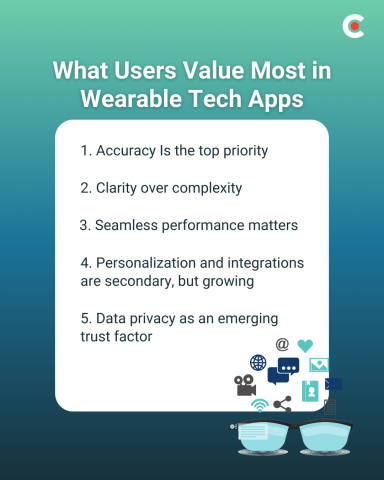
28% of users say receiving accurate and timely data is their most important factor in choosing a wearable. When health and activity metrics feel inconsistent or unreliable, users are far less likely to use them consistently.
Another major segment of users (25%) says easy-to-understand dashboards are their top priority in a wearable. This highlights a growing challenge: As devices collect more data points, the risk of overwhelming users with unnecessary complexity increases.
The most effective apps simplify complex data with clear visuals and high-level summaries, providing actionable takeaways. People often value streamlined insights over maximum information.
Another 13% of respondents prioritize seamless syncing between devices like smartphones, health apps, and other connected platforms. When data syncing is slow or unreliable, it breaks the user experience and undermines trust in the ecosystem as a whole.
Personalization recommendations (7%) and integration with other apps (8%) rank lower than other core performance factors. Still, their presence shows a growing expectation for wearable adaptability.
However, just 2% of users rate design aesthetics as their top priority in a wearable platform. This indicates that most people are willing to trade visual flair for other key benefits, such as reliability and clarity.
Finally, 7% of users list privacy controls as their top priority. This number could continue to grow as awareness around data privacy continues to increase.
Trust is a major factor in long-term adoption, as 87% of consumers are willing to pay more for products from brands they trust. Advanced features have a role to play in building trust, but only when the underlying systems feel reliable and transparent. For wearable manufacturers in 2026, accuracy, battery life, and data privacy shape trust more than any others.
Accuracy is the foundation of every health decision a user makes. When metrics feel inconsistent, users lose confidence in wearable insights, which makes them less likely to continue engaging with the device moving forward.
Battery life is also crucial. Devices that require frequent charging interrupt data collection and break behavioral patterns that users come to rely on. Longer battery life helps a wearable to function as an always-on tool rather than an occasional accessory, making it significantly more practical for daily use.
Finally, data privacy is growing into a baseline expectation. It may not rank as the top priority for most users, but it has a direct impact on brand trust. Any wearable company or app that wants to gain market share will need to account for this — especially as devices collect more personal health and behavioral data than ever before.
Increasingly, users want clarity around how their information is being stored, shared, and protected. Transparent privacy controls, opt-ins, and responsible data practices all have a role to play in maintaining trust and building long-term loyalty.
These trust-defining factors have a variety of implications for product strategy. For example, the consumer emphasis on data reliability signals that companies should focus more on strengthening the quality of existing features before adding new ones. New capabilities only add value when users already trust the brand to share accurate data.
AI-powered insights also need to translate into more actionable takeaways. Instead of presenting recommendations, platforms should explain how conclusions are reached and why they matter to encourage engagement.
Finally, user experience design should prioritize clarity over complexity. Simpler dashboards that help users understand their data quickly will outperform those that overwhelm with detail, in most scenarios.
Wearables are becoming a more foundational piece of many people’s everyday routines. As the technology continues to improve, consumers remain most interested in brands that nail the basics. The most successful platforms in 2026 will be those that deliver meaningful health insights consistently and earn user trust over time through accuracy, reliability, and privacy.