
12 Years With Clutch: How Intuz Builds on a Partnership That Delivers
A Relationship That Has Stood the Test of Time Intuz is an AI consulting and development company established in 2008, with operations in Silicon Valley...
Updated September 8, 2025

Many traditional companies are facing considerable challenges right now. Things that worked five or ten years ago — paper-based processes, legacy software, manual tracking — turned into huge weaknesses of your business in 2025. Customers expect faster service. Teams need better tools. The gap between “old ways” and modern systems is growing very fast.
Can you imagine that 78% of businesses are already using AI in at least one part of their work? That means if your company hasn’t started making changes, your business is under considerable threat.
In this article, we’ll discuss what makes digital transformation urgent, what’s actually working for companies right now, and how to determine whether your business is ready to make the shift. We’ll also share lessons we’ve learned at Empat while helping traditional industries move forward.
For many companies in industries like healthcare, finance, retail, and education, 2025 feels like a very complicated year to keep up. Not because they lack experience or ideas, but because the systems they’ve used for years are becoming outdated.
Processes that used to work are no longer effective. Manual reporting, endless spreadsheets, and approvals that take days — these are the reasons that cause delays and frustrated teams.
Old software is also a major obstacle. Many businesses are still using legacy systems that can’t connect with innovative tools or support effective remote work. Small updates may take weeks. Trying to add something new means ruining the whole system. Does it sound familiar?
At the same time, customers expect more and better. In 2025, consumers want online access, quick answers, and excellent service. They’re comparing every experience to leading companies like Amazon or Google, even if you’re a local clinic or a regional bank.
Hiring has become another challenge. If you work with outdated tools and technologies, you have no chance of hiring or keeping tech-skilled professionals. They feel bored doing repetitive work or using slow systems.
Meanwhile, your competitors aren’t standing still. Many companies are already utilizing automation and artificial intelligence to accelerate their operations, reduce costs, and deliver greater value to their customers. If you haven’t started launching digital tools, innovative technologies, or AI yet, it might already feel like you’re losing the game.
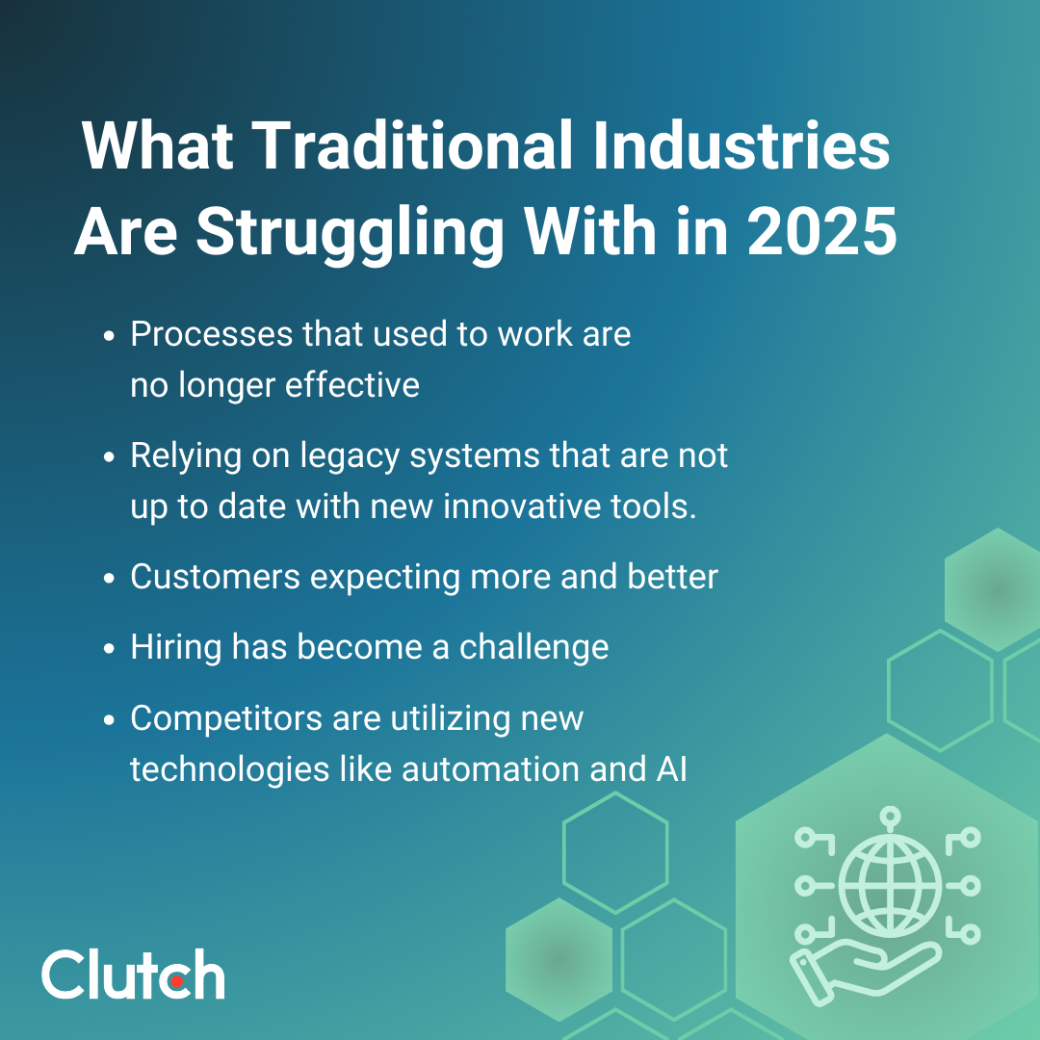
This list of challenges is not meant to scare you, but to outline the bottlenecks you may miss when working in a traditional industry.
Once we’ve discussed what to watch out for, we also have a list of big improvements that may help you succeed in your business. Here are a few digital changes that are really working in 2025.
AI is no longer a future trend. The majority of companies are using artificial intelligence to work smarter and faster. You may personalize customers’ online experience, predict when something might go wrong, or analyze data with it. Anyway, AI tools can make routine work for you and save time for faster and data-based decision-making.
Many companies are finally saying goodbye to paperwork, spreadsheets, and long email chains. Instead, they’re using automation tools to cope with routine work, such as data entry, invoice processing, performance tracking, analysis, and reporting.
An increasing number of businesses are moving away from on-premise software to cloud platforms. Why? Cloud systems are easier to update, simpler to manage, and faster to scale. At the same time, they don’t require big upfront costs.
You don’t need a huge development team to build useful tools anymore. Innovative platforms like Glide or Bubble let non-tech teams prototype apps or workflows in days, saving time and money on development.
We’ve seen traditional companies use no-code tools to test new ideas, build internal dashboards, or create simple portals for clients. All these can be done without writing any code.
As tech moves fast, so do customer expectations. What felt good two years ago can feel like poor service today. People want more convenience.
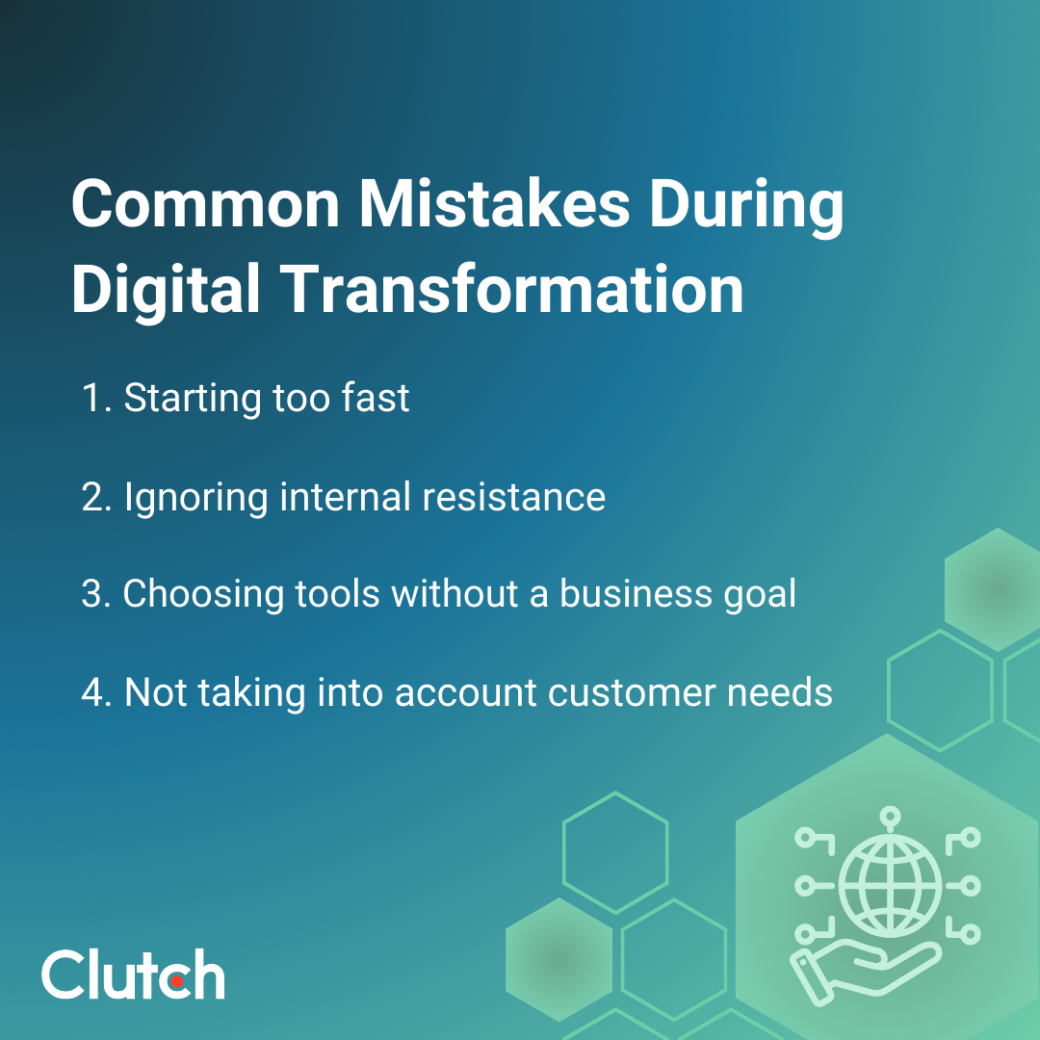
Many companies start their digital transformation with large and ambitious initiatives without a clear and focused plan. Such an approach can lead to wasted efforts, budget drains, and initiatives that never reach success. We recommend starting small with a well-defined plan that allows teams to test, learn, and scale effectively.
Digital tools or technologies alone cannot drive transformation. People can. In case you don’t describe the reasons and concerns to employees, the whole process may fail. If your team doesn’t understand or believe in the change, even the best solutions have no chance to succeed.
Implementing new technologies without adapting them to specific business outcomes is pointless. Technology needs to support strategy, not the other way around.
You cannot focus your transformation efforts only on internal efficiencies. The most successful companies use customer pain points and expectations as a starting point for innovation and digital improvements.
Consider and try to avoid these mistakes in your path of digital transformation. Knowing the bottlenecks of this complicated and risky process will help you succeed.
Modernization and digitalization are no longer optional for traditional businesses. It’s essential for any business that targets growth and long-term success to keep up with new trends and launch technologies into existing business processes. Today, only the companies that adapt to changes, implement technology, and focus on delivering more value to their customers can stay competitive and successful.
Are you thinking about taking the first step toward transforming your business? Start with a discovery call with the Empat team to explore what’s possible.