
How to Use Claude Code if You're Not a Developer
Learn how to use Claude Code to build your own AI agents without a coding background, including setup, first steps, and safety tips backed by Clutch data.
Updated October 9, 2026

Navigating the market and looking for the ideal service provider feels like a project in itself. The unpleasant feeling of opening numerous browser tabs, looking through piles of documents, and exploring countless reviews — all to end up without the right match.
Often, research isn’t the bottleneck, but rather the project brief itself.
Simply put, a clear project brief can speed up the process. Providing vague project briefs to potential agencies will give you mismatched pitches.
Aligning with potential agencies will be tougher if they don’t have the same context as you do. Expecting them to piece together what your project needs creates the problem, making it harder to match with the correct team.
Spare yourself the hassle of tab-hopping by preparing clear, insightful project briefs. This article details what you should include in your agency project brief to help vendors understand your project from the get-go.
Project briefs are short, informative documents that define a project’s requirements, objectives, scope, timeline, and key responsibilities. It explains what the agency needs to do or provides enough information for them to assess whether they can help.
It’s an introduction. A starting point for your project.
Clutch’s Project Brief is a guided tool that helps you define your business challenge and project requirements by answering a few guided questions. The Project Brief goes further by guiding you through the entire process of defining and sharing your project. Essentially, it’s dedicated to:
Naturally, briefs shouldn’t be unnecessarily long. They don’t need to be 15-page documents. And they certainly don’t have to contain every detail of your project, but they have to answer every vital question to guide vendors’ pitches.
The goal is to provide enough crucial information for an agency so they’ll have the best opportunity to assess your project and determine whether their expertise fits your needs.
Think of it as hiring someone for your team and asking them to perform a task right away without explanation. You can’t expect them to get it done correctly right away in that case. It’s important to give clear context for why the task matters, what it is, and who it’s for, and what success looks like.
Vague briefs lead to vague matches. Yes, you’d want to hear back and receive pitches from as many vendors as possible, but the quality of pitches is what matters most. Writing an insightful project brief will help get worthy responses from agencies that actually make sense for your project.
Finding out what information to include and what’s unnecessary may be puzzling at first, but the general rule is to answer these five questions that agencies may have in mind.
Here are five crucial details you need to share to help service providers understand your project.
You can add more details as you see fit, but these five points are paramount to giving service providers a valuable starting point.
Arguably, the most important question that will serve as the foundation for the project itself: what are you trying to accomplish?
Answering this question will give agencies a clear view of what success looks like for you, them, and the project. Don’t just list your targets; provide vital context, such as why you are working on this project and what data or feedback led to it.
Let’s say you’re a marketing manager looking for a web redesign for your business. You don’t simply say:
“We need web design services”
That can’t paint an intelligible picture for the agency. Describe the problem transparently to add more context. So instead, try framing your goal like:
“We’re a [what you do], and we need help with [the problem], because [why now]. Success looks like [outcome + metric] within [timeframe].”
While there’s no exact formula for how to describe your goals, since every project has unique and different ones, this structure should help you best articulate them. Narrow down the information so the vendor knows what they’re walking into.
What’s not working with your current web design? Do you need other services along with web design?
Give the vendor what they need to understand your goals.
The biggest advantage you gain from knowing how to describe your goal is that you get to face fewer introductory calls, mismatched pitches, and unfit matches.
Once you know how to outline your goals, it’ll be easier to answer the rest of the points you need to include in your project brief — type of help, location, company context, and budget.
After explaining your project’s purpose, the next thing to do is to define what you need from the agency.
Don’t just answer this question ambiguously. Don’t just say “video production”; rather, specify what type — is it an explainer or a full-length product video? Or do you need more than one? Don’t spare key details.
And if you’re not sure which particular services you need, describing the problem is the best way to help agencies examine it and offer recommendations. Ultimately, project briefs should present enough detail to help them decide whether their expertise fits your needs.
Location matters when running projects, and your project brief should clarify where you want the provider to be based.
For projects that require local expertise, a provider based in that city, region, or country could provide invaluable insights and experience. Moreover, you should indicate whether you’re open to working remotely and clarify the arrangement requirements for meetings and time zones.
The next question to answer is who the agency will work for and with.
While you don’t need to give them your company’s entire backstory, it’s important to let them know about the following:
You can also mention other details that could impact the project, such as whether you have an internal team working on it and who they’ll be working with.
Lastly, project briefs should also include the budget; while you don’t need to provide exact figures, be upfront about the cost range.
This lets the agency know if it fits their pricing, and allows them to suggest appropriate approaches or phasing for your scope.
Perfecting project briefs in one go isn’t easy, but here are four common mistakes that can make it harder to match with the right service provider.
This circles back to being precise. Telling the vendor what you want without letting them know what they're trying to accomplish will make it difficult to picture where the project is heading.
Ambiguity leaves a lot of room for interpretation, and it’ll be impossible to pitch precisely.
Timelines are important to strategically establish a sense of scale and urgency. Specifying the numbers and expected deadlines helps the agency to determine whether their team has the capacity to help you within them.
Perhaps the most frequent mistake made that leads to misaligned pitches is leaving the budget field blank. It may feel like the safer route; let them set the budget and see for yourself if it fits your limitations, but it doesn’t work that way.
Keeping your price range hidden makes it difficult to align with agencies. As emphasized above, you don’t need to give the precise figures, but make sure they know what you can realistically invest.
Being specific about the scope prevents misunderstanding. More often than not, it’s quite tempting to put everything you might need into the brief, especially as you see agencies offering a plethora of services.
However, if you throw everything in the kitchen sink, how else would the agency know what the core problem is? Prioritize what you need. It’s not about making your project seem simpler but rather easier to grasp.
Avoid tab-hopping by leveraging Clutch’s free project brief template. This step-by-step fillable project brief template can help you outline your project and get matched with the right provider.
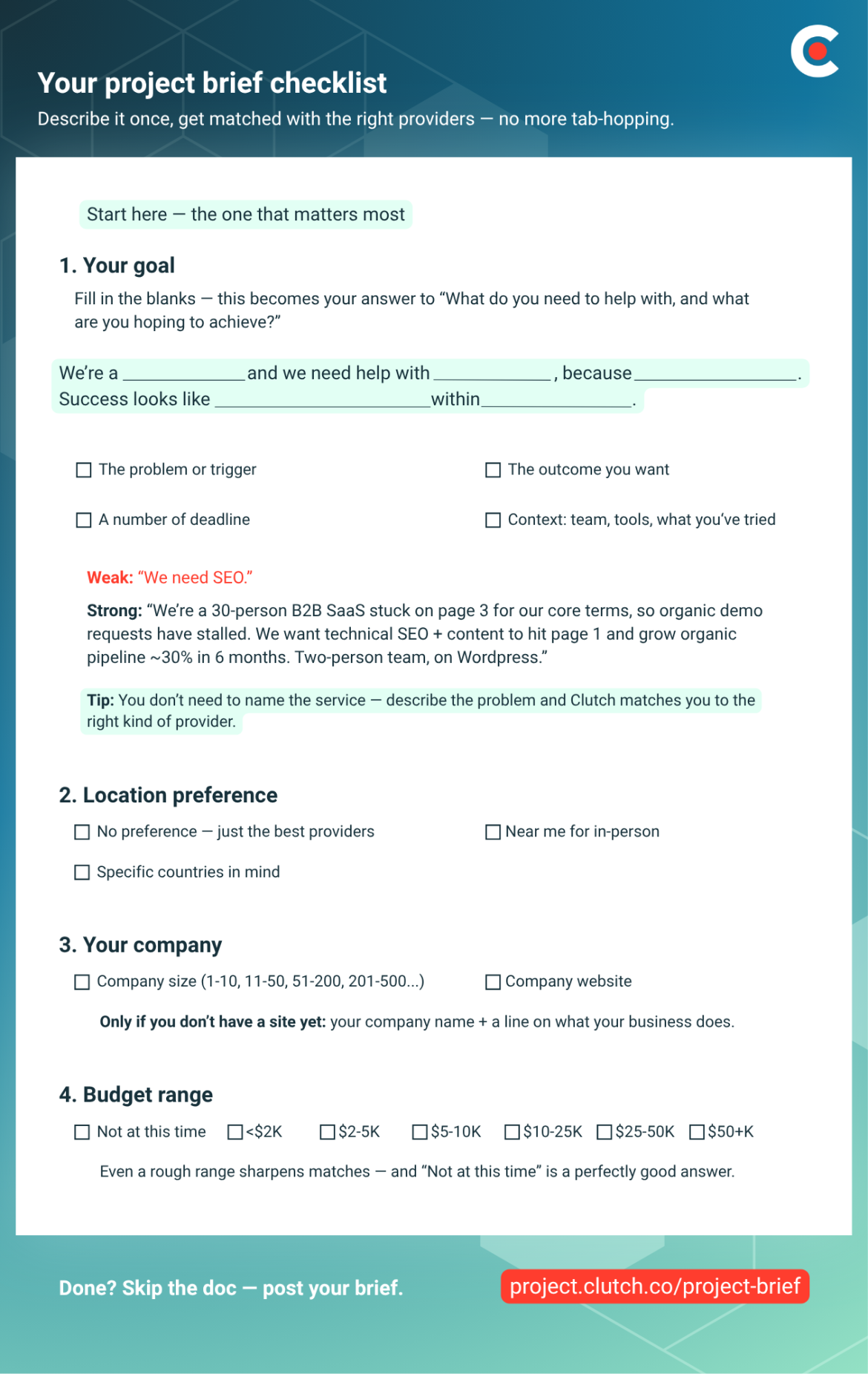
Take advantage of Clutch’s Project Brief tool. It’s an AI-powered guided tool that’s designed to help you submit a clear, detailed plan that helps ensure stronger matches and more productive conversations with providers.
Project briefs, at the end of the day, aren't meant to replace discussions and interviews with potential service providers. They are meant as overviews that should spark productive conversations.
By providing the right information, you save time and effort combing through profiles and checking misaligned pitches. Put the insights you’ve gained from this piece into action and maximize Clutch’s project brief to get matched with vetted providers in minutes.