Lead Quality vs. Lead Quantity: Why B2B Teams Are Rethinking Their Funnel in 2026
Bigger buying committees and tighter budgets are forcing B2B teams to rethink lead quality vs. quantity. Here's how top teams rebalance the tradeoff in 2026.
Updated May 29, 2026

Outsourcing lead gen sounds like a shortcut to growth, until it drains your time, budget, and sanity.
Here’s the hard truth: 20 to 25% of all outsourcing relationships fail within two years, and 50% fail within five.
After:
Looking for a Digital Marketing agency?
Compare our list of top Digital Marketing companies near you
Around 60% of the companies that reach out to us come disappointed and cautious, expecting more of the same.
Some lost money. Some lost time. Some just lost faith in the whole idea.
But here’s the kicker — it’s rarely the model that fails. It’s the execution.
And that’s why we’re here.
I’m giving you a roadmap for avoiding the traps that cause most outsourced lead generation partnerships to crash and burn — so you can skip the regret phase and go straight to the results phase.
Before launch, you should be crystal clear on:
If you’re not asking these questions, you’re basically buying a mystery box — and hoping for gold instead of a pile of junk.
Examples:
Check out these few ideas on how to identify if your future partner is worth it:
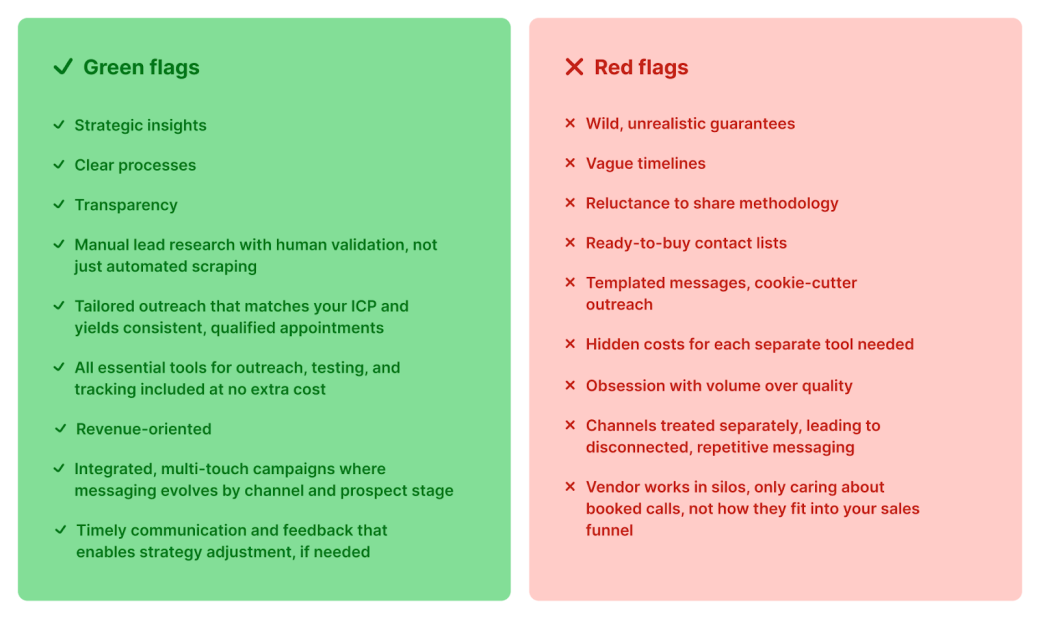
Pro tip: If you’re outsourcing any kind of outreach, including call center work, make sure you understand the model.
Size really does matter here, just not in the way people think.
An enterprise partnering with a boutique agency? You’re likely looking at compliance risks, limited capacity, and a team that may not have the processes or playbooks to handle your scale. On the flip side, a five-person startup working with a massive agency might get lost in the shuffle.
With hundreds of lead generation agencies on platforms like Clutch, it’s easy to pick one based on ratings. But the sweet spot is finding a partner that matches your complexity and goals:
What can go wrong:
What to do instead:
Pro tip: Ideally, look for the full-funnel agencies that know their specialization and have success stories with particular company size and industry.
We get it — budgets matter. But in outsourced lead gen, paying bargain-basement rates usually means bargain-basement results.
The “cheapest” vendor might cut corners with scraped lists, generic templates, and unvetted contacts. This can tank your sender reputation and bury your domain in spam folders before you even notice.
A slightly more expensive partner delivering qualified, sales-ready leads will save you far more in the long run.
What goes wrong: Rock-bottom prices usually mean rock-bottom strategy, lead quality, and data hygiene.
How to avoid it: Instead of negotiating the price, negotiate value — more onboarding support, strategic involvement, or extra services.
Pro tip: Don’t ask for discounts. Ask for better brains on your account.
If your first conversation with an agency jumps straight into “how many emails can we send this month?” — that’s a no-no.
You need to talk about buyer personas/dream clients, value proposition, messaging frameworks, sales handoff processes, and success metrics before anything goes live.
Skipping this stage is like building a house without blueprints. Sure, you’ll have walls. Just maybe not in the right places.
Mistake: Agencies are not mind readers. If you skip defining your ideal customer profile (ICP), unique selling proposition, buyer journey, and other key elements — expect a train wreck.
How to fix it:
Pro tip: Before any campaign starts, align on your ICP and tactics and explore proven lead generation strategies that work for your audience.
One of the biggest killers of outsourced campaigns? Targeting the wrong people from day one.
If your ICP is fuzzy (“mid-market companies in healthcare-ish spaces”), you’re giving your agency a guessing game, and they’ll most likely guess wrong.
Your ICP should be specific enough that someone new to your industry could identify a good prospect in under 30 seconds. That means:
What can go wrong:
How to avoid it:
Pro tip: A good agency will pressure-test your ICP before launch. If they just nod and move on, that’s a red flag.
Automation is great — until it turns you into a robot.
We’ve seen companies automate every touchpoint: AI-written emails, canned LinkedIn messages, pre-recorded voicemails. It saves time, but prospects can smell the lack of human touch a mile away. And once they clock you as “just another sales bot,” you’ve lost them.
Instead, use automation for efficiency, not for replacing personalization. Let your agency scale the grunt work but keep room for thoughtful, high-value touches.
What this looks like:
What to change:
Check out these templated phrases that kill your outreach and what your users see:
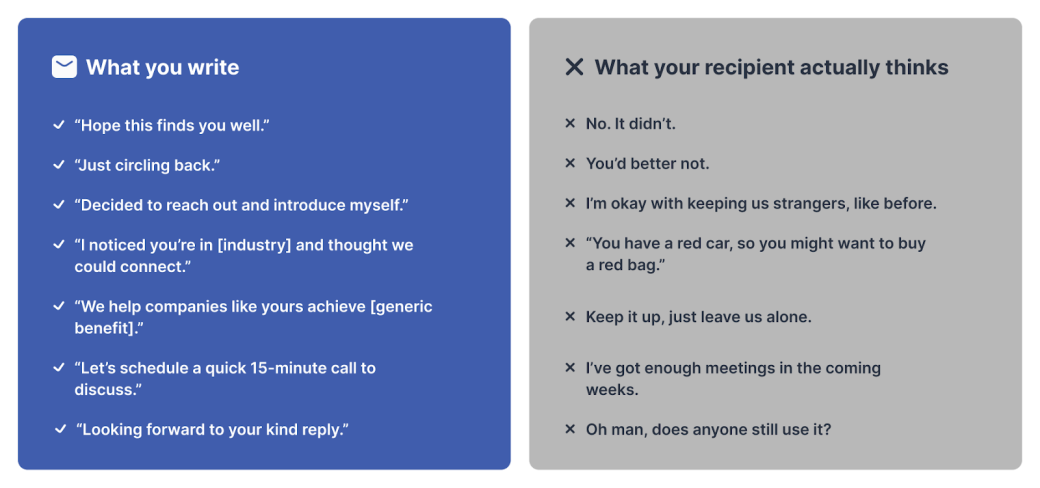
What a human would actually say:
Pro tip: Whether you’re using cold email or LinkedIn outreach (or both), your strategy should balance scale with authenticity.
A surprising number of partnerships fail not because of execution, but because both sides were aiming at different goals the whole time.
You’re thinking: “We need pipeline coverage in 60 days.”
They’re thinking: “Let’s A/B test messaging and channels for 90 days.”
No one’s technically “wrong,” but without shared expectations, frustration is guaranteed.
What can go wrong:
Fix:
Pro tip: Revisit your success definition monthly together with your outsourced agency. Priorities evolve, and your goals should too. For example, our team schedules weekly feedback loops and monthly strategy sessions to align with the client’s overall strategy.
Yes, you hired experts. No, that doesn’t mean you should disappear from the process.
Stay involved enough to guide, but not so much that you micromanage. Think “steering wheel,” not “backseat driver.”
What goes wrong:
Here’s how to fix it:
Here’s an example of how you can share responsibilities:
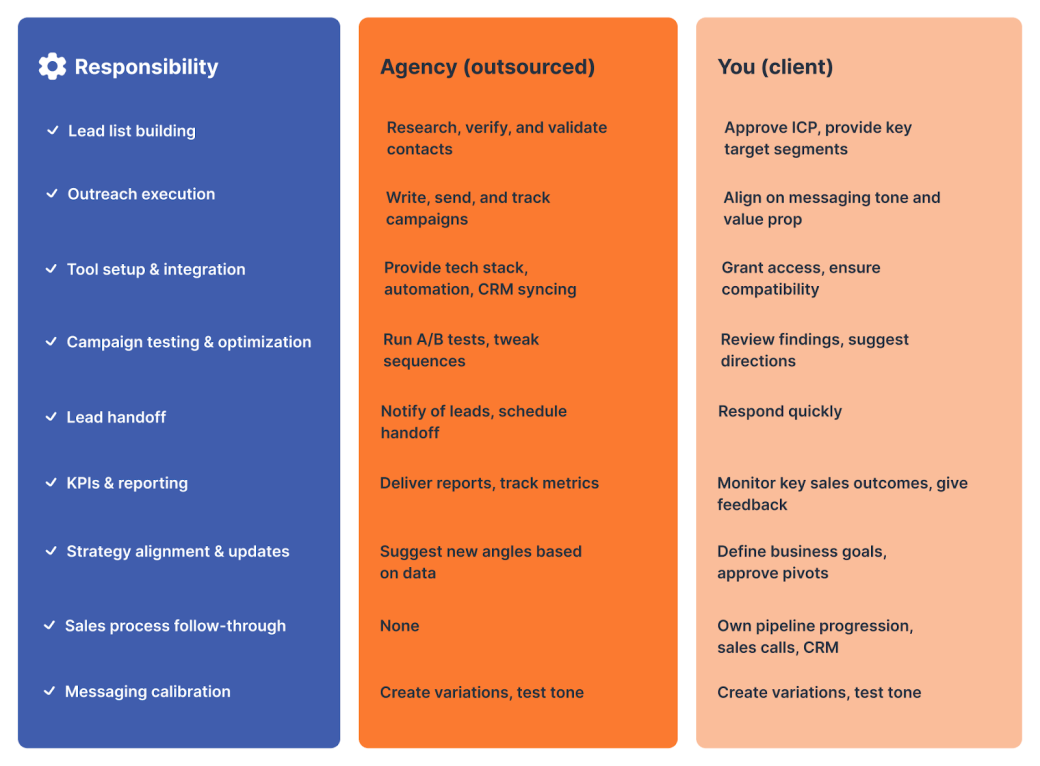
Pro tip: Even with such a responsibility distribution, it doesn’t mean you can’t ask questions about how things are going. Again, 30-min weekly or biweekly syncs can save you out here. It’s short enough not to waste time, but long enough to catch small issues before they snowball into a quarter’s worth of off-target leads.
Your agency’s job is to get qualified leads to your door — not to walk them into a signed contract. If you don’t have a fast, consistent follow-up process in place, even the best leads will wither.
We’ve seen companies lose millions simply because sales reps took too long to respond or never followed up more than once. If you’re spending money to generate leads, treat them like gold from the moment they land in your CRM.
What happens:
Fix:
Insert budget, expect meetings — that mindset kills collaboration. The best results come when you treat your agency like a strategic partner, not a one-way service.
Fix:
Some companies refuse to test new messaging, ICPs, or outreach strategies, even when results stagnate. Flexibility is the lifeblood of iteration, and iteration is what fuels ROI.
Solution:
Outsourced lead gen isn’t magic, it’s momentum. Expecting instant wins within 4 weeks is like judging a fitness trainer after one workout.
You need time to build, iterate, and optimize. Quite often, the first 3 months are all about evaluating the team, not the numbers.
Timeline advice:
Outsourced lead generation can either feel like rocket fuel or like lighting your budget on fire. The difference? It’s not just who you hire. It’s how you set the foundation, collaborate, and adapt over time.
Success doesn’t come from plug-and-play execution. It comes from real alignment, feedback loops, and shared accountability between you and your agency.
Here are some key points for you to keep in mind:
Because at the end of the day, outsourced lead gen isn’t about handing off the work. It’s about multiplying your impact without losing your direction.