Lead Quality vs. Lead Quantity: Why B2B Teams Are Rethinking Their Funnel in 2026
Bigger buying committees and tighter budgets are forcing B2B teams to rethink lead quality vs. quantity. Here's how top teams rebalance the tradeoff in 2026.
Updated August 31, 2026

Both cold email and LinkedIn outreach have their place in outbound sales, but the real game-changer is using them together. This blog will highlight when and how to effectively use each channel, their unique advantages, and why a multichannel approach is the future. Readers will walk away with practical insights, clear best practices, and strategies to improve their outreach results.
With so many technological advancements and people having shorter attention spans, reaching them on only one channel will limit your lead generation.
Did you know that LinkedIn and email are some of the top channels for generating leads in 2025?
Looking for a Digital Marketing agency?
Compare our list of top Digital Marketing companies near you
So, what to choose? How to choose? How to use it? Get answers to all these questions in this blog and optimize your lead generation game plan!
We will start with cold emailing. This is known by sales and marketing teams for being a budget-friendly and standard way of outbound B2B lead generation.
In this section, we will understand how to use cold emailing, what to do, and what to avoid.
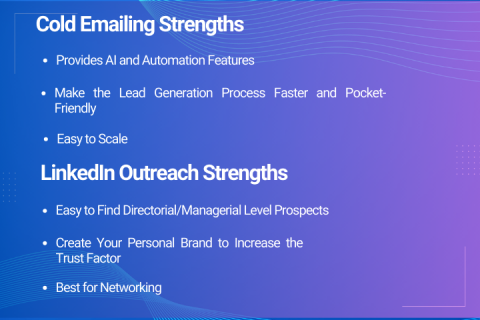
Cold emailing is suitable for scaling because modern tools have many automation features that help speed up the process. Also, if you correctly warm up your email accounts, you can send hundreds of emails daily.
A skilled email outreach specialist plays a crucial role in this process. They craft personalized messages, track responses, and optimize email sequences to maximize conversions. Having a dedicated expert ensures that your outreach efforts are targeted, engaging, and yield measurable results.
But don’t just bombard the prospects. Ensure you use proper personalization, email deliverability checks, and email list segmentation before increasing the number of emails you send.
As discussed above, cold emailing tools for B2B lead generation, outreach, or CRM are developing automation and AI features.
This greatly increases the efficiency of sales and marketing teams.
Of course, if the tools you use for cold emailing support you for scaling and have the latest technologies, achieving results faster is a given. For startups working on MVP development, leveraging cold emailing can be a cost-effective way to validate their product idea, reach early adopters, and gather initial feedback without heavy marketing investments.
To further optimize outreach, businesses can leverage NPS tools that integrate with HubSpot. These tools help centralize customer feedback, improve engagement tracking, and enhance email personalization—making cold emailing more efficient and data-driven.
Also, sending one cold email is much cheaper than running ad campaigns or lead-generation methods. These cost-effective tools are easy to find online and work smoothly.
Email warm-up is nothing but slowly increasing the speed of email sending. If you're hiring Python developers and reaching out to multiple candidates or clients through cold emails, manually warming up your email account can be tedious and time-consuming.
However, using an email warm-up tool can automate the process, ensuring better deliverability and engagement. Instead of handling it manually, you can opt for a tool that includes email warm-up in its package, making your outreach smoother and more efficient.
But if you use cold emailing to reach out to hundreds of prospects daily, doing manual warmup would be very time-consuming. Instead, you can use email warm-up tools to do that.
Or you can choose a tool with an email warm-up added to their package.
Email deliverability is the ability of your email to reach your prospect's inbox. Authenticators like DKIM, SPF, and DMARC (DNS records) are needed to achieve this. Before scaling your outreach, run an EasyDMARC Email Deliverability Checker to test your inbox placement across major email providers and uncover issues that could be impacting delivery.
Also, using secondary domains, removing spam words, and warming up email accounts should be handled.
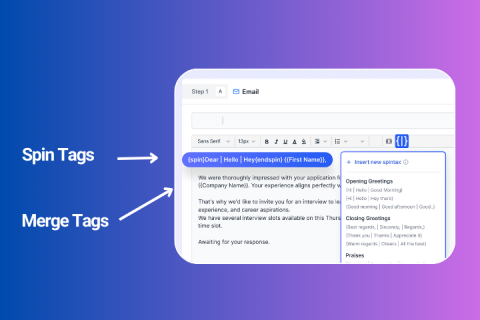
This is one of the top reasons cold emails land in the spam folder. Prospects who think your emails are generic or a marketing gimmick can even mark them as spam, which is even worse.
Because if they mark your domain, all your future emails will also be spam.
The only solution is to send prospects personalized, valuable, and relevant content. It is also a good practice to keep emails short and to the point. Additionally, ensuring a proper email format can improve deliverability and make your messages appear more professional. One simple but effective tip is to add your logo to your email signature. This not only reinforces your branding but also adds a more personal and professional touch to your outreach.
This is for people who need to send many emails daily. If you use your primary domain for email, the risk of your domain being marked as spam, receiving spam complaints, or, even worse, being block listed increases.
Email deliverability experts suggest using secondary domains to reduce this risk.
What these domains do is they look similar to the primary domain, and cold emailing tools keep rotating them to not put a load of bounces on any one of them.
This is a given — if your emailing list is outdated, you will send emails to prospects who don’t even exist today. This is where you get hard email bounces.
You can do it manually or use reverse email lookup that does live segmentation and list cleaning to send campaigns to relevant people.
Now, let’s see how LinkedIn outreach can help in B2B lead generation.
In this section, we will understand how to use LinkedIn outreach, what to do, and what to avoid.
LinkedIn is known for its networking capabilities. It is easy to find and connect with people with the designations you want. Thus, it's no wonder people who want to improve their outreach on this platform give LinkedIn email finders a try.
The best part of using LinkedIn for networking is that you can find the latest information and work details about the prospects. George from Clipping Path says, “We regularly network on LinkedIn to land us the best leads.
Usually, using other methods, reaching upper-level prospects is difficult, as their emails are managed differently.
But LinkedIn is still a place people use for themselves, and the reply % is higher.
Unlike cold emailing, where prospects don’t have an easy way to know about you or your business, LinkedIn gives you the option of having a detailed personal profile.
If you keep your personal profile updated, your prospects can visit your profile and see your work. It also helps increase the trust in your business. You can also add your profile to a business vCard for easy access.
Many people just drop messages into direct messages without building a connection with the prospect. Instead, what works the best is connecting with them on their posts and in groups before, building a relationship, and then going for direct messages.
Be genuine in your pitch. This is a networking platform; people will not want to connect with you if they find your profile salesy.
Not Following Up After The Initial Message: This works for both cold emailing and LinkedIn outreach. Sometimes, your prospects are busy and forget to check or reply to messages.
Following up increases your chances of getting a reply, but ensure a proper interval in between. Using a reminder app can help you stay on top of follow-ups without missing the right timing. The usual wait time is 3 to 5 days.
Not Having an Optimized Personal Profile: Reaching out to people without adding details about yourself or your business on your official page will ensure prospects are unsure about responding.
So, a well-updated and detailed profile, including a professional LinkedIn banner, is a must before you start doing LinkedIn outreach. It helps create a strong first impression and adds credibility to your profile.
In this section, we will compare the response rates, scalability, and effectiveness of cold emailing and LinkedIn outreach-led generation methods.
| Key Difference | Cold Emailing | LinkedIn Outreach |
| Avg. response rates | 10% to 20% | 30% to 50% |
| Scalability |
Highly scalable | Limited scalability |
| Effectiveness | Scaling lead generation, appointment setting, and outreach that rely on volume. | High-value B2B sales, networking, and building trust before moving to email. |
| ROI | Cost per lead - lower | Cost per lead - higher |
As we learned from the above table, both of the channels have their own pros and cons. But why limit your outreach with the limitation of a channel when you can use both?
As B2B lead generation becomes more difficult and laws become stricter, the best approach is to use a multichannel approach. This allows you to take advantage of both while canceling their limitations.
It also collectively provides better ROI. So, if you are ready to invest in both channels, your lead generation will be optimized.
In 2025, multichannel is the best solution for outbound sales and B2B lead generation. This means using a mix of cold emailing, LinkedIn, cold calling, and other methods that suit your industry best.
If managing multiple outreach strategies feels overwhelming, you can hire a virtual assistant to help streamline prospecting and follow-ups. Your primary focus should be finding quality leads and the right balance of channels that works best for you. Relying on only one channel would allow your competitors to steal your prospects.