
12 Years With Clutch: How Intuz Builds on a Partnership That Delivers
A Relationship That Has Stood the Test of Time Intuz is an AI consulting and development company established in 2008, with operations in Silicon Valley...
Updated June 26, 2025

While 50% of millennials embrace AI at work, only 19% of boomers do the same. This generational tech divide is costing your company a competitive advantage, but it doesn't have to.
AI tools have already entered the workplace, and your organization can't ignore them anymore if you want to remain competitive.
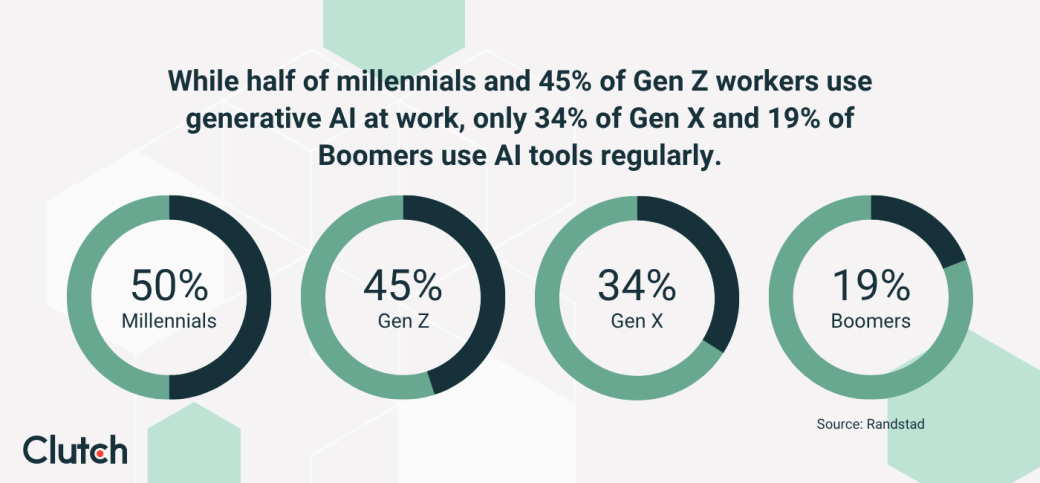
Your team may span generations, with some who embrace every new AI tool that hits the market and others who still prefer to print emails on paper. In fact, a recent survey about AI in the workplace supports this generational gap in tech adoption. While half of millennials and 45% of Gen Z workers use generative AI at work, only 34% of Gen X and 19% of Boomers use AI tools regularly.
Not exactly shocking, right? Younger workers grew up with smartphones and social media. They adapt to new interfaces like breathing.
But dig deeper, and you'll realize that these gaps aren't just about age. They reflect different comfort levels with change, varying learning styles, and distinct workplace cultures.Your millennial product manager might crave feature-rich platforms. Meanwhile, your Gen X finance director values stability and routine.
"Younger workers might say, 'Can you add more features?' Folks who are used to the older platform might say, 'Why is there stuff all over the place? I had a routine, and my routine has now changed.'" explains Christopher Kouzios, CIO of Schellman. That's your challenge in a nutshell—encouraging all of your team to adopt new tech.
Every generation needs to be on board. Not because it's trendy, but because your competition is already marching ahead. In this day and age, markets shift overnight, and customer expectations evolve weekly. Companies that fail to leverage their entire workforce's potential end up as footnotes.
Tech adoption drives revenue growth, streamlines operations, and opens new markets. But only when your whole team participates.
The challenge? Building bridges across generational divides without leaving anyone behind. Here's how you can achieve just that.
Getting multigenerational teams to embrace new technology requires strategy, not mandates. You can't just drop a new platform on Monday and expect everyone to love it by Friday. That's a recipe for resistance, frustration, and, ultimately, failure.
Tech adoption happens when people see value, not when they're told to comply. These four approaches work because they address real concerns across every generation in your workforce.
Start with the "why" before the "how."
Your senior sales director might not care about AI's technical specifications, but she cares about closing deals faster. Your Gen Z analyst? He wants to eliminate repetitive tasks so he can focus on strategic work.
You can encourage adoption by mapping technology to pain points:
Ask direct questions during team meetings:
Then, connect the dots between their frustrations and available solutions.
One-size-fits-all training often fails because it assumes everyone learns the same way.
But different generations absorb information differently. Your 25-year-old programmer might master a new tool from a 5-minute YouTube video, whereas your 55-year-old operations manager may need hands-on practice with a patient instructor. Both approaches work, but neither works for everyone.
A better approach is to build a multi-channel training and development program:
Offer Multiple Learning Options
Tech "book clubs" are another great way to transform training from obligation to opportunity. Groups of six to eight people can meet weekly to explore new features together, and be sure to mix generations deliberately. The 25-year-old developer brings fresh perspectives, while the 55-year-old accountant brings implementation wisdom.
Technology selection equally determines adoption success.
Flashy features mean nothing if people can't use them. So, it's better to always prioritize intuitive design over bells and whistles. Your team shouldn't need a computer science degree to complete basic tasks. Here are a few practical ways to do that:
Can someone accomplish core functions within a few clicks? If not, keep looking. Complex navigation frustrates everyone, especially time-pressed executives.
Also, test platforms with actual users before purchasing. Gather a few people spanning different generations, watch them complete typical tasks, and note where they struggle. Their confusion reveals design flaws that vendor demos might hide.
Your sales team may live on smartphones, whereas developers might toggle between desktops and laptops. So, choose platforms that perform consistently across devices.
Nothing kills adoption faster than features that glitch on different devices.
That small gray text might look sleek, but it may be illegible for some team members. But accessible design benefits everyone, not just those with disabilities.
Here are a few essential accessibility features to include:
Tech deployment marks the beginning, not the end. Real-world usage actually reveals gaps that the planning phase often misses. You need continuous feedback loops to catch problems before they become roadblocks. Here are a few practical ways to gather feedback from your team:
Nothing discourages input like ignored suggestions. When you implement changes based on feedback, announce it. "Based on your input, we've simplified the expense report process" shows you're listening.
Sometimes, feedback reveals the need for platform changes. If your marketing team discovers that their AI project management tool creates more problems than it solves, it may be wiser to switch platforms. It could be a tough decision initially, but it may ultimately lead to improved productivity.
Boomers didn't grow up with smartphones, and Gen Z never knew life without the internet. Some of your team members may need three months to feel comfortable with the new tools, while others adapt in three days.
Both timelines are valid—don't rush things, as patience prevents abandonment.
Resistance to new technology isn't really about the technology. It's often about fear—fear of looking incompetent and the fear of change itself. You need to get your team on board with new tech, like AI.
Show your team what’s possible when they adopt new tools. An analyst could discover that she can create reports in minutes instead of hours, while a director could see productivity jump 30% without hiring anyone new.
Now, that's not just about the tools anymore, is it? Instead, it's about the future you're building together as a team. Make that future irresistible, and adoption takes care of itself.