
What Are AI Influencers? A Guide to Virtual Creators
AI influencers abound on social media. Clutch explains what they are, why brands partner with them, and whether people can tell them apart from human...
Updated April 23, 2026

For SaaS companies offering cutting-edge AI tools, learn the keys to AI pricing and the different models to set the right pricing for your clients.
As artificial intelligence becomes increasingly integral to business operations, many software-as-a-service (SaaS) companies are creating AI tools. The challenge for many organizations comes in figuring out how to price these offerings. As a result, the way companies are structuring pricing agreements is evolving.
“AI-driven tools often offer dynamic pricing based on usage or performance, which helps businesses only pay for what they use,” says Facundo Galan, a lead generation marketer at the software development company, Nybble Group.
Looking for a Artificial Intelligence agency?
Compare our list of top Artificial Intelligence companies near you
In the past, flat rate pricing was common. But as companies use more computing power, many SaaS providers are shifting to usage-based pricing models. “As AI evolves, SaaS platforms are also incorporating advanced functionalities that justify premium pricing due to the increased value they provide in automating business processes and decision-making,” said Galan.
That being said, that doesn’t necessarily mean that your AI tool should automawwtically shift to a dynamic pricing model. With a firm understanding of the trends in AI pricing for SaaS tools, you can select the pricing model that best serves both your business and its clients.
To start, you must think about the audience for your services. Is it primarily IT developers? Are your clients looking to integrate the technology within their customer resource management (CRM) tools to help agents resolve customer issues? Once you understand how your clients will use your tools, this can inform how you set pricing to meet their needs.
Make sure the services you offer directly support a company's organizational goals. For instance, if they have employees with different skill sets using AI tools, you may want to offer flexible pricing structures that allow organizations to easily adjust the level of AI access that they require. If an organization is new to AI, then its ROI is unproven, so you want to minimize volatility to simplify their budgeting.
It's also important to consider the size of organizations that you work with. An enterprise-level company has access to greater resources and may be willing to pay top dollar for advanced AI tools, while small businesses may only want to spend on a couple of features they really need.
Conduct market research to compare your SaaS product offerings to what else is out there and determine how they measure up. To remain competitive, you want to set pricing comparable to services with roughly equivalent AI tools in terms of speed, accuracy, and depth of integration.
To give you a better idea of your options, here is an overview of the most common pricing models typically advertised in the marketplace that you can consider for your AI technology.
In a subscription-based model, your clients pay a monthly or annual fee to get licensed users access to AI capabilities, features, or services. This is a flexible system, as several of the other models can incorporate subscriptions as well.
One major benefit of subscription-based pricing is that it establishes a predictable cost structure. Most subscription models work on tiers based on factors such as:
For example, you might offer a base tier that provides users access to core AI functionality like extracting data or summarizing text. Companies would have to pay for a higher tier to access services like parsing images or advanced analytics.
One advantage of subscriptions is that they provide a guaranteed regular income, allowing for more predictable budgeting.
The biggest concern about a subscription-based payment model is the level of utilization. If your company offers a tier that provides many general features only used by a portion of users, you may be offering wasted levels of support to maintain them.
Some customers may not want to sign up for a contract where they must pay monthly or yearly, which can lead to fewer sales.
You must also consider whether your company will charge extra if customers wish to cancel seats or downgrade their subscription tier. For example, seasonal businesses might be inclined to drop a subscription once their busy season is over to avoid paying for the unused features.
Usage-based pricing charges organizations variable amounts depending on how much they use a tool or service. As a vendor, aligning cost with actual consumption of your AI resources can allow you to provide clients with more flexibility in deploying AI capabilities to different departments or for various use cases.
Example metrics you might use to calculate pricing include:
One reason usage-based pricing is rising in popularity is that AI applications often have higher infrastructure and processing demands than other SaaS offerings. Fixed subscription-based models may not accurately cover the costs to run these platforms. For example, if a business uses a natural language processing (NLP) AI tool to analyze paper documents, you can bill them for the time used to train a model.
Your company can pitch the avoidance of paying for unused resources as a benefit to clients. Instead, they pay only for what gets used, achieving better cost-efficiency.
Usage spikes, such as an increase in call volume to a customer service center because of a service outage, could unexpectedly increase costs beyond your clients' expectations. Arranging usage limits or putting in place alert mechanisms can reassure your clients that they won't go over their budgets.
With freemium pricing, organizations receive basic AI tool services for free and then can pay for more advanced services. An example of a freemium subscription is one that only provides a certain number of monthly API calls for free and charges for any over the limit. There may also be restrictions on how much data users can process or what capabilities they can access. For example, you could limit your base tier clients to deploying one free chatbot.
Freemium models can work well to advertise your services, helping your clients determine their exact needs when using AI. Once a client decides they need more services that fit their needs, it's an opportunity to pitch them on paid subscription-based tiers that offer more benefits. This keeps you from expending a lot of resources until your customers start paying for those services.
The limitations of the free tier can draw complaints from customers. They also may not appreciate the AI platform’s full potential and may hesitate to pay more for services if they lack confidence in a tool's ability to scale to fit business demands.
Under a one-time or perpetual license, you charge organizations a one-time fee for indefinite access to a specific software version. The purchasers gain ownership of that software version.
This can attract more business from enterprises that require only a particular software version and are not looking for the latest and greatest.
Your company can immediately bank the money clients pay in upfront costs, which helps the bottom line. Clients gain by not having to worry about future expenses. They won't have to deal with price fluctuations, while you only need to focus on maintaining a specific software version for them.
While clients might believe they won't need upgrades, the march of progress can render the version they use obsolete. Depending on your contract, you could be on the hook to keep an older version of your AI technology functional. If you decide to stop support after a specific date, you can lose that client if they do not wish to upgrade.
Your business can offer customized pricing to larger enterprises, which is the practice of many AI tool vendors. These organizations often want broader, more scalable access to AI technology for workers nationwide or worldwide.
Enterprise contracts often bundle licenses, support services, and integrations with other popular AI tools and applications. Offering a product built to fit organizational use cases, workers' needs, and expected workloads can attract more clients.
The complexity and longer-term nature of enterprise contracts might cause some potential clients to walk away. They may have concerns regarding your AI platform's ability to grow and change with their organizational needs.
Keep the following in mind as you evaluate how to set SaaS AI pricing models for your company's products.
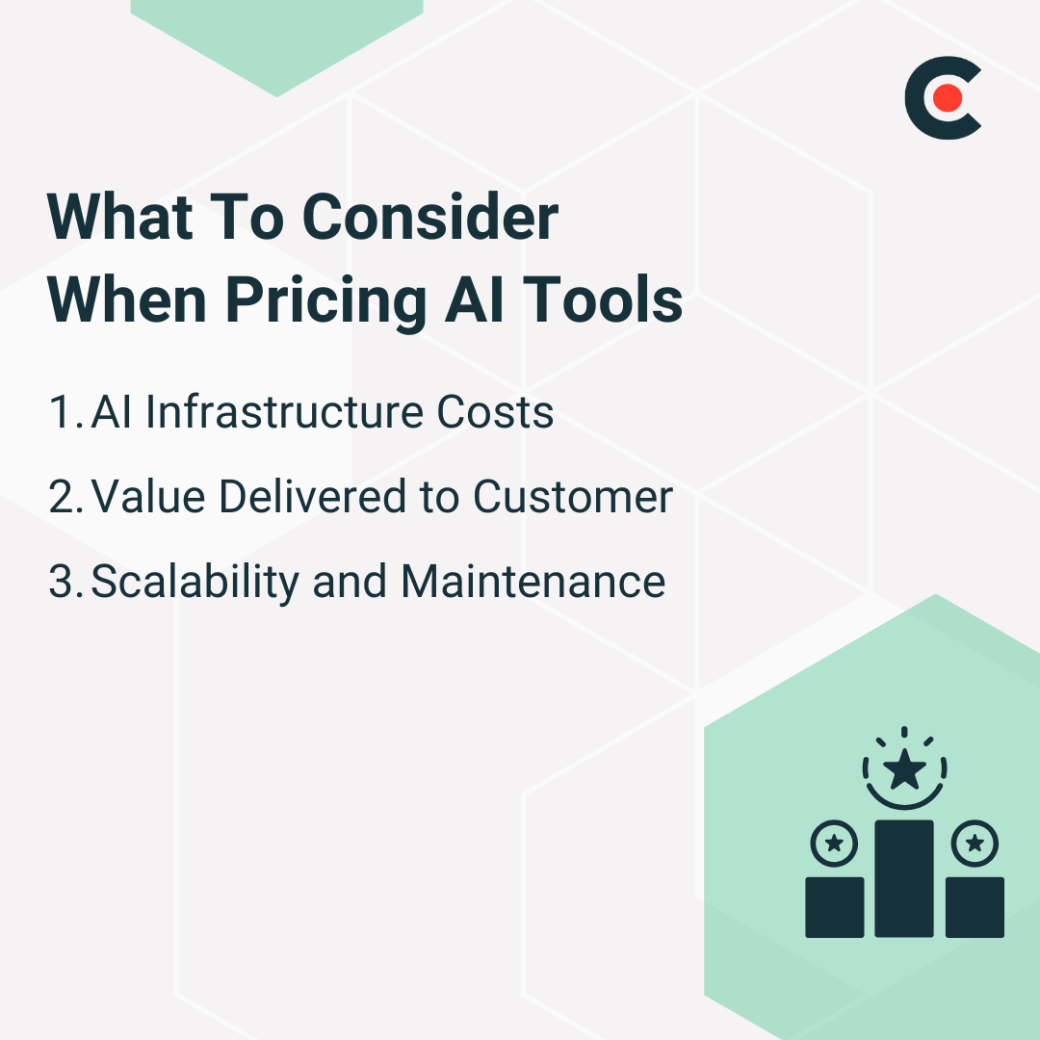
Before you set prices for your AI tool, consider the costs to provide your clients with the services they expect. AI workloads consume a lot of resources. If a client employs data specialists who run large language models or perform a lot of real-time data processing, you'll need hardware capable of handling their requests.
If your client is a manufacturer, they may be looking to speed up the detection of product defects to improve operations. That may require investing in edge computing devices to handle the surge necessary to support their needs. Make sure your pricing can cover these investments.
When pricing your tools, always be aware of how much value you are delivering to your customers. Ultimately, the greater their expected return on investment, the more your customers will be willing to pay.
With the recent advances in AI, customers are often expecting impressive ROI thanks to the advantages of automation to improve efficiency. The easier it is to integrate your SaaS into their everyday operations, the more likely they are to realize its value.
Freemium pricing models are one way to demonstrate the value of your product. Free trial periods for subscriptions can also give businesses a chance to realize how much your SaaS AI tools can do for them.
Small- and medium-sized (SME) organizations often lack the IT resources of large enterprises. Consider whether you want to offer lower tiers that fit the budget of these types of businesses. While the individual contracts may not be as large, supporting a lot of small companies can be lucrative, as they make up a majority of the market.
These organizations may not have an IT department that can support AI needs. It's an opportunity to step into that gap and support companies looking to support AI initiatives, such as increasing their use of natural language processing. You can help small companies maneuver quickly in response to market demands with subscription-based models that they can scale up or down as needed.
To see these models in action, here is a quick overview of the pricing strategies employed by three top AI tool vendors.
OpenAI bases its pricing on a customer’s product choice and the required level of access. They offer a freemium model for their consumer-facing product ChatGPT. Costs start at $0 per month for limited access to features. Users can perform real-time data searches and have limited access to capabilities like:
Users can then upgrade to paid tiers offering expanded access to ChatGPT features. There are also plans available for developers and enterprises requiring the purchase of tokens or paying a monthly fee per user.
Jasper AI offers two subscription-based plans. Companies can pay per seat for access to their services. There’s also a personalized Business tier where companies can work with a sales representative to set up a plan that fits their organizational environment.
Organizations can sign up for a basic free subscription tier at GitHub Copilot. The available features include unlimited access to repositories, security updates, and 500MB of package storage.
Individuals and organizations can move up to the Team tier for $4 per month, which expands access and offers additional services like:
Enterprises can reach out to the sales team for a customized subscription.
Considerations for pricing AI tools should account for the needs of clients as well as your infrastructure costs. As a SaaS vendor, consider expanding your pricing models beyond subscription-based plans. By leveraging usage-based pricing, drawing in clients with freemium features, or offering one-time licensing or enterprise contracts, you can continue to profit while providing the services your clients need and expect.