
Why Searching for a Specialized Dev Agency Takes Longer Than It Should — And What to Do About It
Looking for a niche software development agency? Learn how to define your requirements, find specialized providers, and vet their experience.
Updated April 24, 2026

New technologies don’t take off overnight. Their adoption follows a predictable path, moving from tech-savvy innovators to cautious laggards. Businesses that recognize where their product fits on this curve can tailor their strategies to gain traction, ease resistance, and facilitate adoption. Here’s how each stage unfolds — and what it means for your success.
Remember when smartphones first hit the scene? Some dismissed them as pricey toys for tech enthusiasts, while others saw them as a communication revolution they would become. Now, they’re practically glued to our hands. That’s technology adoption in action, and it can make or break products, reshape industries, set market trends, and even define how we live. Spotting these trends allows your business to position its products effectively, avoid expensive mistakes, and predict customer behavior and buying shifts.
So, how exactly do new technologies gain traction? The technology adoption curve offers a framework for understanding this process.
Looking for a Software Development agency?
Compare our list of top Software Development companies near you
The technology adoption curve is a widely recognized model that maps how different users embrace new products or innovations over time. Introduced by the sociologist, Everett Rogers in 1962, this model breaks down adoption into 5 stages and categorizes based on when they adopt new tech.
The technology adoption stages include:
This progression is generally predictable. Early enthusiasts experiment first, then broader market segments join in, and finally, the most resistant users come on board. Identifying where your product or service falls on this curve is key and allows you to fine-tune your marketing strategy, distribute resources as needed, and maximize growth potential.
While innovators and early adopters can generate initial excitement, sustainable success depends on winning over the broader market. Even a life-changing technology can fizzle out without a clear strategy for engaging each adopter category.
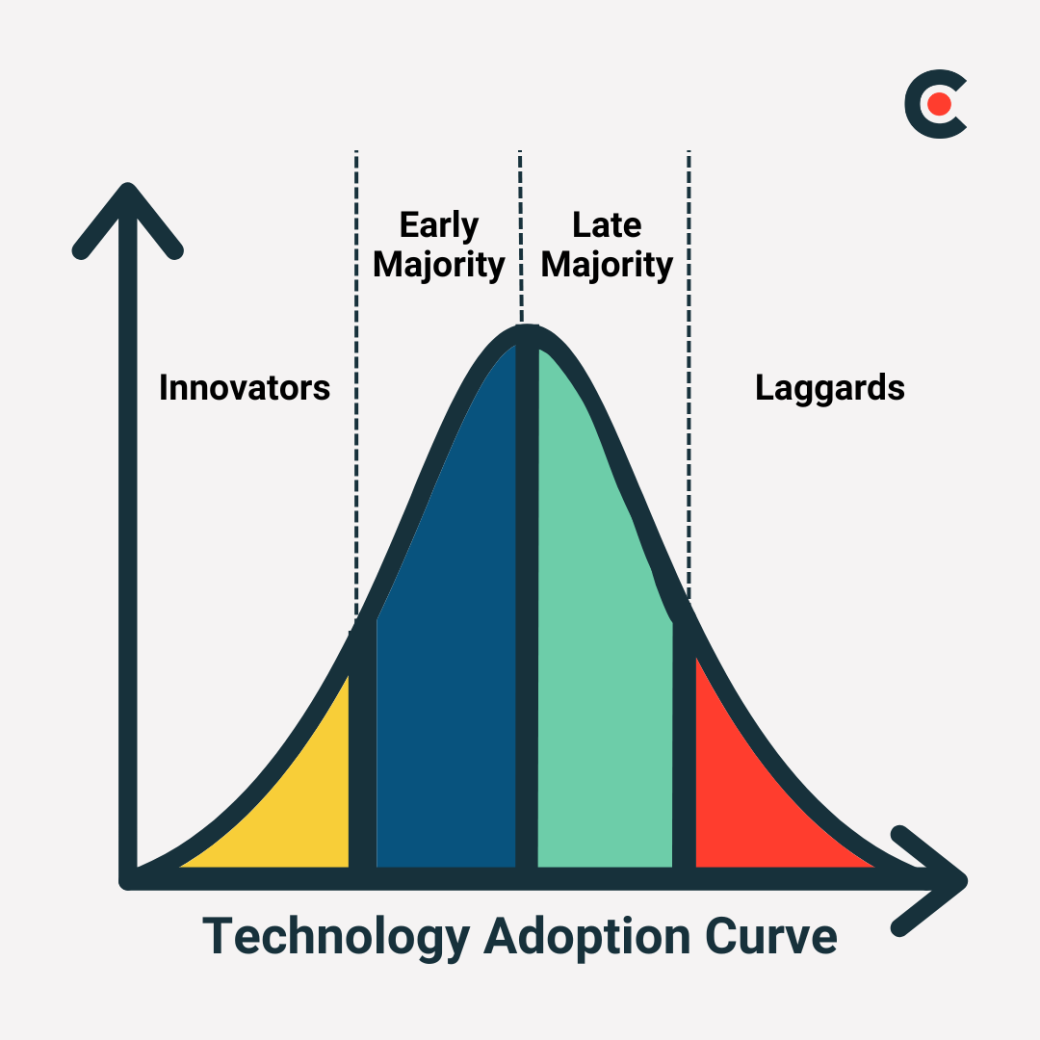
Ultimately, understanding the technology adoption curve can help business leaders tailor their product and marketing strategies to more effectively convert potential users.
Early in a product's lifecycle, companies should prioritize features that excite innovators and early adopters. As the user base grows and the focus shifts to the more skeptical majority, the emphasis should move toward reliability, ease of use, and solving practical pain points. That shift should be reflected in marketing language and messaging as well.
New technology doesn’t hit the market and explode overnight. Adoption unfolds in phases as different types of users assess and incorporate innovations at their own speed. Each of the technology adoption curve's five distinct stages encompasses specific user characteristics, motivations, and adoption obstacles, and each group helps influence a product’s success.
Comprehending these stages allows your team to adapt its approach to meet users where they are — sparking early interest, solidifying your product’s reputation, and addressing resistance along the way.
Innovators are the tech world’s daredevils. They dive headfirst into new technology before anyone else. This small but influential group lives for experimentation, eagerly seeks out emerging products, and willingly takes risks, even early in a product’s development, but there aren’t many of them out there. Innovators only account for roughly 2.5% of the market, but capturing their attention is essential for growing adoption over time.
As the first users of everything from groundbreaking software to cutting-edge electronics, innovators wield significant influence over which products gain traction. Their invaluable feedback helps product teams refine features, address usability issues, and identify potential roadblocks.

“Early adoption typically hinges on a mix of novelty and practical value,” explains Nick Vasylyna, CEO Busy Rebel Labs. “There’s always a group that loves to test and champion new gadgets and apps—if you win them over by demonstrating clear utility, they’ll become evangelists and help bring others on board. This is especially true if your product significantly reduces pain points or offers a differentiated approach that no one else is doing (or at least not as well).”
The launch of early virtual reality (VR) headsets perfectly illustrates this. When the first consumer-ready VR devices launched, the hardware was expensive, its setup process was complicated, and the range of compatible software was limited. Even so, tech enthusiasts eagerly embraced VR. Their experiences provided critical insights that helped developers enhance the user experience (UX) and improve accessibility, performance, and content options.
Early adopters share some traits with innovators, but they’re more cautious, carefully weighing the potential advantages before committing. Making up an estimated 13.5% of the market, early adopters shape public opinion, help bring new tech into the mainstream, and build momentum for sweeping adoption.
Because early adopters tend to be vocal, their experiences strongly influence a product’s reputation. A successful launch with this group builds trust and credibility, while poor performance or unmet expectations can create lasting doubts.
The tech industry often relies on early adopters when introducing new software or devices. The rise of cloud computing took off when forward-thinking companies shifted their critical operations to platforms like AWS and Microsoft Azure. When these early adopters demonstrated the model’s reliability, scalability, and cost benefits, they paved the way for broader acceptance.
Successful companies actively engage early adopters with perks like exclusive access, personalized support, and incentives for sharing their feedback. This strengthens customer relationships and amplifies positive word-of-mouth, which encourages broader adoption.
Early stages of the adoption lifecycle are all about generating buzz and capturing attention from people who are risk takers. Early adopters are willing to take risks on new, unproven technologies, but the early majority is far more pragmatic, seeking reliable, well-supported solutions with clear value, but capturing more users gets increasingly difficult.
Geoffrey Moore called this gap between the early adopters and early majority “The Chasm. ” Many innovations gain initial traction with enthusiasts but fail to “cross the chasm” because they don’t adapt their messaging, product, or use cases to meet the needs of mainstream buyers.
For businesses looking to make their product more mainstream, they must successfully cross the chasm. Usually, this requires shifting from experimentation to scalability. They should focus on specific customer segments, demonstrate tangible ROI, and build trust through proven results.
The early majority has to see it to believe it. Unlike early adopters, who embrace innovation for its potential, this group wants clear evidence of the product’s success, reliability, and widespread use. But once they’re convinced, they’re instrumental in propelling mass adoption. This is where adoption starts to grow more quickly — approximately 34% of your audience will start using your product at this stage.
To reach the early majority, marketing and education are essential. Highlight concrete results, customer success stories, and endorsements from trusted third-party sources to build consumer confidence. Offering free trials, live demos, and easy-to-understand documentation can alleviate pushback and smooth the path to adoption.
Look at the ascent of e-commerce. While early adopters jumped on the online shopping bandwagon in the ‘90s, the early majority hesitated. Worries about security, payment processing, and shipping logistics slowed far-reaching adoption. But as companies like Amazon and eBay improved their platforms, added customer protection, and proved that online shopping was safe and convenient, the early majority followed suit. Their involvement solidified e-commerce as a standard rather than a fad.
Those considered among the late majority don’t adopt technology because they want to; they do it because they have to. This group holds off until a product becomes the industry standard, prices drop significantly, or social and professional pressures force their hand. This segment usually represents 34% of your audience, and is a key indicator that adoption is successful.
Convincing this group means showing irrefutable evidence of value. They’re looking for a tried-and-true product with minimal risks, excellent customer support, and smooth integration with their existing tech stack.
“They want to see your product is stable, widely adopted, and comes with robust support,” explains Vasylyna. “They also value cost-effectiveness—by this point, there’s often a cheaper or more convenient variant in the market.”
The move to cloud-based productivity tools demonstrates how the late majority adopts technology only after it reaches critical mass. While early adopters and the early majority embraced platforms like Google Workspace and Microsoft 365 years ago, many businesses resisted until remote work became mandatory. Concerns about data security, learning curves, and cost kept the late majority on the sidelines, but once these platforms became the industry norm, adoption was unavoidable.
To target late adopters, your company should prioritize competitive pricing, comprehensive support, and easy transitions from older systems. Once the late majority is on board, only one group remains: the laggards.
Laggards are the last holdouts. They resist technological change for as long as humanly possible. Whether because of skepticism, limited access, or just plain resistance to change, this group only adopts new technology when there’s literally no other option. These people aren’t risk takers and are among the last 16% of people to adopt your product.
“They want absolute proof that the technology is safe, reliable, and, more importantly, that everyone else they trust has adopted it,” explains Vasylyna.
Think about those who switched to smartphones years after they were ubiquitous, often only when their old flip phones stopped working. Similarly, companies that stuck with fax machines or paper-based processes eventually had to modernize when suppliers, customers, and regulations demanded digital solutions.
Reaching this group calls for a different strategy. Laggards respond much better to ironclad guarantees, reliable customer support, and a sense of familiarity than flashy innovation. If you want to bring laggards aboard, emphasize smooth conversions, long-term dependability, and personalized assistance over sophisticated features.
By the time laggards adopt a technology, the rest of the market has already moved on. While they may not set trends, their eventual adoption marks the final phase of universal acceptance.
Prompting broad adoption can be an uphill battle, but some strategies can smooth the process and spur quicker buy-in from those at every point on the curve.
“Eliminate guesswork from the get-go,” advises Vasylyna. “If users instantly see how your product solves a real problem or simplifies their workflow, they’re far more likely to keep using it. Early demos and free trials work well here—people love a taste of the benefits before paying or committing.” If a product quickly demonstrates how it can solve a problem or improve efficiency, it builds trust and convinces users of its worth. Immediate value helps reduce uncertainty, making users feel confident in their decision to adopt the technology.
A well-designed onboarding process also reduces frustration, increases user satisfaction, and accelerates the learning curve, making it easier for users to realize the value of the product. “Offer step-by-step guides or quick product tours to get users into the app’s core features without confusion,” Vasylyna recommends. “If you can, add in-app tutorials or tooltips that guide people as they start exploring.”
When potential users see that others—especially peers, industry leaders, or well-known companies—are successfully using and benefiting from a technology, they are more likely to feel confident in adopting it themselves. “Users trust users. When people see industry peers or credible influencers talking up your product, they’ll be more open to giving it a go,” notes Vasylyna. “Showcase testimonials, case studies, or endorsements from known names in your space.”
When early adopters share their positive experiences, whether through reviews, testimonials, or word of mouth, it helps create a sense of credibility and trust around the product.
“Early adopters are usually excited about new tech,” explains Vasylyna. “Encourage them to share their experience—whether it’s on social media, user forums, or personal networks.” Their experiences can serve as proof that the technology works and has value, making it easier for others to feel comfortable adopting it.
By rapidly refining a product and making updates visible, you show users that their feedback is valued and that the product will continue to evolve to meet their needs. “Be transparent. When you iterate based on user feedback and keep the community in the loop, it sends a strong message: 'We’re listening, and we’re improving fast.' People love seeing their feedback shape the product,” shares Vasylyna.
Public iteration also allows potential users to see continuous progress, which can reduce concerns about the product being incomplete or stagnant. It signals that the technology is actively being developed, which can attract more users who are eager to try something that is evolving and improving.
Fitting users into neat categories isn’t all there is to understanding the technology adoption curve. Most importantly, you have to meet consumers where they are. Success hinges on knowing how and when to engage each adopter group. Innovators and early adopters may ignite the spark, but true market impact comes from winning over the majority.
Addressing reservations and hastening adoption requires:
When introducing new tech, the goal is to make it indispensable. When adoption is simple and painless, sure, your product will gain users. But who knows? It may even become an essential part of everyday life.