10 Actionable Link Building Tactics to Build Brand Authority & Legitimacy
Discover 10 actionable link building tactics to boost brand authority and rankings. Learn how quality backlinks build lasting trust in the AI search era.
Updated June 3, 2026

The article argues that link-building strategies should serve both traditional Google search and AI systems. Backlinks primarily help AI visibility indirectly by boosting organic rankings, while factors like content structure, brand mentions, and editorial placements in listicles determine whether AI actually cites your brand. It recommends investing in original research, earning third-party editorial inclusions, and building an authentic community presence to gain visibility across both systems simultaneously.
A decade ago, the SEO playbook was simple. Publish a thin article, point a batch of links at it, and watch it rank. Higher rankings meant more clicks, more leads, more revenue — and the quality of the page itself barely entered the equation.
That playbook is gone. Google has reshaped how it rewards content, redefining what counts as quality along the way, as well as which backlinks move rankings. On top of those changes in search, AI rushed the stage and its role keeps expanding. Potential customers are now researching in two places at once.
Looking for a SEO agency?
Compare our list of top SEO companies near you
Some still type queries into Google. Others ask ChatGPT, Perplexity, or Gemini. Many do both: using Google for price comparisons and AI for the 'which one should I choose?' questions. If your link-building strategy is built only for one of those audiences, you're missing the other at the exact moment someone is forming an opinion.
Having to change your ways can make us anxious at first, but there’s always good news for those ready to make the change. The good news is that the two systems share more than they don't. Authority still matters. Content quality still matters. But the way each system reads them differs, and the brands gaining ground right now are the ones designing for both.
According to a recent Clutch survey, 32% of AI assistant users now turn to an AI assistant first when they need information, edging out the 28% who still go to Google first. Nearly 70% of users say they use Google less because of AI tools.
From a business’s perspective, this isn't a niche behavior from early adopters but a redistribution of attention that’s happening every day. And it includes the research phase, exactly when potential customers are forming opinions about who they should hire or buy from. AI synthesizes information from across the web and surfaces a single recommendation. Your brand is invisible in the conversation if it isn't part of that recommendation.
Now, there’s a strategic question that pops up that every business owner should be asking. When AI describes your category, services, or competitors - where does it pull from? And what role does link building play in getting your brand into that pull?
The answer involves more than “build more backlinks”.
Several recent studies make the relationship between backlinks and AI visibility clearer:
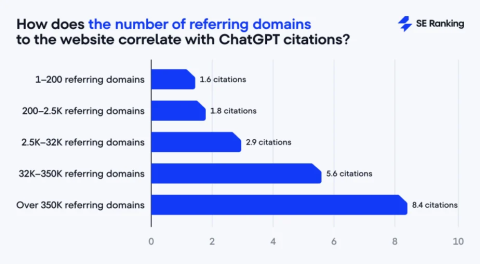
Source: SE Ranking
These findings point to the same pattern: backlinks matter for AI visibility, but indirectly. The link doesn't make AI cite you; it’s the ranking it earns that does. Get into the top 10 organically, and your chances of appearing in an AI-generated answer rise sharply.
There's also a threshold effect worth understanding. Beyond a certain baseline of referring domains, more links produce diminishing returns. Past the threshold, content structure, format, and brand context become the deciding factors.
Google indexes the web and treats links as a sorting signal. A page with more high-quality referring domains tends to rank higher, all else being equal. Google's own AI Mode and AI Overviews inherit that index, so links carry through to those surfaces directly.
LLMs like ChatGPT and Perplexity work differently. They don't evaluate link graphs in real time. They generate responses by drawing on training data and, for newer retrieval-augmented models, by pulling relevant content from indexed sources. What they reward isn't the raw count of backlinks pointing at a URL — it's how easily a page's information can be extracted, understood, and credited.
That means a few things traditional SEO doesn't fully account for:
This is why a strategy built solely on backlink counts often stalls in terms of AI visibility, even when the same brand ranks well on Google.
Evertune's analysis of 25,000 highly-cited URLs revealed a striking pattern. Approximately half are listicles, and 63% of all LLM citations point to listicle-format content. Ranked lists outperform unranked ones, and pages with clear structure outperform those without.
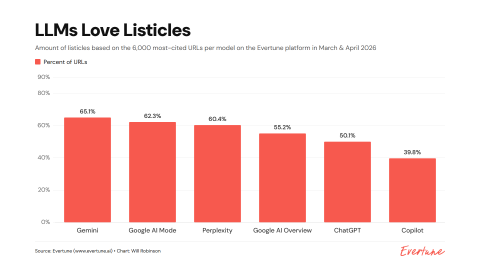
Source: Evertune
Listicles aren't the only format that performs well. Tutorials, comparison pages, original research, and data-backed guides share the same underlying traits — and those traits are what make a page citable:
If your link-building campaign points to a page that lacks these signals, the page may rank in Google but still struggle to earn AI citations. Format and authority work together; neither carries the full weight on its own.
The strongest link-building tactics now are the ones that serve both audiences in a single motion.
Publishing original research (survey data, proprietary analysis, and industry benchmarks) earns high-authority backlinks from publications that cite your numbers. It also creates the exact kind of structured, data-rich content that LLMs lean on when generating answers.
A single piece of original research can be cited dozens of times across editorial publications, industry blogs, and AI-generated responses. The link equity supports your Google rankings, while the data points and quotable findings supply the substance AI extracts.
Getting your brand featured in existing high-ranking list content (e.g., "Top 10 [your category] for [use case]") is one of the most direct ways to bridge search and AI visibility in a single placement. AI systems already cite these lists, and when your brand sits inside them, AI cites you by extension.
This is often more efficient than building a competing listicle of your own, which would have to outrank the existing ones to earn the same citation share.
There's a recent shift worth flagging, noticed by Lily Ray (founder of Algorythmic), regarding publishing listicles on your own website. Since early 2026, sites that publish self-serving listicles have been losing ground in AI recommendations, especially those that have built dozens or hundreds of such lists.
Patterns observed across affected sites suggest Google may now treat such listicles as competitor reference material and citation fodder, while excluding the publishing brand from the actual recommendation surfaced to users. Small-scale use of the tactic still appears to work in some cases, but the safer bet is to earn placements in third-party listicles rather than build self-ranking lists of your own.
A contextual mention of your brand on Wikipedia, a major publisher, a niche-authority site, or a trusted directory can earn AI citations even without a hyperlink. AI models cross-reference mentions across sources to build trust.
Where it's feasible, convert unlinked mentions into links, and that's where digital PR meets traditional link building. But don't dismiss unlinked mentions since they carry independent value and often outweigh a single low-quality link.
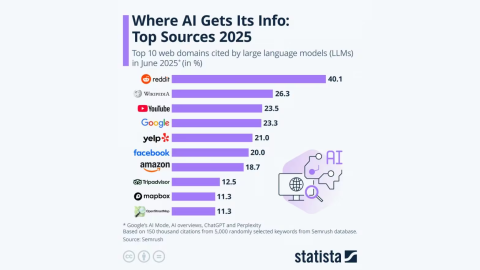
Image source: Statista
Reddit is one of the most-cited domains in Google's AI Overviews, which makes sense, since Reddit and Google made a deal in February 2024, when Reddit made its content available for training Google’s AI models. Forums and Q&A platforms appear frequently in LLM responses because users go there for unfiltered, peer-driven information (exactly the kind of source AI models treat as authentic).
Authentic, helpful participation in relevant subreddits and industry forums creates a layer of visibility that traditional link building can't replicate. The goal isn't promotional posting. It's contributing useful answers under a brand-aligned account, building credibility that AI systems recognize over time.
Some link-building practices yield search-only results, and others yield no measurable results at all. If your strategy still leans on any of these, it's worth auditing.
A quick self-check: If your backlink count is climbing month over month, but your referring domain diversity is flat, and your AI citations remain at zero, the strategy is one-dimensional. It's optimized for one metric and one system, and it will continue to underperform in the other.
Domain rating and total backlink count are still real metrics, but they're no longer enough on their own. Tracking AI visibility requires a second column on the dashboard:
Tools are catching up. Bing Webmaster Tools now reports AI citation data. Morningscore and Evertune both offer ChatGPT and AI Overview tracking. New entrants are emerging weekly.
The most useful check is also the simplest one - open ChatGPT, Perplexity, and Google AI Mode, and search your own brand. Ask the same questions your customers would ask before they know your brand exists: "Best [category] for [use case]," "How to choose a [service]," "What's the difference between [brand A] and [brand B]." Read what comes back. That five-minute self-audit will tell you more about your current AI visibility than any single tool.
The brands gaining ground are the ones treating link building as a positioning strategy: where you appear, in what context, and how clearly your brand is referenced matter as much as the link itself.
That means a few practical shifts. Invest in original research and digital PR, because the same campaign earns links and creates citable content. Pursue editorial placements in existing high-ranking listicles, because AI already cites them. Build an authentic presence in the communities AI treats as primary sources. And audit your own brand inside AI tools regularly, so you know what customers actually see when they ask.
Customers are forming opinions about your business in two places at once. Recognizing link building as part of a broader brand presence (and not a metric chased in isolation), the strategy that will get you visible in both.