
Why Your B2B Outbound Emails Never Reach the Inbox (And What It Costs You)
Your B2B cold emails might be landing in spam, not inboxes. Learn how to check placement and the 4 fixes that actually move the needle—not copy edits.
Updated September 3, 2026

A practical breakdown of what changes when you're preparing content for AI retrieval instead of human readers, covering everything from how retrieval actually works to what a real content audit should catch that most miss. It's not a trend piece; it's a hands-on framework that content teams can actually use.
Generative AI systems now retrieve and summarize enterprise information at scale, and most organizations aren’t ready for it.
According to Gartner, 63% of organizations either don’t have (or are unsure whether they have) the right data management practices for AI, and the firm predicts that through 2026, organizations will abandon 60% of AI projects that are unsupported by AI-ready data.
Looking for a Content Marketing agency?
Compare our list of top Content Marketing companies near you
Knowledge bases, customer service bots, employee self-service portals, and copilot tools all depend on pulling relevant content from internal repositories and assembling it into coherent answers. The quality of those answers directly reflects the quality of the underlying content.
Here’s the problem: Enterprise content ecosystems were built for human readers, not machine retrieval. Inconsistent metadata, ambiguous taxonomy terms, duplicate records, and outdated information frustrate human users and degrade AI-generated outputs, producing hallucinated facts, incomplete answers, and confidently stated errors.
Preparing enterprise content for AI retrieval requires action across six areas:
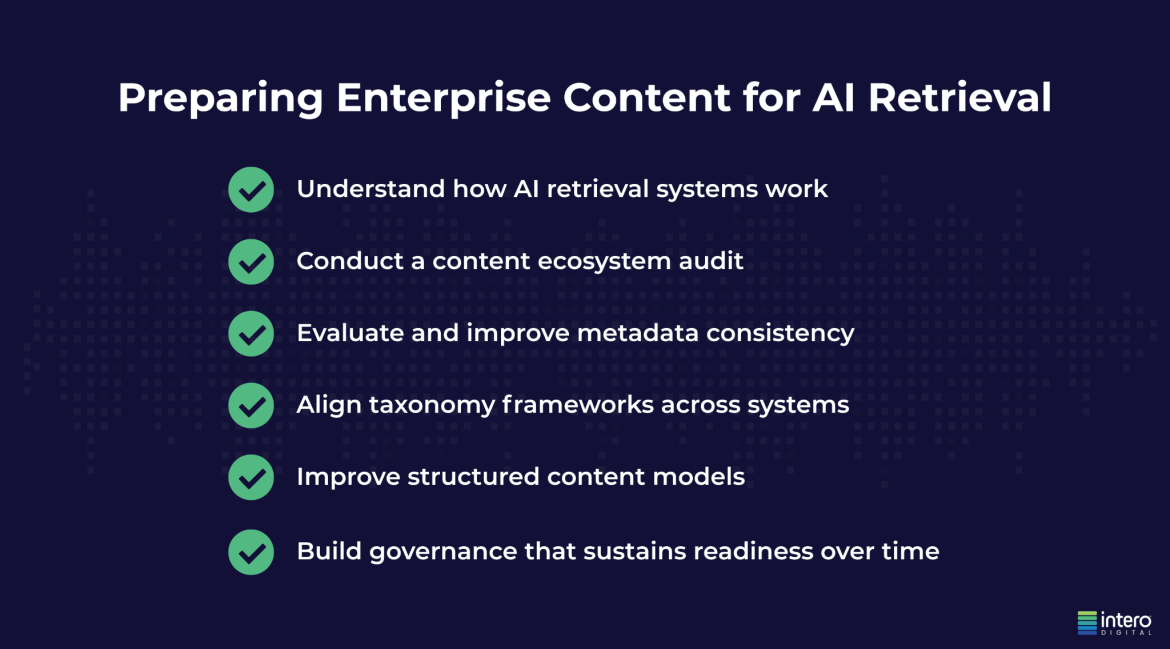
Each section below addresses one of these areas in sequence, moving from foundational concepts to practical implementation steps.
Most enterprise AI systems use one of two retrieval approaches (or a combination of both).
The first is lexical search, which matches query terms against terms in a document index. Most content teams already understand this model from traditional SEO.
The second approach is semantic search. Semantic or vector search is often used inside retrieval-augmented generation (RAG) systems. In a RAG system, both documents and queries convert into numerical representations called embeddings. The system retrieves content whose embeddings are mathematically closest to the query, regardless of exact keyword overlap.
Semantic retrieval is sensitive to meaning and context. Content that is vague, internally contradictory, or dependent on surrounding context for interpretation performs poorly, even when it contains the right terminology.
AI systems also retrieve content in chunks (typically paragraphs or fixed-length segments) rather than whole documents. As research from the 2024 International Conference on Advances in Artificial Intelligence notes, little attention has been paid to optimizing the knowledge base content itself, even as teams invest heavily in model tuning and retrieval architecture. Content that buries its key claim at the end of a long paragraph or requires reading an entire document to understand a single section is poorly served by chunked retrieval.
The practical takeaway: Every retrievable content unit needs to carry enough context to stand on its own.
The starting point for AI readiness is an honest assessment of what content exists, where it lives, and what condition it’s in.
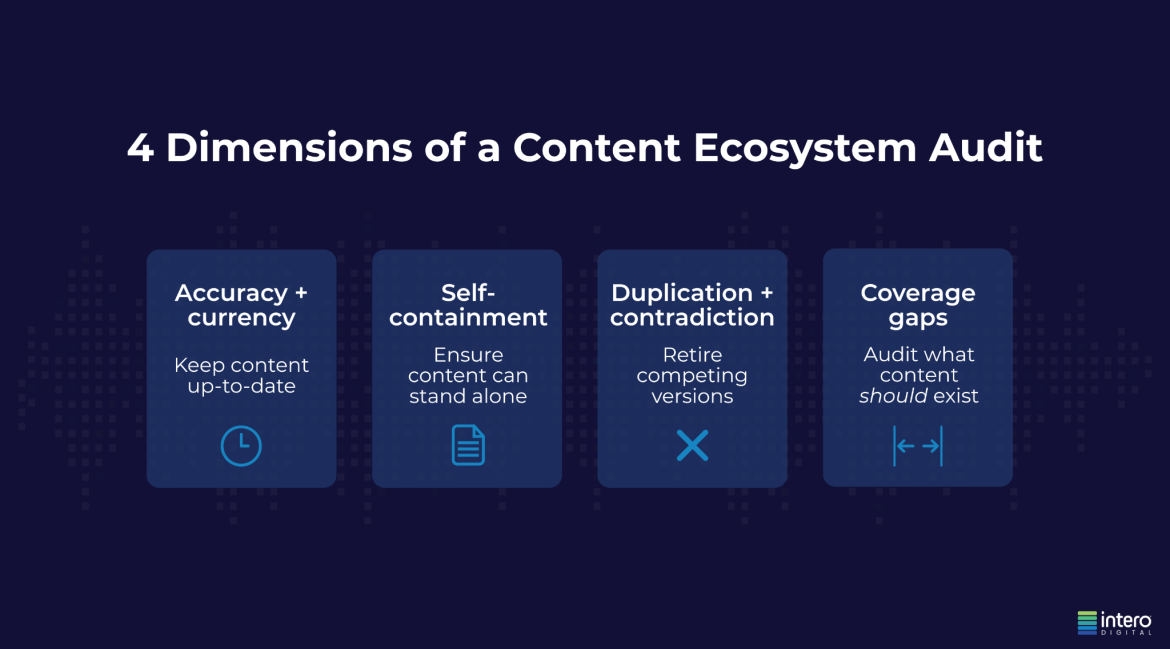
Content audits are not new, but the evaluation criteria for AI readiness differ from those used for human-facing content. A thorough audit covers four dimensions:
Metadata is the primary mechanism by which AI retrieval systems filter, prioritize, and contextualize content. It’s also one of the most persistent weaknesses in enterprise content environments.
The core problem is inconsistency.
A document tagged with a product name in one system might carry a product code in another. A topic category in the knowledge base might not correspond to any field in the document management system. Date fields are often unpopulated, ambiguous, or formatted differently across records.
For AI retrieval, metadata such as ownership, creation date, sensitivity classification, and data domain are attached to each retrievable chunk, enabling filtered and governed retrieval. Without it, the system has no reliable basis for ranking relevance or filtering by recency or authority.
At a minimum, establish consistent standards for these fields across all repositories feeding an AI system:
Achieving consistency across legacy content requires two approaches working in tandem: automated metadata enrichment (using AI tools to suggest or apply tags to unstructured content) and governed authoring workflows that enforce metadata requirements at the point of creation.
Neither approach works well without the other.
Taxonomy alignment determines whether AI retrieval produces coherent results or a confusing mix of loosely related content.
Many organizations operate multiple taxonomies in parallel: one in the CMS, another in the document management system, a third in the intranet, and a fourth implied by folder structures in shared drives. When an AI system draws on multiple repositories, it navigates several different filing systems simultaneously.
The goal isn’t necessarily replacing all existing taxonomies with a single enterprise-wide controlled vocabulary, which is a politically and technically difficult undertaking. A more pragmatic approach is to establish a crosswalk or mapping layer that recognizes equivalent terms across systems as synonymous.
This work requires collaboration between content, IT, and the business units that own different repositories.
Pay particular attention to terms that carry different meanings in different organizational contexts: product names that are also common words, abbreviations shared across business units, or internal jargon that doesn’t match industry-standard terminology. These ambiguities are invisible to human readers who are familiar with the context. They create retrieval failures for AI systems.
Structured content that’s organized into discrete, typed fields or components and separated from its presentation is inherently better suited to AI retrieval than unstructured narrative documents.
A structured product description with distinct fields for name, specifications, compatible systems, and known limitations gives an AI retrieval system precise, labeled information. A PDF brochure containing the same information embedded in marketing copy is far harder to parse reliably.
Organizations that haven’t adopted structured content models (such as DITA, component content management, or structured authoring in a headless CMS) should consider adopting one for high-priority content categories. AI readiness adds to an already strong business case: Structured content reduces localization costs, improves reuse, and simplifies multichannel publishing.
For organizations that aren’t ready for a full structured content initiative, some intermediate steps can meaningfully improve AI retrievability:
The more clearly content is organized before AI systems encounter it, the more reliably they can retrieve and represent it.
Content preparation for AI retrieval isn’t a one-time remediation project. It’s an ongoing discipline.
Gartner’s definition of AI-ready data requires content that’s actively governed at the asset level, supported by quality gates, managed through live metadata, and continuously quality-assured. Traditional content governance (like quarterly audits and annual reviews) doesn’t meet that bar.
Effective governance starts with clear ownership. Someone is accountable for making sure content is reviewed on schedule, metadata is maintained when content is updated, and retired content is formally archived rather than left available for retrieval.
It also means building AI readiness criteria into content review workflows. When a document comes up for periodic review, the reviewer assesses not only accuracy, but also whether the content is appropriately structured, whether its metadata is complete and current, and whether it remains interpretable out of context.
Organizations deploying AI systems benefit from establishing a content readiness working group that includes representation from content management, IT architecture, legal and compliance, and the business units most affected by AI outputs. This group defines quality standards, monitors retrieval quality through user feedback and evaluation frameworks, and prioritizes remediation based on what the AI is most likely to retrieve.
One of the most valuable yet underutilized practices is evaluating what the AI system actually retrieves in response to representative queries.
This practice, often called retrieval evaluation or RAG evaluation, involves constructing a test set of queries representative of real user interactions, running those queries against the retrieval system, and examining both the retrieved content and the generated answers.
Retrieved content that’s outdated, off-topic, or contradictory points to specific problems traceable back to their source: a missing metadata field, an ambiguous taxonomy term, a document that should have been archived, etc.
Run retrieval evaluation before an AI system goes live. Repeat it at regular intervals, particularly after significant content updates, taxonomy changes, or system configuration modifications.
The organizations that extract the most value from enterprise AI systems treat content quality as infrastructure — as foundational to AI performance as model selection, system architecture, or prompt design.
For content management professionals, this represents a genuine opportunity. The discipline of content strategy (taxonomy design, metadata governance, structured authoring, and content life cycle management) is exactly what enterprise AI needs. The tools and frameworks already exist.
What’s required now is applying them with AI retrievability as an explicit design criterion alongside human usability.
Making content machine-readable and making content better for human readers are, in most respects, the same work: more accurate, more clearly structured, more consistently maintained, and more reliably findable.