Software development used to be about shipping features fast. But now, your engineers spend more time navigating legal mazes instead of writing code.
The average GDPR (General Data Protection Regulation) fines jumped to €2.8M in 2024 — a 30% increase from last year. The EU AI Act, implemented in August 2024, brings penalties up to €35M or 7% of your global revenue. Meanwhile, California's CCPA (California Consumer Privacy Act) can slap you with $7,500 per violation.
AI regulation is a hot topic right now because AI technologies are evolving faster than laws or policies can keep up. This raises serious questions around safety, ethics, economics, and control. And development teams are paying the price. Every new feature needs legal review, and every deployment faces compliance checkpoints.
Looking for a Software Development agency?
Compare our list of top Software Development companies near you
But what if you could turn this regulatory nightmare into your competitive advantage?
The Regulatory Landscape: What Developers Are Up Against
The EU AI Act was the first major comprehensive law regulating AI, and it has a huge impact on development teams. Passed in 2024, it attempts to ensure that AI is safe, ethical, transparent, and respects fundamental rights — especially when used in high-stakes areas like healthcare, law enforcement, hiring, or education.
The Act divides AI systems into risk categories. Prohibited systems are off the table. And high-risk systems require transparency reports, extensive documentation, and human oversight mechanisms built into your architecture. Even limited-risk systems require clear disclosure to users:
- Your facial recognition feature for employee access is high-risk.
- That chatbot handling customer service is limited-risk at a minimum.
- The recommendation engine driving your core product could fall anywhere on the spectrum, depending on implementation.
GDPR and CCPA haven't made AI development easier either. Every feature you build needs consent mechanisms, data access portals, and deletion workflows incorporated from the start.
You're asking developers to be part engineer, part lawyer, part ethicist, and it's breaking their workflows in unanticipated ways.
How AI Regulation Is Impacting Software Development Teams
The ripple effects of AI regulation touch every corner of your development process. What started as legal requirements has transformed into technical debt that compounds daily.
Your teams face a new reality where compliance isn't an afterthought but the main event.
Workflow Disruption
Developers and product managers now spend considerably more time reviewing compliance checklists, performing risk classifications, and generating extensive documentation to meet regulatory requirements like the EU AI Act.
Now every feature starts with a compliance checklist:
- Is this AI system high-risk?
- What data does it process?
- Which jurisdictions apply?
Your engineers sit through meetings with legal teams, trying to translate legalese into technical requirements. They document every decision, every data flow, and every algorithmic choice. A simple feature that once took two weeks now stretches to six.
The back-and-forth never stops. Legal asks for clarification. Privacy teams need modifications. Compliance wants additional safeguards. Your developers ping-pong between writing code and defending their architectural choices to non-technical stakeholders.
This shift toward governance adds friction to traditionally agile processes, slowing down iterations and lengthening release cycles. Teams also face frequent back-and-forth with legal, compliance, and privacy stakeholders to ensure that AI systems meet standards for transparency, fairness, and accountability. As a result, the development process is becoming less about rapid innovation and more about controlled, auditable execution — often at the cost of speed and flexibility.
Release Delays
With more regulation, many dev teams are adding layers of approval which can slow development. That new AI feature you promised to customers last quarter is still sitting in review, and the approval layers keep stacking up:
- First, your internal compliance team reviews the implementation.
- Then the legal team examines the documentation.
- Privacy officers check data handling.
- Risk assessors evaluate potential harms.
- External auditors verify everything.
Each review cycle reveals new requirements you missed. Maybe the AI model needs better explainability features. Perhaps the data retention policy conflicts with GDPR Article 17. The human oversight mechanism might not be robust enough for high-risk classification.
Then you're back to the drawing board. Another sprint. Another delay.
Hidden Development Costs
AI regulation is driving up development costs by introducing significant new requirements that extend far beyond traditional coding. Teams are now investing in extra tooling, such as:
- AI explainability platforms, which run thousands per month.
- Consent management systems that require another subscription.
- Audit logging infrastructure requires custom development fees plus ongoing storage costs.
These tools often come with licensing fees, integration overhead, and ongoing maintenance.
Additionally, companies increasingly need to pay for external audits, legal reviews, and formal risk assessments to validate compliance, especially when building high-risk AI systems.
This adds both direct expenses and indirect delays, as legal and technical teams collaborate to address gaps. Altogether, these regulatory demands are reshaping budgets, timelines, and staffing models, making AI development substantially more expensive and operationally complex. The sticker price of compliance keeps climbing, and most executives don't see it coming.
Developer Burnout & Talent Strain
Your best engineers didn't sign up to be compliance officers. They joined to build innovative products and solve complex problems.
Now they spend their days attending legal meetings and implementing consent flows. The creative work that attracted them to your company gets buried under regulatory requirements.
To make matters worse, the talent market for engineers who understand AI regulation remains painfully thin. You're competing with every tech company for the same scarce pool of privacy engineers and AI ethicists. It's forcing companies to train internally or pay premium prices for experienced hires.
5 Key Strategies for Smoother AI Regulation Compliance
However, there's a silver lining. Compliance doesn't have to cripple your development process. Smart organizations are finding ways to integrate regulatory requirements without sacrificing innovation.
The key is to stop treating compliance as an obstacle and start treating it as architecture.
Embed Legal Into the Dev Process Early (Shift Left on Compliance)
Stop treating compliance as a final checkpoint. Bring legal and privacy teams into sprint planning, design reviews, and architecture discussions. When developers understand legal requirements early, they build compliant solutions from the start.
Also, create compliance champions within engineering teams. These developers bridge the gap between legal requirements and technical implementation. They translate legalese into actionable engineering tasks.
Invest in Privacy and Ethics-by-Design Principles
Stop bolting privacy features onto finished products. Instead, build them into your foundation.
Create reusable compliance components your teams can drop into any project, such as:
- A consent management module
- An audit logging service
- A data deletion workflow
When every new feature starts with these building blocks, compliance becomes automatic.
Another best practice is to develop standard patterns for common regulatory requirements:
- Need explainable AI? "Here's your template."
- Processing personal data? "Follow this blueprint."
- High-risk system? "Use this architecture."
Your teams should treat ethical considerations as non-negotiable from day one.
Automate Compliance Where Possible
Manual compliance processes kill velocity. So, deploy tools that continuously monitor your systems for regulatory violations. For instance, you can set up automated data mapping that tracks where personal information flows through your infrastructure. Or use bias detection systems that flag problematic model behavior before it reaches production.
Another great solution is to implement policy-as-code frameworks. For example, it could be Open Policy Agent or Checkov. Define your compliance rules once, and enforce them everywhere.
However, connect these tools to your existing development workflow. Compliance warnings should appear in pull requests, not quarterly audits.
Train Developers on AI and Data Regulations
Your engineers need to understand the purpose of compliance requirements. Run monthly workshops where legal teams explain regulations in technical terms or build a knowledge base of compliance patterns, anti-patterns, and edge cases your teams have encountered.
Many organizations even partner with legal to create "compliance office hours" where developers can get quick answers without scheduling formal meetings. Sometimes a five-minute conversation prevents a five-week delay.
Besides all this, regulatory knowledge should become a part of your organization's engineering career ladder. Engineers who understand compliance become technical leads faster.
Plan for Longer Release Cycles & Higher Budgets
Compliant development now takes longer and costs more, so plan accordingly. It's wise to add a buffer to your development timelines for compliance-related work.
Also, budget for ongoing legal review, not just initial assessment. As regulations evolve, you often need continuous legal guidance.
Then there are external audit costs, which you can factor in from the start. Don't let these surprise your CFO (Chief Financial Officer) mid-quarter. If you're building high-risk AI systems, you might even need quarterly audits.
Beyond Compliance: Turning Regulation Into an Advantage
Don't treat compliance as a defensive obligation. In fact, companies that design for trust and transparency can gain a competitive edge.
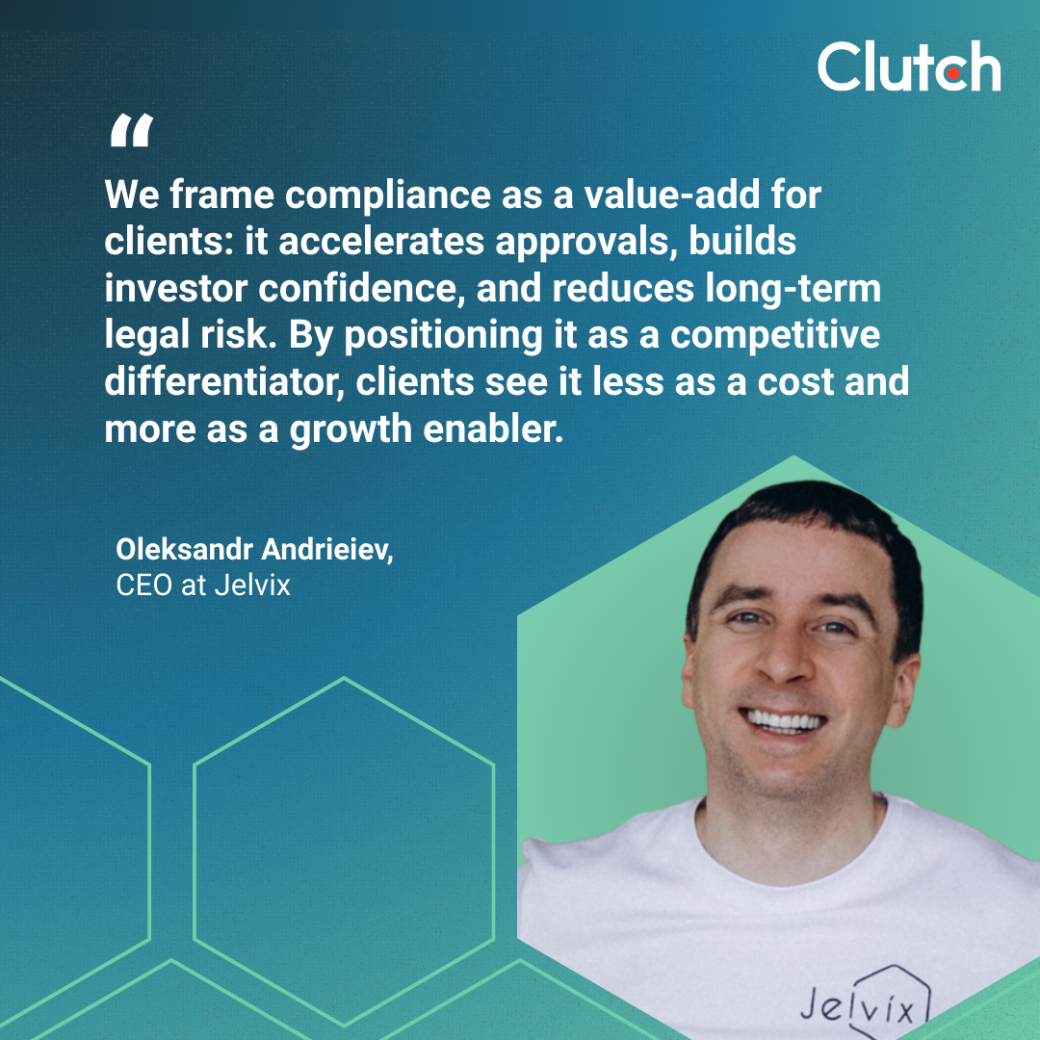
"We frame compliance as a value-add for clients: it accelerates approvals, builds investor confidence, and reduces long-term legal risk," says Oleksandr Andrieiev, CEO at Jelvix. "By positioning it as a competitive differentiator, clients see it less as a cost and more as a growth enabler."
Large enterprises and government agencies now require proven compliance track records. You might have seen that many healthcare organizations or financial institutions only work with vendors who demonstrate rock-solid compliance. Your commitment to AI regulation becomes a competitive differentiator in such cases. Companies that nail regulatory compliance win enterprise contracts others can't touch. Your adherence to AI regulation becomes your ticket to these lucrative markets.
Most importantly, strong compliance practices improve brand reputation and user trust. And user trust translates directly into business metrics. It's a virtuous cycle that starts with compliance.
Your compliance infrastructure is a moat in itself that competitors can't easily cross. While they scramble to meet basic requirements, you're already building advanced features on your compliant foundation.
Ultimately, brand reputation in the AI era hinges on ethical deployment. One algorithmic discrimination scandal can destroy years of brand building. But consistent, transparent, compliant AI practices? That builds the kind of reputation that attracts top talent and premium customers.
Embrace AI Regulations
AI regulation isn't going away. If anything, it's accelerating.
Many development teams treat compliance as a burden that slows innovation and frustrates engineers. But the best way forward is to embrace it as the new foundation for building trustworthy and sustainable products. In fact, a recent Clutch survey shows that 75% of developers already expect AI to significantly reshape software development.
Thus, the organizations that build AI compliance into their DNA will dominate the markets. They'll attract the best talent who want to work on meaningful, ethical AI. They'll win the enterprise deals that demand regulatory excellence. And overall, they'll build the user trust that fuels long-term growth.
So, start small. Pick one team, implement compliance practices, and measure the impact. Learn what works for your organization and scale successful approaches gradually.
Most importantly, stop treating compliance as the enemy. It's simply the new rules of the game. Master them, and you'll build better, more trustworthy systems that customers actually want to use.
About the Author
Hannah Hicklen
Content Marketing Manager at Clutch
Hannah Hicklen is a content marketing manager who focuses on creating newsworthy content around tech services, such as software and web development, AI, and cybersecurity. With a background in SEO and editorial content, she now specializes in creating multi-channel marketing strategies that drive engagement, build brand authority, and generate high-quality leads. Hannah leverages data-driven insights and industry trends to craft compelling narratives that resonate with technical and non-technical audiences alike.
See full profile