7 Tips For Designing Web Forms
Clutch surveyed 502 web users about what they actually want from form design. Here are 7 data-backed UX principles that reduce abandonment and improve...
Updated February 14, 2026

Accessibility gaps remain widespread, even as courts and consumers demand inclusive design.
The internet is supposed to be for everyone, but for millions of users with disabilities, it still isn’t. A new report shows that many of the world’s most-visited websites continue to fall short on basic accessibility, leaving users locked out of essential services and everyday digital experiences.
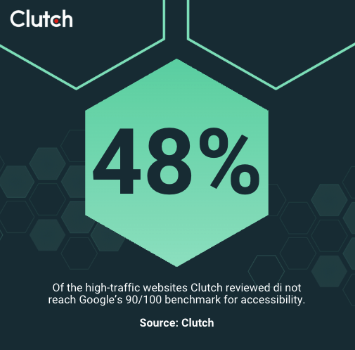
According to Clutch research, almost half of the internet’s most-visited sites are failing basic accessibility checks. Out of the 95 largest websites analyzed, 48% didn’t meet Google’s accessibility threshold of 90/100, leaving millions of people with disabilities unable to use them fully. The average score was just 89.2, and only 18 websites achieved a perfect 100. Clutch’s own site is among the top scorers, achieving a 100/100 accessibility rating — proof that inclusion is possible when it’s prioritized.
Looking for a Web Design agency?
Compare our list of top Web Design companies near you
The failures are widespread. Nine out of ten news outlets and 56% of e-commerce platforms fell short of accessibility standards. That means everything from breaking news to essential shopping services remains out of reach for many of the 70 million Americans with disabilities (CDC) and 42.5 million adults with disabilities (US Census). Globally, this overlooked market represents a staggering $13 trillion in annual spending power, according to The Valuable 500 and Yale University’s 2024 white paper.
Despite clear legal requirements under the Americans with Disabilities Act (ADA) and Section 508 of the Rehabilitation Act, the data shows major platforms systematically exclude users with a disability. With billions of visits flowing to these sites each month, the problem is not only an ethical one, but it’s also a massive missed business opportunity.
Clutch’s audit shows just how far leading platforms are from meeting basic accessibility standards. Of the 95 high-traffic sites reviewed by Clutch, 46 did not reach Google’s 90/100 benchmark.
Problems were consistent across these categories:
The websites with room to grow may be surprising. WebMD, a top destination for health information, scored only 67/100 — putting essential medical content out of reach for users who rely on accessible design. USPS.com also scored 67/100, a concerning result for a government service that is expected to meet Section 508 accessibility standards. Entertainment and sports sites also struggled: ESPN landed at 75/100, Rotten Tomatoes at 68/100, and CBS Sports at 70/100.
Each of these examples reflects content that 75% of adults with disabilities report trying to access regularly — underscoring how much harder it is for them to use the internet compared to those without disabilities.
The implications go beyond accessibility compliance. In the United States, people with disabilities hold $490 billion in annual spending power, and the global figure climbs to $13 trillion. Companies that fall short are not only excluding a massive audience but also increasing their exposure to litigation, which we’ll touch on more below.
News outlets emerged as the lowest-performing category in our audit. The average score was 83.8 out of 100, placing most major publishers below Google’s accessibility threshold. This finding is especially concerning given that news organizations often cover disability rights while their own platforms remain inaccessible.
The results show consistent accessibility gaps across major news platforms:
These scores highlight barriers to reliable information — placing many readers at risk. Auto-playing videos without controls, missing alt-text on graphics, vague link text, and poor color contrast are just a few examples of the challenges users with disabilities face.
Because news sites fall under “public accommodation” in the Americans with Disabilities Act, publishers face real compliance risk. More importantly, accessibility shortfalls erode public trust and undercut the role of journalism in providing equal access to information.
E-commerce platforms account for some of the most significant accessibility failures in the dataset. More than half of the sites reviewed, 56% did not meet basic standards. That means a global market valued at $13 trillion in annual spending by people with disabilities remains partly inaccessible to the very customers it should be serving.
Several high-traffic retailers illustrate the issue:
These examples highlight how gaps in web design and testing translate into missed revenue and heightened liability for some of the world’s largest retailers.
Out of our audit, 18 companies showed what full accessibility looks like. Target received a perfect score of 100, the result of changes made after its lawsuit that set a precedent for online retail. Apple also scored 100, continuing its long record of pairing technology with inclusive design. IKEA joined them with a perfect 100, demonstrating how consistent design principles can be applied across a global e-commerce platform.
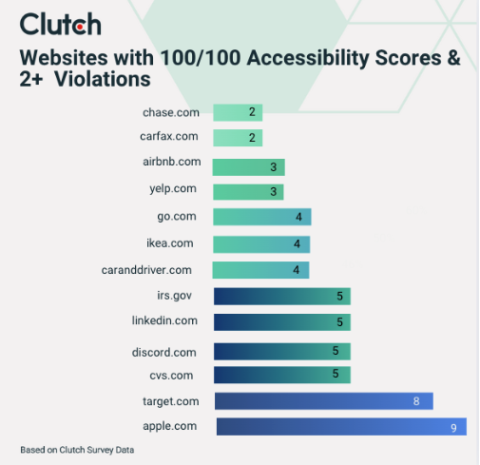
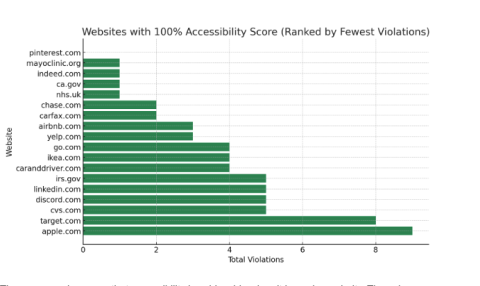
These companies prove that accessibility is achievable when it is made a priority. They also highlight a competitive advantage. Companies that take accessibility seriously not only meet compliance standards but also build stronger reputations and reach a wider audience.
Courts have been shaping the rules around digital accessibility for more than a decade. A key moment came in 2008 when the National Federation of the Blind took Target to court. The case ended in a $6 million settlement and made it clear that a website has to be treated like a physical store when it comes to access.
Another turning point followed in 2012. The National Association of the Deaf reached a $795,000 settlement with Netflix, which established that even companies that operate entirely online must comply with the Americans with Disabilities Act.
ADA Civil Penalties
Even one lawsuit can cost businesses far more once you add in legal fees, settlements, and remediation plans.
Source: AudioEye
Since then, lawsuits have multiplied. Retailers are frequent defendants, and most settlements require not just a payout but also a long-term plan to fix accessibility gaps. The rise in cases shows that businesses that delay improvements often end up spending more, both in court and in lost trust. Both examples point to the same conclusion. When companies choose universal design, the benefits extend beyond compliance. Accessibility improves the experience for every user and creates an edge over competitors that continue to leave barriers in place.
The number of sites in each category was limited, but some patterns still emerged among top performers. Of the 18 sites that scored a perfect 100, two were government sites, two were jobs and education platforms, and four were in the computers and electronics category. Notably, the computers and electronics group averaged 97.5 overall, with no outright failures. These results suggest that when accessibility is treated as a requirement — especially in sectors with technical or compliance-driven cultures — strong performance is possible.
By contrast, other groups performed far worse. Seven sports sites failed 83% of the time with an average score of 81.2. Five online community platforms, including forums and social media-style sites, failed 80% of the time, averaging a score of 82. Fourteen news outlets failed 90% of the time, averaging 83.8. Each of these categories attracts large audiences, yet most of the platforms in the sample remain difficult to use for people with disabilities.
The contrasts are sharp. Sports sites perform poorly even though Paralympic and adaptive sports are highly visible, while technology companies tend to lead, suggesting accessibility has become part of the technical baseline in that sector. Health content shows the widest spread. Mayo Clinic and the NHS both scored 100, while WebMD came in at 67.
Because this analysis covered only the top 100 most-visited sites, these sector averages highlight directional patterns rather than comprehensive industry coverage.
Accessibility is often seen as a box to check, but it can be a growth driver. In our audit, 18 sites scored 100/100. They came from different industries, which shows that strong performance is a matter of choice, not technical limits. The companies that treat inclusion as a strategy are already using it to stand out from competitors.
Some of the most common website accessibility issues are also the simplest to address. Touch targets were too small or too close together on 64% of websites, while color contrast problems appeared on 54%, and Critical ARIA errors showed up on 22%. Fixing these areas first would raise scores quickly and improve usability for a wide range of users.
The companies that do this well usually follow a clear progression:
The legal environment is moving quickly. WCAG 2.2 is becoming the reference point for compliance, and recent rulings show that courts are backing plaintiffs more often. Companies that address accessibility early are able to plan improvements on their own schedule, budget for them, and roll them out in a way that aligns with broader digital roadmaps. In other words, they keep control of how and when fixes are made.
The findings show how much work is left. Nearly half of the largest sites failed Google’s accessibility check, with news outlets averaging just 84% and more than half of e-commerce sites falling short. These results highlight that accessibility gaps aren’t about technical limitations, but about organizational commitment.
The stakes extend beyond compliance. People with disabilities control $13 trillion in global spending power. Courts are adopting WCAG 2.2 as the standard, and recent cases have favored plaintiffs. Companies that act now gain loyalty and reach. Companies that wait often end up paying more, both in court and in lost trust.
Accessibility has shifted from a compliance issue to a competitive advantage. The direction is clear: some organizations will lead, and others will be forced to follow.
This analysis reviewed 95 of the top 100 websites ranked by aHrefs organic traffic. Five sites were excluded because they blocked crawling.
Accessibility was measured using Google PageSpeed Insights, which scores sites on a 0–100 scale. Scores of 90 and above were considered “Good,” 60–89 “Needs Improvement,” and below 60 “Poor.” No site in the dataset fell below 60.
Compliance with WCAG 2.0, 2.1, and 2.2 at the A, AA, and AAA levels was also evaluated. The review covered each site’s homepage along with primary user pathways. Industry categories followed standard classifications for sector analysis.
There are limits to this type of review. Results reflect a point in time and rely on automated scoring. Major violations were verified manually, but some false positives are possible.