
How to Define Brand Values That Guide Every Business Decision
Brand values are the principles that guide company decisions, define what a brand stands for, and shape how it treats customers, employees, and partners.
Updated May 25, 2026

Organizations of all sizes and industries need logos representing their missions well. To ensure your brand is encompassed within your logo, look to logo design success stories for inspiration.
Your brand encompasses the collective experience, perception, and reputation that people associate with your services. Branding involves the strategic actions taken to build your brand, while a brand identity represents the tangible manifestation of your brand, such as your logo, typography, and colors.
However, it's crucial to acknowledge that your logo holds significance for your business as it conveys ownership, quality, and values. It becomes imprinted on your products, business cards, website, social media platforms, and, most importantly, in the minds of your clients.
Looking for a Public Relations agency?
Compare our list of top Public Relations companies near you
Considering that your logo often serves as one of the initial points of interaction with your company, it presents an opportunity to make a lasting first impression, demonstrate your commitment to delivering a quality service, and visually articulate your purpose.
Connect with the best logo design companies on Clutch.
There are a large number of logo designs that have been around for many years. Some of the designs look dated, but some of them feature a timeless quality. The logo designs that have maintained their relevance offer valuable insights.
If they were visually appealing over 50 years ago and still possess an appealing aesthetic today, they will likely remain equally effective in the next 50 years. It is this timeless quality that we can learn from. Studying these designs enables us to comprehend the factors contributing to their enduring success.
We can identify the characteristics that have allowed these logos to remain influential. By understanding these qualities, you can make informed decisions during the design process, whether you choose to deviate from them or adhere to elements that are likely to withstand the test of time.
Here are the top five characteristics of a successful logo design:
Clarity and conciseness are vital traits for a successful logo. Since logos serve as the universal symbol of a brand, an effective mark should visually capture the brand's essence.
Vague or excessively intricate logos can impede viewers from comprehending the brand's message. It is crucial to keep the design simple, avoiding unnecessary embellishments unless they contribute to the overall impact or concept of the logo.
Legibility is a crucial aspect that often goes overlooked when crafting logos. Connected to clarity, a legible logo that can be effectively utilized across diverse media platforms is a significant advantage for achieving success.
The logo should maintain legibility whether scaled down to a small size, such as on a shirt sleeve or blown up to a large scale, like on billboards or vehicles. Ensuring consistency across all size variations and backgrounds is essential to guarantee universal logo visibility at its highest quality.
Neglecting legibility can cause the logo design to become lost amidst the constant chaos of the marketing and advertising landscape.
A fundamental attribute is developing a logo mark that aligns with the brand's purpose.
The design process should prioritize context and function over form. Put simply, the visual elements of the logo must align with its intended purpose. A logo designed purely for aesthetics may lack substance and fail to resonate with viewers.
Establishing a meaningful connection between the logo's appearance and intended function is essential.
Creating something memorable can be a challenging task, and the same holds true for logos. Uniqueness is pivotal in ensuring a logo design maintains a memorable appearance.
While having certain similarities with another brand may not be a complete downfall, a logo must possess distinct characteristics that set it apart from the crowd. Learning from competitors can offer valuable insights on how to achieve memorability. Analyzing their successes and failures can guide the construction of a logo.
Utilize both positive and negative information to your advantage, ensuring the logo mark is unique and memorable compared to others in the industry.
A logo that remains unchanged for years or even decades is a testament to its effectiveness. Styles evolve over time, and a logo that transcends trends or specific eras has the potential for longevity.
It's important to remember that in logo design, form follows function, and the allure of trends should be disregarded from the outset. A logo that quickly becomes dated can disappoint loyal brand followers. Therefore, when creating a logo, it's essential to prioritize the brand itself over fleeting design fads.
Focus on the enduring essence of the brand rather than succumbing to external design influences.
Let’s take a look at the top seven successful logo design examples:
Nike's "swoosh" symbol has become one of the most renowned icons globally, but they didn’t have a great start.
Source: Nike
In 1971, the iconic Nike "swoosh" was brought to life by designer Carolyn Davidson, who was then a student at Portland State University. The task assigned to her was to encapsulate the concept of movement. Initially, she received a payment of $35 for creating the logo, but later on, she was also granted Nike shares.
Today, Nike stands at an impressive position of number 89 on the Fortune 500 list, with a market valuation surpassing $100 billion.
Throughout Apple's history, its logo has endured significant transformations alongside the company, witnessing both periods of notable struggle in the 1990s and the resounding triumphs of recent years.
Source: Apple
Like the Starbucks logo, the evolution of the Apple logo follows a unique narrative. Initially, it featured an intricately engraved illustration depicting Isaac Newton's discovery of gravity, represented by an apple.
However, unlike Starbucks, Apple's transition to the simple iconic logo we recognize today occurred simultaneously. In 1977, Rob Janoff introduced the multicolor striped version, which has remained consistent in its shape ever since.
While the shape has stayed the same, it has undergone various stylistic adaptations since 1999.
The concept of Starbucks' mermaid logo traces its origins back to 1971, but it underwent a substantial simplification and transformation into its recognizable form as a "proper" logo in 1987.
Source: Starbucks
Starbucks serves as a compelling illustration of how the primary function of a logo is to evoke recognition, rather than explicitly describing the products or services offered by a company. Opting for a depiction of a bare mermaid may not appear as an obvious choice for a coffee company.
However, this distinctive approach has precisely elevated Starbucks' logo to make it stand out amidst fierce competition. The gradual graphic simplification of the logo over the years has further enhanced its memorability and impact.
Coca-Cola boasts one of the oldest logos that is still in use today. Similar to McDonald's and numerous other exceptional logos, it was not created by a professional "designer."
Source: Coca-Cola
The Coca-Cola logo draws inspiration from the Spencerian script, a popular style in the United States during its creation. By preserving its traditional logo amidst evolving design trends and passing fads, Coca-Cola has successfully retained its iconic status.
Additionally, various branding elements, such as the renowned glass bottle, have significantly reinforced the logo's memorability.
Mcdonald's current logo design has been in use for over fifty years!
Source: McDonald's
Similar to numerous exceptional logos, the recognition of the Coca-Cola logo is bolstered by its broader branding elements, notably the distinctive red and yellow color palettes associated with the company.
This is evident in the triumph of a recent advertising campaign that effectively utilized closely cropped segments of the logo, the two brand colors, and minimal additional elements to great success.
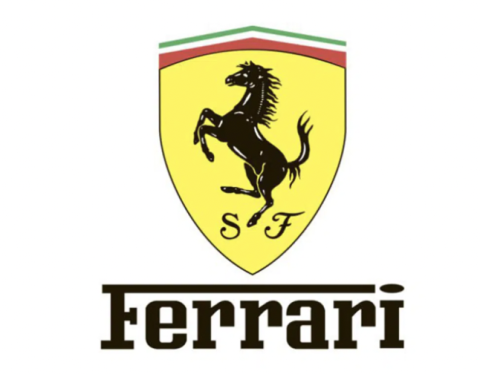
The Ferrari logo harmoniously combines several distinct elements into its composition.
Source: Ferrari
The upper part of the yellow shield in the Ferrari logo showcases the Italian tricolor, while below it sits the renowned black prancing horse with the engraved letters 'S' and 'F' on either side of its hind leg.
Directly beneath the emblem, the Ferrari wordmark is positioned. The black prancing horse is a tribute to an Italian aviator who tragically lost his life in an air crash during World War I, symbolizing courage and bravery.
The success of the Ferrari logo is not solely attributed to its story, but rather to its simplicity, memorability, and strong association with the concepts of speed and power, making it a perfect fit for a sports car.
Lego, the beloved toy of countless children, embodies creativity, freedom, and playtime. The brand's vibrant logo seamlessly captures the essence of these concepts, forging a strong connection with its audience.
Source: Lego
Throughout the early years of the company, the logo underwent numerous iterations. The introduction of bubble writing can be traced back to approximately 1954, and the current version has been in continuous use since 1973, with only a minor modernization in 1998.
The perfect logo communicates volumes without uttering a single word. It encompasses honor, trust, pride, excellence, and integrity. It embodies a collection of virtues and values, eliminating the need for lengthy text and a team of copywriters.
It instills a profound connection between a brand and its consumers, fostering a bond between a company and its community of supporters, friends, critics, allies, and champions. A brand logo is an exclamation. It serves as a symbol of success and a testament to customer commitment.
It represents the culmination of a partnership between a business owner and a graphic designer, their collaboration an act of communication that leads to the creation of a final design shaped by discussions on the desired impact of the logo. A logo's significance extends beyond its visual appearance; it also possesses the power to captivate the attention of existing and potential consumers.
Looking to build or refresh your logo? Connect with logo design agencies on Clutch.