Lead Quality vs. Lead Quantity: Why B2B Teams Are Rethinking Their Funnel in 2026
Bigger buying committees and tighter budgets are forcing B2B teams to rethink lead quality vs. quantity. Here's how top teams rebalance the tradeoff in 2026.
Updated September 18, 2026

Running a digital agency isn’t easy and comes with challenges of employee engagement, due diligence, customer retention, and timely delivery. If these challenges are overcome, your agency will be on a better path to success.
The biggest challenges of running a digital agency in 2026 are adapting to AI, winning new business while protecting margins, retaining clients, hiring and keeping talent, differentiating from competitors, delivering on time, and staying compliant.
None is insurmountable, but the ground has shifted: AI is reshaping how agencies price, staff, and prove their value, and clients increasingly weigh bringing work in-house. This guide breaks down the seven challenges and how to overcome each.
Looking for a Digital Marketing agency?
Compare our list of top Digital Marketing companies near you
| Challenge | Why its harder in 2026 | Core response |
| 1. Adapting to AI | Clients automate work; fees compress | Use AI to deliver; sell strategy AI can't |
| 2. New business & margins | Lead gen and margins are top stressors | Niche down; price to outcomes |
| 3. Client retention | In-housing tempts clients away | Prove ROI; deepen relationships |
| 4. Talent | Hiring bottlenecks cap growth | Engage, upskill, and retain the team |
| 5. Differentiation | Generalists blur together | Specialize into a defensible niche |
| 6. Timely delivery | More channels, faster turnarounds | Tight PM + selective outsourcing |
| 7. Due diligence | Pricing-law patchwork; cash-flow risk | Systemize compliance and invoicing |
AI is the challenge every other challenge now runs through. Generative tools let agencies produce more, faster — but they also let clients do more themselves, which compresses fees and tempts brands to bring work in-house. The market reflects the squeeze: worldwide ad spending grew 8.6% in 2025, yet agency holding-company revenues fell 1.2% as automation ate into billable work.
The agencies that win treat AI as leverage, not a threat. Use it to speed research, drafting, and reporting — then reinvest the saved hours into the strategy, creativity, and measurable results AI can't replicate. Crucially, shift the pitch from "we make the deliverables" (which AI commoditizes) to "we produce outcomes." Agencies that can prove their work drives revenue are far harder to replace with an in-house prompt.
Lead generation and profit margins consistently ranked as the biggest concerns for agencies heading into 2026. Two forces make this harder: AI-driven and zero-click search are shrinking the inbound traffic agencies once relied on, and buyers are more cost-conscious. The counterintuitive fix is focus — the same research found that agencies which narrowed their service mix grew 13% on average and posted 30% net margins, outperforming generalists. A tighter offer is easier to market, easier to price, and easier to deliver profitably.
Customer retention is a serious challenge for many businesses. Digital agencies have it worst, as there is no clear standardization or differentiator of their services that they can claim to beat the competition at.
Unfortunately, no one can control circumstances under which a customer leaves, but we can do our best to understand the reasons and take preventive action.
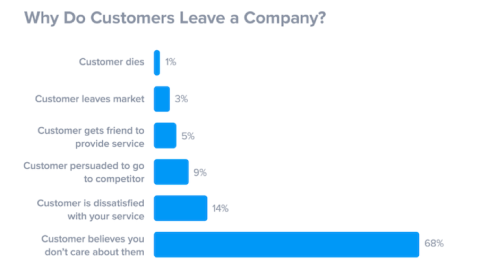
Source: SuperOffice
The good news is that your competition isn’t very effective at stealing clients from you – it’s in your hands to influence how the client feels about you and ensure they stick around for long. You can do this by:
Essentially, you can’t go wrong with using best practices for customer service. It’s important to stay focused in this area of your business to prevent customers from regretting their decision to work with you and seeking out your competitors.
For many agencies, growth in 2026 is limited less by demand than by execution capacity — hiring bottlenecks. When teams are at capacity, agencies turn down new business or delay onboarding, creating a growth ceiling unrelated to the pipeline. That makes engaging and retaining the people you already have a competitive advantage, not just an HR nicety.
Engaged staff become the human face of the brand, recommend what's genuinely best for both agency and client, and build the relationships that cement retention. Keep them engaged with frequent internal communication and continuous learning — there's something new in digital marketing nearly every day. For distributed teams, tools like Slack replace the missing "water-cooler" moments, helping remote colleagues share knowledge and build real working relationships. Increasingly, that also means training the team to work with AI rather than fear it.
When every agency lists the same services, buyers can't tell them apart — and undifferentiated agencies compete on price, which erodes margin. The current consensus across the industry is that specialization wins: narrowing into a defensible niche (an industry, a channel, or a productized service) lets an agency build deep expertise, market to a specific pain point, and command higher fees. As the data above shows, agencies that narrowed their focus grew faster and kept more margin than those chasing everything.
As a service-based business, it can be tricky to ensure that you deliver your promises on time. Whether it’s a website launch, brand creatives, copy for a downloadable ebook, or social media posts, a digital agency must deliver quickly without compromising on quality.
Project management is an important aspect of on-time delivery, no matter the task at hand. There is an array of options, methods, and tools to keep your project on schedule and progressing. These are the ones that managers crave the most:
You need to start by knowing the deliverables and milestones in-depth. Establish clarity with the client on the course of action and execution methods. Agree on simple processes for approvals, change requests, and control. Automate wherever possible. Put in place analytics for tracking crucial metrics and KPIs for every project or campaign at all times.
You might also want to implement time-tracking software for in-house work. This allows you to manage the efficiency of your team members and also makes sure you aren’t undercharging for your services.
If you determine that you don’t have the in-house capabilities to complete a project, don’t hesitate to outsource or “nearshore” part of the project to a relevant service provider who has the necessary competencies. There is a lot of help available online — specialists such as software architects, UX designers, data scientists, and DevOps consultants are all available on hand to collaborate or work on specific tasks so that your delivery wheels never stop churning.
Finally, always be realistic when agreeing on deadlines with your clients. As a digital agency owner, you will know from experience how long it takes to develop creatives, how long a particular campaign should run, and what obstacles might come up during a website redesign or a product launch.
It’s not worth risking the loss of a client – or worse, your reputation – by overpromising on deliveries and falling flat on the delivery date.
Building due diligence into daily operations prevents a lot of headaches. Digital agencies face many variables that businesses don't:
Keep documentation accessible so leadership, staff, partners, and vendors can act quickly within existing agreements — many agencies use secure cloud-based data rooms for contracts, NDAs, and client material, which also supports regulatory compliance. On finance, put a system in place so invoices go out promptly (roughly a week after delivery is a good rule) and clients pay on time, with payment terms spelled out in every contract. Online invoicing tools like FreshBooks simplify record-keeping and corrections.
No challenge here is insurmountable. Digital agencies are among the most adaptable businesses there are, and there are new pressures reward exactly that adaptability: agencies that use AI as leverage, specialize into a defensible niche, price to outcomes, and prove their ROI will pull ahead of those clinging to legacy models. Work through the strategies above and your agency will be built for where the market is going, not where it's been.
Adapting to AI. It compresses fees, tempts clients to bring work in-house, and forces agencies to shift from selling deliverables to selling measurable outcomes. Nearly every other challenge — margins, retention, differentiation — now runs through it.
Services are hard to differentiate, and then, clients increasingly weigh doing the work in-house with AI tools. The best defenses are proving ROI relentlessly and building genuine, responsive relationships.
Specialize. Industry research shows agencies that narrowed their service mix grew faster and posted higher net margins than generalists. A focused offer is easier to market, price, and deliver profitably — and outcome-based pricing protects margin better than billing by the hour.
Yes, hiring bottlenecks — not lack of demand — cap growth for many agencies. Engaging and upskilling the team you have (including training them to work with AI) is as important as recruiting.
By systematizing it: staying current with GDPR, CCPA, and the expanding US state privacy laws, keeping documentation in secure and access-controlled systems, and building compliance into everyday workflows rather than treating it as a scramble.