
Why Salesforce Staff Augmentation Is Becoming a Strategic Choice
Salesforce staff augmentation is no longer a stop-gap. Learn why more businesses now use external specialists to access expertise, move faster, and scale...
Updated May 26, 2026

When it comes to IT services, should businesses onboard an in-house IT team or hire an MSP? This article will go into the benefits and challenges of both resources to help companies make the best choice for their businesses.
All businesses that work with client information need to invest in IT services. Why? Because without that support, your company can be in grave danger.
One in every four Americans will stop doing business with a company after it suffers a data breach, and with malware attacks increasing significantly over the last few years, having IT support is more important than ever.
Looking for a IT Services agency?
Compare our list of top IT Services companies near you
Looking for an MSP Company?
Compare our list of top MSP companies near you
Every modern business needs dependable IT support — whether it’s to safeguard sensitive data, reduce downtime, or scale with growth. Strong IT infrastructure is the backbone of day-to-day operations, from secure data handling to cloud-based tools and collaboration platforms. Without it, even minor disruptions can lead to major setbacks or security concerns.
That support generally comes from one of two sources: a managed service provider (MSP) or an internal IT team. Choosing between them depends on your company’s size, goals, and technical needs.
An MSP, like an in-house IT provider, can support a company’s network & IT infrastructure, deliver ongoing support, and perform other tasks that need IT management.
The catch is that an outsourced IT team can fix IT problems remotely. Learn more about managed IT services here.
Having in-house IT support that works full-time could save your company from any internal IT disaster.
In-house IT support will have intimate knowledge of your IT infrastructure, giving them the opportunity to fix problems quickly.
Dependent on company size, you can choose to hire as many or as few IT professionals as you like.
Professional IT support can do the following for your company:
Now that it’s clear what IT service support can do for any business, the next challenge comes with whether to hire internal IT staff or outsource the work to a managed service provider (MSP). The answer depends on what type of partner your company is looking for.
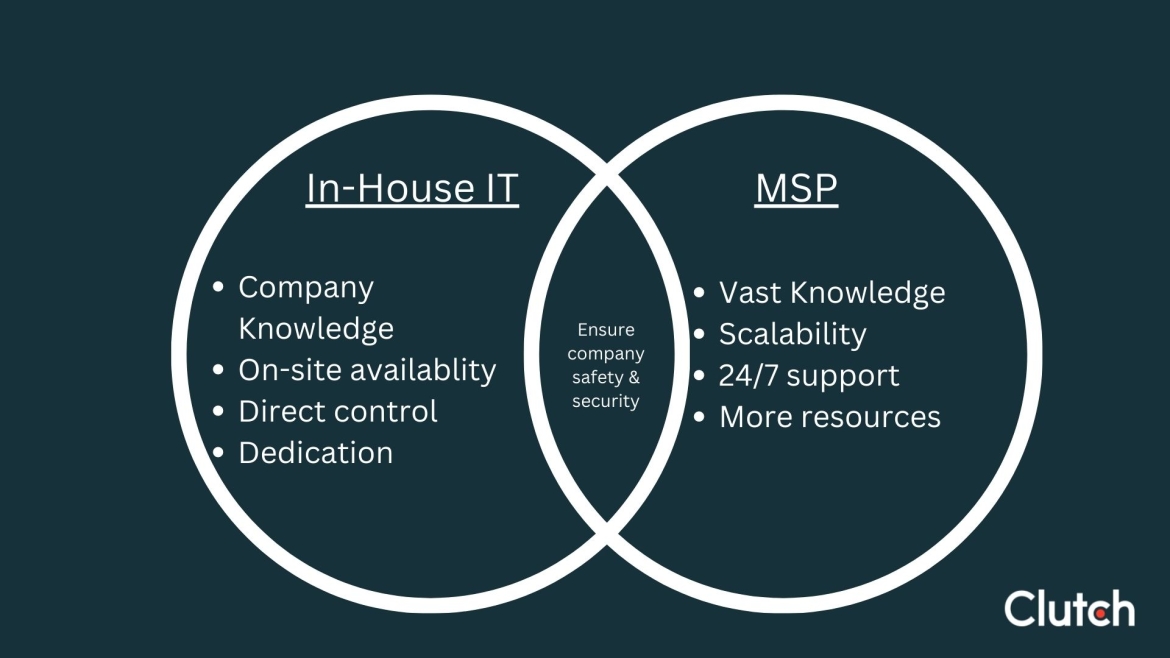
While we’ll explore each in depth below, here’s how they compare:
Choosing the right IT support model starts with knowing what’s most important to your business.
Looking to hire for IT services? Explore our list of the top technical support solutions.
MSPs can deliver a wealth of knowledge to their clients. Here are some of the benefits of hiring a managed service provider to help with IT solutions:
One of the benefits of working with an MSP and that you already know what your IT expenses will cost each month. Most providers provide set pricing to cover the services you need. This makes it easier to budget and avoid surprise costs that may occur with in-house teams. You don’t need to think about overtime hours in a crisis or the costs associated with onboarding new hires because you’re working within a framework. That stability can make a huge difference over time.
One benefit of working with an outsourced IT services provider is that they’ll likely deliver 24/7 support since they’re not employed to work during your company’s business hours.
Any problems that might arise during your off hours will be handled by an around-the-clock MSP.
Having 24/7 support will also limit the chance of major outages or snafus due to the consistent monitoring that is occurring with an MSP.
Managed service providers specialize in information technology, meaning that MSPs offer more tools, resources, experience, and talent in terms of dealing with IT support issues.
An in-house IT staff might only have a few specialized skills relevant to the company that they’re working for, which can work, but what happens when a major cyberattack occurs that leads to data loss, and your current staff doesn’t have the expertise to manage it?
Managed service providers are continually learning and expanding their capabilities.
With an MSP, there are a lot more resources available to your business than with a small team that works in-house.
If you’re relying on one or two IT team members, then your requests might fall behind if there is a sick day. An MSP is able to cover those with their on-staff engineers that work endlessly.
Learn how to build an IT budget with our guide.
If your company is looking to add in-house IT support full-time, explore the benefits:
Many businesses prefer in-house IT support because of the on-site access.
Having day-to-day support within your business hours can provide effective coverage for your company and team. For example, if an in-office team member is having issues downloading the latest version of Microsoft Excel, an in-person interaction with a member of the IT staff can do the trick.
In-house IT support can provide your company with quick support when it’s needed the most.
Learn more about how the world of IT works with our IT services glossary.
Having an internal IT team will have direct knowledge about your company and IT solutions. Since in-house IT support is directly ingrained in your company culture, they will be informed of company policy changes and other factors that might impact their own processes.
As previously mentioned, they will also have more knowledge of your IT infrastructure since they are directly connected.
Internal IT staff get to know your people, your systems, and your way of working as they are onboarded. Over time, this familiarity helps them deliver support that fits how your business actually runs.
When someone has an issue with their tools or setup, they’re talking to someone who understands their history and not starting over with a stranger. This kind of service builds trust and makes everyday tech frustrations easier to solve.
In-house IT teams can also offer input that matches your company’s goals, not just general best practices. That personalized support is hard to replicate with an outside provider who isn’t there day to day.
With an internal IT team, your stakeholders have direct control of who and how many to hire.
During an interview process, you can evaluate candidates based on their expertise as well as how closely they’ll fit within your company culture.
Working with outsourced IT employees gives your business no control over how many team members will be supporting your IT needs since an MSP works with so many different clients.
Managed IT service providers offer a lot of support to their clients, but there can be a few challenges with choosing to go with outsourced IT support:
MSPs have different clients, which means their focus isn’t solely on your company. They will be working with others and setting priorities inside their organization. Because they’re not embedded in your day-to-day operations, they may not fully understand your company’s culture, values, or internal processes.
An MSP engineer will try to visit your site frequently, but not as frequently as the IT team member who has a desk in your office.
Outsourcing your IT services can have various costs — so your business should have a secure budget in place.
While you’re not hiring a full-time employee, MSPs can charge monthly rates depending on the services they end up providing.
Generally, your partnership will be through a service-level agreement (SLA) that guarantees a specific service and quality. Setting up that relationship often includes upfront costs: onboarding, system audits, software migration, or infrastructure upgrades. These initial expenses can be significant, so it’s important to factor them in when comparing MSPs to internal hires.
A big challenge of working with an MSP is that they are outsourced, which gives them less control.
Being away from the IT infrastructure can lead to delays in response time and other issues that could impact business needs.
If another party sets up your IT systems, there will also be a learning curve for an onboarded MSP taking on a new project.
Additional Reading: ‘How to Create an IT Budget [With Template]’
Along with the benefits, there are drawbacks to having exclusive, in-house IT support:
Having an in-house IT team is more expensive for businesses. In fact, hiring an MSP can reduce in-house costs by 40%.
In-house IT can come with unpredictable costs, including sudden turnover, rising salary expectations, or unplanned benefit increases. These are in addition to standard expenses like recruitment, paid vacation, and healthcare.
With an MSP, that isn’t a lift on the client.
Learn how much IT services cost with our IT services pricing guide.
One of the biggest challenges with in-house IT is staying current with new tools, systems, and security protocols. Unless your team has time and budget for ongoing training, they may fall behind as technology evolves. That can leave your business vulnerable to inefficiencies or cyber threats, especially if your internal team is stretched thin or focused on day-to-day fixes.
This challenge does depend on who your company chooses to hire for IT support, but it isn’t a surprise that an in-house IT department will lack the expertise and knowledge that an MSP delivers.
As the IT world continues to shift, some new technologies and innovations need to be communicated. It is likely that a business doesn’t have the bandwidth to provide specific training to their in-house team while that would be a main focus for an MSP.
Here are several factors that might impact your choice of IT services support:
IT technical support is a key element of any company, no matter the industry. Companies won’t run without the appropriate IT infrastructure in place. To have effective IT services support, businesses need to make the right choice in hiring an in-house team or outsourcing an IT team.
If businesses choose to follow the in-house support route, your business will have a dedicated team with on-site availability but might spend a lot on personnel costs. If hiring an MSP, remember that your business isn’t their only client, but their skill level and 24/7 support should make up for it.
All companies are different – consider the pros and cons of each IT support option and make a decision based on business goals.