Lead Quality vs. Lead Quantity: Why B2B Teams Are Rethinking Their Funnel in 2026
Bigger buying committees and tighter budgets are forcing B2B teams to rethink lead quality vs. quantity. Here's how top teams rebalance the tradeoff in 2026.
Updated October 12, 2026

A white label partnership reduces your business expenses, expands your portfolio, and builds your company’s reputation. As a result, a white label partnership is an investment in your firm’s future.
Consider hiring a white label partner when client demand exceeds your delivery capacity, you need expertise your team lacks, or you want to test a new service before committing to permanent staffing. Before choosing a provider, define the work you need, calculate the full delivery cost, and agree on quality standards.
Use the seven signs below to identify your agency’s needs, then test a prospective partner on a clearly scoped project.
Looking for a Digital Marketing agency?
Compare our list of top Digital Marketing companies near you
A white label partner delivers services that your agency sells under its own brand. For example, your agency might manage a client relationship while a partner handles website development or campaign execution.
The distinction is how delivery and branding are arranged. In AgencyRelay’s published partnership models, white label delivery keeps the agency as the client’s contracting party, while a referral arrangement has the provider contract with the client directly.
Before engaging a partner, decide who owns strategy, approves deliverables, communicates with clients, and manages account access. Document those responsibilities rather than assuming both teams interpret “white label” the same way.
Before we talk about why you need a white label partnership, it is important that you understand how one works. To do so, we’ll look at an example.
Let’s assume Company A is a full-service digital marketing company. It has many different clients who each have their own marketing needs.
In order to provide these services, Company A would need to hire an entire in-house team. It takes time to recruit the right professionals and money to keep them happily employed. It also means Company A will require more space, more equipment, and more investment costs.
Enter Company B. Company B is a white label partner. Company B has a full team of experienced personnel. It has hunted down the necessary talent for each service it provides; it pays its employees and overhead costs.
When Company A hires Company B to provide the services its current staff cannot, they enter into a white label partnership.
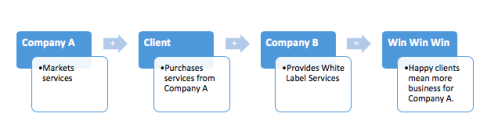
As a white label partner, Company A can resell the services Company B provides without having to divulge their partnership to clients.
Now that you understand what a white label partnership is and how it works, it is time to explain the signs that you need one.
Review recent proposals and client requests. Which opportunities required skills your team does not have? Which services were requested repeatedly?
Start with one service that complements your existing work. For example, if you manage paid campaigns, assess whether landing page development would help you deliver the work clients already request.
Before adding that service to your offering, ask a prospective partner for relevant samples, delivery requirements, and a quote for a representative project. Use those details to define what you can confidently sell.
Use a partner evaluation to investigate a specific quality gap. Identify where your team needs support: technical reviews, campaign setup, design consistency, or another defined task.
Ask the provider to explain its review process and show an anonymized deliverable comparable to your work. Specify your acceptance criteria, included revisions, and process for correcting errors.
Do not assume every provider includes unlimited fixes or refunds. Ask for those terms in writing. White Label IQ’s evaluation checklist identifies documented quality assurance, peer review, and defect tracking as useful checks.
Build a cost comparison around the same service scope and expected workload. Include the partner’s fee alongside your agency’s time for briefing, project management, quality review, and client reporting.
For an internal hire, include compensation, recruitment, training, tools, and management time. Compare both options at realistic workload levels.
Review your backlog, missed milestones, overtime, and declined projects. Determine whether the pressure comes from a temporary surge or an ongoing workload.
Then specify the capacity you need: a fixed project, a defined number of deliverables, or reserved time each month. Request a proposed start date and delivery schedule from shortlisted providers.
Keep an internal owner responsible for reviewing the work. Include that person’s availability in the plan before adding external delivery capacity.
Audit the client experience you want a partner to support. Review report templates, terminology, presentation standards, response expectations, and approval steps.
Ask the prospective partner to complete a sample report or deliverable using those standards. Check whether your team can review and adapt it efficiently.
Also agree on client communication boundaries. Your agency might handle every client conversation or authorize a partner specialist to attend selected calls. Record who can contact clients and how that person should be introduced.
Use account reviews to identify unmet needs before expanding your services. Ask clients what support they need and whether it connects to their existing goals.
For example, a website client may need ongoing maintenance after launch. Define the proposed service, confirm the client’s interest, and assess the delivery requirements before engaging a partner.
Track the results of the added service through renewal decisions, complaints, and client feedback. You can also use Clutch’s customer loyalty guidance to plan broader retention efforts.
Track how leadership time is spent over several working weeks. Identify repeatable delivery tasks that could be handed over with a clear brief and review process.
Before outsourcing those tasks, write down the inputs, expected output, decision owner, and acceptance criteria. Estimate how much internal coordination the handoff will require.
Use a pilot to test whether the arrangement frees the time you need for sales, strategy, or account management. Compare the time spent managing the pilot with the time previously spent doing the work.
Start your white label partner hiring process with a brief that defines the problem you need solved. Use the same brief when comparing providers.
Ask each candidate:
Request examples and written terms alongside answers. These checks align with the scope, communication, quality, and pricing areas in White Label IQ’s partner checklist.
For paid advertising, review platform requirements as part of the delivery plan. Google requires third-party partners to disclose management fees and, where applicable, report Google advertising costs separately from their own fees. See Google’s transparency requirements.
A white label partnership gives your marketing company a competitive advantage. A white label partner helps your firm grow by cutting your costs, expanding on your portfolio of quality services, and keeping your customers happy.
Choose a representative project with a clear brief and manageable delivery requirements. Agree on the fee, timeline, deliverables, revisions, and acceptance criteria before kickoff.
Assign one internal owner and one partner contact. Record the time your team spends briefing, reviewing, and managing the work.
After delivery, assess whether the partner met the agreed standards, communicated effectively, and fit your cost model. Use the results to decide whether to expand the relationship, adjust the process, or evaluate another provider.
With a customer retention rate of 2.5 years, a 42% year-over-year increase, and more than 27 years of experience, 51Blocks is a leading Google Partner. With degrees from colleges all over the U.S., the 51Blocks team is composed of diverse marketing experts who thrive on seeing our partners excel.
There are plenty of benefits to working with a white label partner. If you want to grow your business while reducing your own costs, a white label partnership can help. From an expanded portfolio filled with quality services to increased customer retention rates and an improved reputation, a white label partner gives you a competitive advantage while keeping your own expenses low.
If you are interested in learning more about how a white label partner can help, contact the experts at 51Blocks today.