The Real Cost of Your MVP in 2027
AI made code cheap, but not software that holds up. See how MVP cost drivers have shifted and why human validation and taste are now what you’re really...
Updated February 19, 2026

What is full-stack development, you ask? Full-stack developers can plan, code, maintain, and deploy a wide range of software and applications. Adding them to your team can reduce project costs, as experienced developers can fill multiple roles. Clutch's VP of Development, Sergei Dubograev, discusses when full-stack development is the best choice over specialized teams and how selecting the right framework can impact the scalability and maintainability of your applications.
In the rapidly evolving world of technology, full-stack development has become a buzzword for technical leaders, business owners, and development teams alike.
In this article, we will explore the key components of full-stack development, its benefits, popular steps and frameworks, and more to help you determine whether it is the right choice for your business and broaden your understanding of how it fits into your company’s development vision.
Looking for a Software Development agency?
Compare our list of top Software Development companies near you
Full-stack development is the building, maintaining, and testing of entire programs or applications. Unlike front- and back-end developers, who focus on specific areas of a project, full-stack developers can do it all. They jump into any project phase and immediately get to work on areas including servers, application logic, and user interfaces.
Keith Shields, CEO of Designli, says that the full-stack development approach can offer collaboration and speed advantages, but it can present challenges as well.
“Uneven distribution of a developer’s workload could affect the quality of the work, and heavy reliance on specific developers might create bottlenecks,” Shields said.
Clutch’s VP of Development, Sergei Dubograev, feels that full-stack development is often a good fit for startups or small businesses.
“Full-stack development is a powerful option, especially for projects where speed, flexibility, and resource management are critical,” Dubograev said. “However, full-stack is not always the best choice for large, complex projects that require deep specialization in specific areas.”
With businesses relying on robust digital solutions to stay ahead of the competition, knowing whether full-stack development is necessary for your business needs can be a game-changer.
Full-stack developers understand front-end and back-end development and use the technologies to complete tasks.
Front-end development, also called client-side development, deals with the part of the application a user interacts with, like a dashboard or keyboard. The back-end, or server-side, technology is the foundation of the application and guarantees that the website functions correctly. Back-end tech deals with areas like database management and APIs.
Opting for full-stack development helps ensure that both halves of your project will work smoothly together. Knowing exactly what the front end of the website or application needs to deliver to the users and where any pain points are means that the back-end infrastructure can be optimized to focus on what's needed instead of wasting resources on things that aren't.
Full-stack development is an all-in-one package for creating and maintaining applications, websites, and platforms. Some of the advantages that come along with full-stack development include:
Full-stack development provides a significant advantage for businesses looking to optimize their development processes. Whether you’re a startup or a tenured company looking to make a change, embracing full-stack development can be a great strategic move for your development projects.
Developers use frameworks to make their tasks easier. Frameworks usually have pre-made components and code developers use to build apps faster.
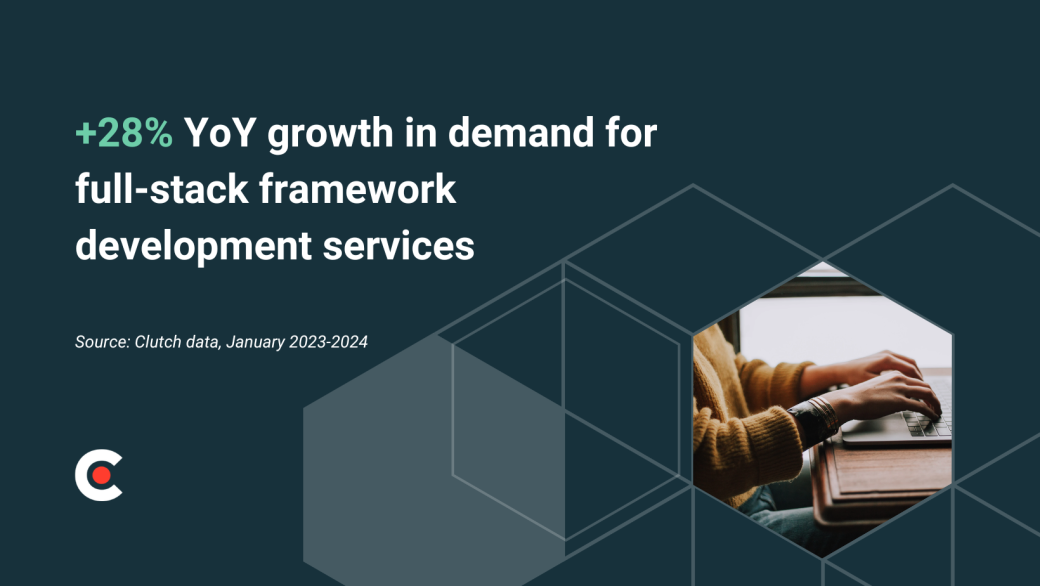
Clutch data shows a 28% YoY increase in demand for the 3 frameworks below from January 2023 to 2024, reflecting the recent interest in full-stack development and shift in consumer expectations.
Here are some of the top frameworks that full-stack developers use:
Ruby on Rails is a server-side framework that pairs with the Ruby language. It uses a Model-View-Controller (MVC) structure and provides a comprehensive set of libraries and tools for faster development. Ruby on Rails is great for developing social media platforms and e-commerce websites.
Django is a back-end Python framework that follows a Model-Template-View (MTV) pattern. Django emphasizes security and is easily scalable. Developers use Django for data-driven applications and sites with a lot of content.
Clutch data also shows an increased interest in Laravel with nearly 19% growth in the month of September 2024.
Laravel is a Hypertext Preprocessor (PHP) framework that follows MVC architecture. It simplifies tasks like authentication and caching. Developers use Laravel for API back-ends and small- to medium-sized business apps.
In software development, a stack combines languages, libraries, frameworks, and tools developers use to make their jobs easier. The correct blend of technologies lets developers build and maintain applications with predefined workflows. Both LAMP and MEAN stacks are popular with full-stack developers.
Dubograev believes that the choice of a full-stack development framework can make or break an application's maintainability and scalability.
“MEAN, for example, is great for startups and fast-growing businesses that need to scale quickly and maintain agility, especially in real-time applications,” said Dubograev. “On the other hand, LAMP is a more traditional and stable choice, perfect for content-heavy or enterprise-level websites that prioritize long-term reliability over rapid iteration.”
The framework that’s right for you will depend on your project’s goals.
LAMP is an acronym for the technologies included in the LAMP stack. The stacked technologies are Linux for its operating system, Apache for the web server, MySQL for its database management system, and PHP for its language. The LAMP stack is great for content management systems (CMS), e-commerce websites, and enterprise applications.
LAMP has been a popular full-stack developer stack for decades. The underlying operating system, Linux, is stable and can handle demanding workloads while being optimized for servers. Because PHP and MySQL pair with Apache, the LAMP stack is an excellent choice for dynamic, database-driven websites and applications. Developers can also use the back-end languages Python and PERL with the LAMP stack.
Like the LAMP stack, the MEAN stack is also an acronym representing the technologies it includes. The technologies stacked in the MEAN stack include the NoSQL database MongoDB, Express.js as a back-end web framework, Angular as a front-end framework, and Node.js as its back-end runtime environment. It is a terrific choice for real-time, cloud-based, single-page applications (SPAs) projects.
The MEAN stack’s technologies are entirely JavaScript-based, which unifies development between the client and server sides. Angular allows developers to build dynamic front-end applications, although it’s possible to substitute Angular with another JavaScript front-end framework. One popular choice is React.js, which is sometimes called the MERN stack. However, the runtime environment, Node.js, is vital for its functioning, handling server-side operations and interacting with Express.js and MongoDB.
If scalability is key, MEAN stacks are ideal, but for projects where stability matters the most, work with LAMP frameworks to provide reliability.
Full-stack development from start to finish follows five general steps.
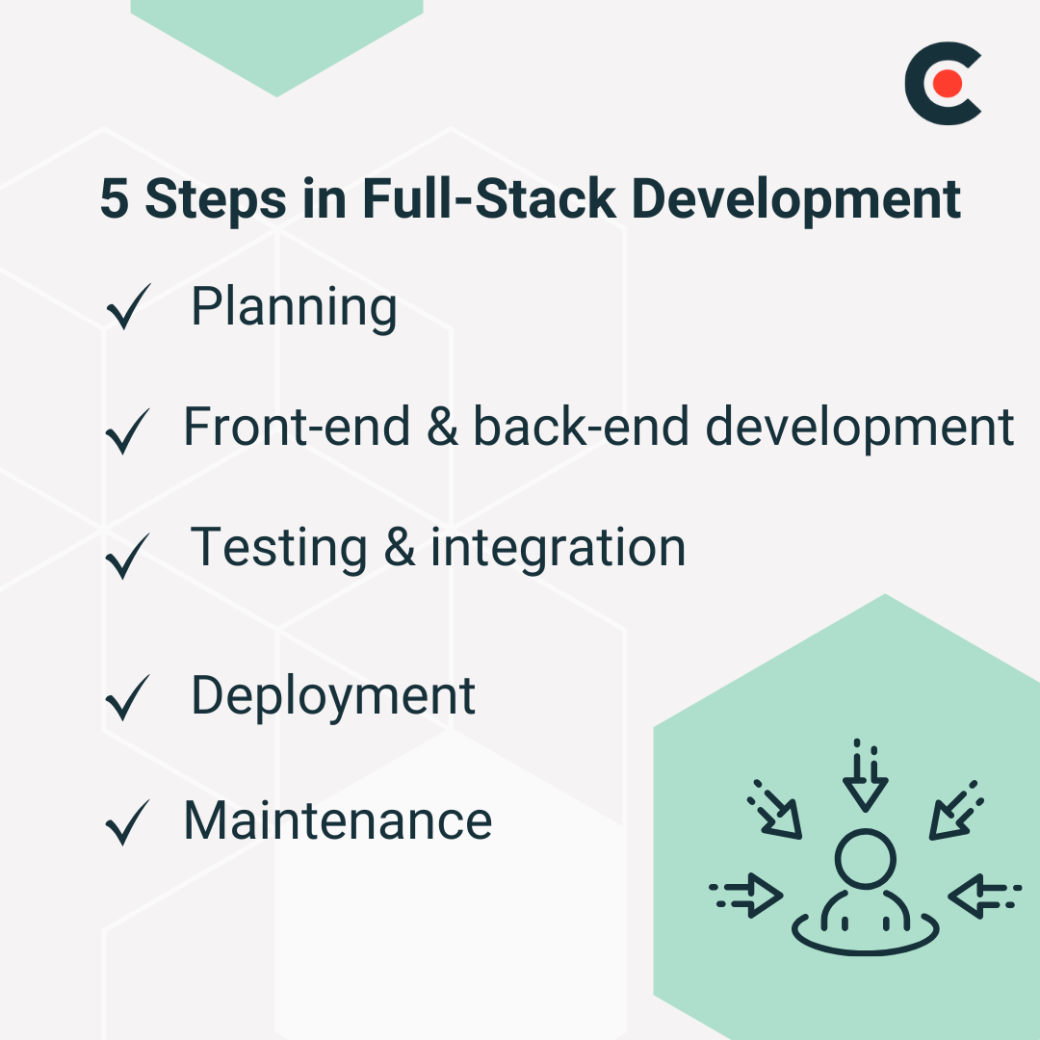
The key stages are:
Following these steps allows full-stack developers to build comprehensive and user-friendly applications for their audience.
Organizations hire full-stack developers for all sorts of projects. These projects can be simple applications like notepads where users can add, edit, and delete information or complex platforms with user authentication, real-time messaging, and notifications.
“Projects that benefit most from a full-stack development process often require MVPs consisting of simple, somewhat ‘manual’ and less automated/sophisticated feature sets,” said Shields. “These types of projects demand quick iterations and changes, making it easier for a full-stack developer to pivot between different aspects of the project without waiting for specialized input.”
Here are some popular full-stack development projects.
Project management applications help teams plan, collaborate, and track tasks. These apps might include a real-time chat, file sharing, and calendars.
Full-stack developers use front-end technology to create a straightforward user interface and back-end technology to build APIs and store and retrieve data. Examples of project management tools include Jira and Trello.
Gaming Apps
Building a gaming app through full-stack development is a great idea. The technology needed will depend on the type of game in development. Games will require dynamic elements, such as the gameplay, and specific aspects, like a scoring system or multiplayer interaction.
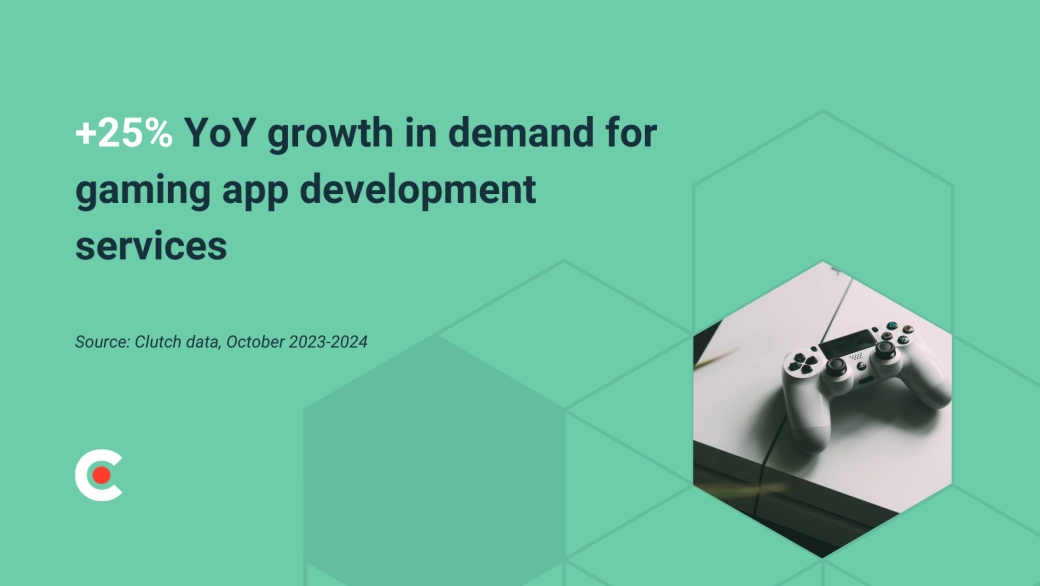
Renewed interest in mobile game development services is evident. From October 2023 to 2024, Clutch saw a 25% increase in demand from businesses seeking gaming app development services.
Social media platforms, like Facebook and LinkedIn, are sites or applications that people use to build networks and relationships with each other. Creating one requires various features that work together, such as creating and sharing posts, newsfeeds that update in real-time, and systems where users can connect and follow one another.
Social media platforms require a lot of work on the front end to make sure users have a pleasant experience and can navigate the application with ease. On the back end, the platforms must be able to store and retrieve data from thousands or even millions of users.
Chat applications are somewhat simple and can be integrated into more complex projects. Chat applications may require notifications, user authentication, group chat support, and encryption. Examples of popular chat apps include WhatsApp and Line.
Full-stack developers can participate in any part of a project, from planning to release. They understand client-side and server-side operations, making them valuable additions to any software development team.
“Tech is always moving, and so should your stack,” said Dubograev. “That doesn't mean you should go use them all but at the very least you should understand new ones that pop up so you can make the best choice for your business in the future.”
Whether you’re an entrepreneur looking to launch a new digital product or a small business starting from the ground up, understanding the value of full-stack development is essential. As technology evolves, the demand for comprehensive digital solutions will only grow.
To find the best full-stack developers to support your projects, use Clutch. At Clutch, we match businesses with the talent they need to attain organizational goals. Browse our directories of the top developers in various specialties to find the right match for your business.