
Why Salesforce Staff Augmentation Is Becoming a Strategic Choice
Salesforce staff augmentation is no longer a stop-gap. Learn why more businesses now use external specialists to access expertise, move faster, and scale...
Updated October 23, 2026

Businesses working to become more data-driven are always looking for new ways to manage information efficiently. A data lake is a centralized repository for storing large volumes of data in its original or near-original format, including structured, semi-structured, and unstructured data. Teams can later process and analyze that information for business intelligence (BI), data science, and other business needs.
For example, a company might store data from its operational databases, applications, and connected devices in a data lake, then prepare relevant datasets for analysis. A data lake can help businesses work with diverse data, but it does not automatically make information clean, easy to find, or ready for reporting. Governance and data management are essential.
Taking a data lake approach may help businesses improve customer interactions, enhance research and development (R&D), and increase operational efficiency. This article explains what data lakes are, their core benefits, how they can support BI, and how different industries may use them.
Looking for a IT Services agency?
Compare our list of top IT Services companies near you
Businesses should understand what a data lake is, how it can work alongside BI solutions, and what considerations come with implementation. Read on for an overview.
A data lake is a big data repository where you can store all of your structured and unstructured data. All data comes into a data lake in its native format as retrieved from the source, passing through little or no transformation. Teams can apply structure when they access or prepare data for a particular use, an approach often called schema-on-read.
By adopting a data lake, you can take full advantage of data storage and processing capabilities, reference the data for analysis at any moment, and use any tools and frameworks.
Valuable data can give your company a competitive edge. Researchers from Aberdeen estimated that a company’s data grows at a rate of at least 50% yearly. Such volumes can complicate the work of data-dependent companies and require sophisticated solutions to be effective.
Adopting a data lake can help companies tackle several business-critical tasks. Nearly half (43%) of surveyed companies responded that data lakes help increase operational efficiency.
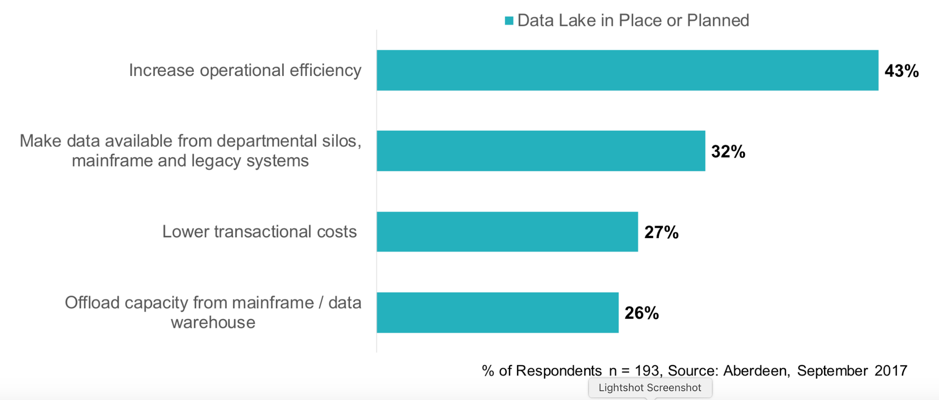
Other key benefits included making siloed data more available for all (32%), lowering transactional costs (29%), and offloading capacity from the mainframe (26%).
Unlike a data warehouse, a data lake offers more advanced architecture and multiple opportunities for storing and processing data. They make it easier to deal with the growing volumes of data and obtain better insights while using less effort. Data specialists can access data at any time to proactively use it for solving a company’s needs.
Implement a data lake around a specific business need, such as combining sales and inventory data for analysis. Start with a small, useful workload, then expand as the organization learns what data and controls it needs.
A data lake requires ongoing management. Without clear ownership, documentation, security, and quality checks, stored data can become difficult to find and trust.
A data lake provides key capabilities that can help uncover new ways to level up your analytics and inform your decision-making.
We’ve painted a positive picture of a highly valuable data lake, but there are some downsides. Given that a data lake architecture is designed to handle raw data, the content requires outside control.
Human supervision is necessary to ensure that the data is usable, accessible, up-to-date, and valuable. In that way, a data repository might be better suited to implementing your data initiatives, depending on the situation.
BI is an efficient approach that can allow specialists in your company to use advanced methodologies to work with large volumes of raw data. This helps retrieve meaningful insights, which can improve decision-making and unearth new opportunities for business growth.
The role of BI solutions across various industries is hard to overstate. BI has become a top priority:
Computational capabilities and cloud technology enable the processing of big data, reinforcing the digital transformation of those industries.
A data lake can enhance a BI solution by providing greater potential for data processing. It can serve both as a centralized source of data for building a data warehouse and as a direct source of data for BI.
Data lakes have applications in data science and machine learning engineering, where massive datasets are the backbone of technical solutions. In sum, a data lake can be an important pillar of BI and help optimize raw data processing.
Quick access to raw data, secure storage, reduced efforts at the start, and time-saving can benefit different industries. Here are a few examples.
Cargo storage, packaging, transporting, and distribution have a lot to do with big data. The same goes for the optimization of existing routes — in other words, transportation means, delivery methods, and allocation of workforce resources.
A data-driven approach can help optimize operational efficiency, minimize errors, reduce delivery costs, and boost sales and revenues.
The role of big data in this industry is mainly to mitigate money-related risks while increasing productivity, and improving customer service.
Data visualization tools are very useful in retrieving hidden information. Faster and more accurate reporting is what makes it possible to instantly share critical insights. What’s more, clients can receive better service due to simplified claim management and invoice processing.
Big data helps professionals in the industry to promote personalized medication and reduce the costs of treatment. Better data management is a vital part of life-saving activities. Having data at hand influences the reduction of medical errors and helps improve patient safety.
Automation has already caused significant changes to this industry. It can help boost team productivity by handling repetitive tasks that involve customer relationship management. Automation is poised to reduce operational expenses and improve service delivery.
A data-driven marketing strategy can yield an increased return in investment (ROI). Marketing specialists can leverage big data to get more accurate market insights and also to improve customer targeting.
This insightful report from Enterprise Irregulars dwells on some other industry-specific applications of cloud BI solutions.
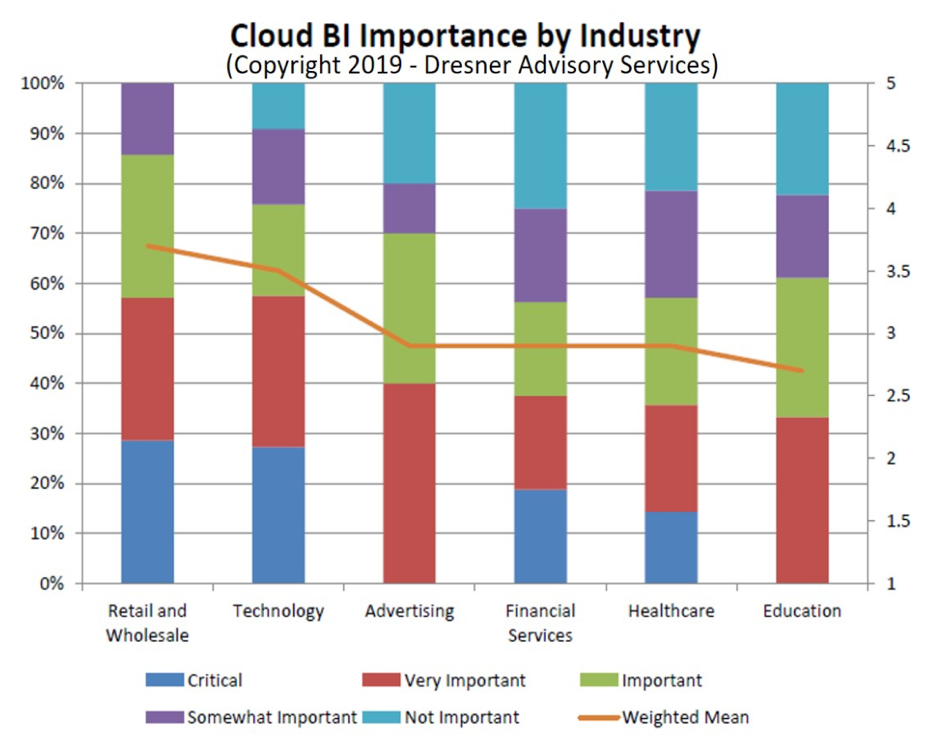
Over 70% of survey participants in the retail, technology, and advertising industries all consider BI to be important, with retail taking the lead at close to 85%.
The opportunities that BI opens up may vary depending on the industry and business type.
There is no one-size-fits-all approach, so it’s worth it to consult experts in BI and big data to help you figure things out. That could range from structuring your company’s data to creating custom, easy-to-interact-with dashboards to visualize workflows.
Data lakes offer a full range of benefits for businesses of various sizes. A forward-looking company should consider implementing a data lake to solve complicated business challenges.
By better managing your data, you can:
Building your data lake can help you adopt the best data management practices. Upstage your competitors by providing a solid, data-driven base for your business.
Katrine Spirina is a Technology Journalist at InData Labs, a professional services firm delivering AI-powered software and technical solutions to companies who want to leverage data and machine learning algorithms for business value. Katrine writes about AI, machine learning, and data science from the perspective of the transformative potential of technologies for businesses.
See full profile