How UGC Video Ads Outperform Traditional Creative in Paid Social Campaigns (With Real Examples)
Learn why UGC video ads outperform traditional creative in paid social, with real examples, best practices, and proven strategies.
Updated May 25, 2026

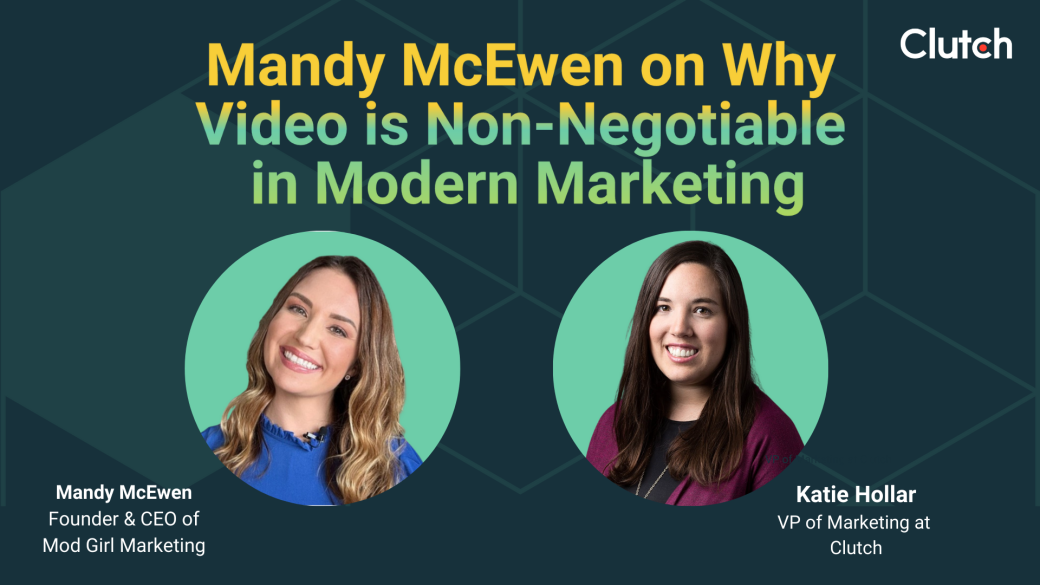
In this interview, Mandy McEwen, Founder & CEO of Mod Girl Marketing, highlights the essential role video plays in today’s marketing landscape, focusing on how it enhances engagement, builds trust, and drives conversions across various platforms. This conversation is jam-packed with invaluable insights and actionable takeaways— grab your notepad and press play!
In this video, you’ll learn:
Looking for a Video Production agency?
Compare our list of top Video Production companies near you
Welcome, Mandy. Before we dive in, can you tell us how your journey led to founding Mod Girl Marketing?
Mandy McEwen [00:4-02:08]: Like many agency owners, I started by accident around 2010. After college, I didn't enjoy working for others and was always a computer nerd. While working as a home improvement sales rep, I started exploring how to make money online - learning affiliate marketing, HTML, and SEO. I couldn't make enough from selling dog treats and $9 courses, but I noticed other home improvement and roofing companies complaining about their web designers and SEO providers. Since I was already doing that for fun on the side, I started offering to help these business owners, which naturally evolved into my agency, Mod Girl Marketing.
We've noticed how actively you use video marketing on LinkedIn and sharing insights on topics like social selling and personal branding. Video is dominating so many platforms today. What do you think makes video a must have in today's marketing?
Mandy McEwen [02:18-03:55]: Back when social media was just starting, video was seen as a cool but difficult extra. Even then, it stood out, especially in B2C. Fast forward to today, as I've pivoted to B2B with my LinkedIn training consultancy and agency, video has become essential everywhere in both B2B and B2C. It's non-negotiable because it helps us connect with people faster than any other medium. And with today's noise - just look at how many software companies exist now compared to ten years ago - there are so many companies, professionals, and brand narratives competing for attention. Video is the best way to stand out, differentiate yourself, and build emotional connections with followers and buyers quicker than anything else can accomplish.
What makes video more unique and effective than other content formats for building a social presence?
Mandy McEwen [03:56-05:02]: I think it's the easiest way to get people to understand what you do and how you can help them specifically. There's so much power in leveraging video - little things like the person on screen, their movements and expressions, the background audio, B-roll footage, stock footage. You can really build this emotional connection and vehicle for getting people to understand who we are at our core and how we can help. Nothing else can accomplish that in such a deep way so quickly. It really is a way to connect with people that goes deeper and beyond what reading text on a screen can do.
With so many platforms supporting video, how should businesses decide where to focus their video efforts for maximum engagement?
Mandy McEwen [05:33-07:20]: You need to be on YouTube regardless of B2B or B2C - even B2B companies and creators are investing more in long-form video there. I'm doing the same with my new program in 2025.
Beyond YouTube, choose platforms based on your audience. Are you targeting B2B professionals, marketing executives, sales executives? Then focus on LinkedIn. Is your audience on TikTok, Instagram, or Twitter/X? In the B2B world, I recommend focusing video efforts on LinkedIn and YouTube, though some B2B audiences are active on Twitter too.
Honestly, use as many platforms as you can strategically manage. Repurpose your long-form YouTube videos or podcasts everywhere - even B2B content on TikTok can work. But don't dilute your resources. Focus intensively on 1-2 platforms while distributing content across all channels.
What's the top mistake businesses make when evaluating the ROI of their video campaigns? How can they avoid it to get a clearer picture of success?
Mandy McEwen [07:43-10:06]: People focus too much on vanity metrics and expect instant ROI, looking just at views, comments, and likes. But there's both qualitative and quantitative data to consider, plus "dark social" factors. The old attribution models are dead - you can't precisely say a video drove $0 value. When you're doing marketing well, people discuss you across channels, privately and publicly.
Ask customers how they heard about you. Often, they'll mention your videos, something metrics won't show you. For example, my LinkedIn video views were terrible two years ago, but video was my biggest revenue driver - I know because clients told me directly. Someone looking purely at stats might say I shouldn't post videos due to low impressions, but they were driving qualified opportunities. You need to look at the big picture beyond traditional attribution models.
For companies with limited resources, what aspects of video production are best suited for outsourcing? What should they consider managing in-house?
Mandy McEwen [10:45-12:39]: Thanks to AI, video editing and strategy require fewer humans now. For companies with limited resources, here's what I recommend: Longer-form educational videos might still benefit from human editors to ensure attention is captured. Short-form videos need humans too, but can use AI tools like Opus Clip for simpler editing. AI capabilities are advancing rapidly - tools can even adjust eye movements now.
Someone should still own the video process internally. Even if you're a small company, find someone who likes video and train them on AI tools. You don't need a 15-year veteran videographer to create great videos anymore thanks to AI.
What do you think about the actual kind of meat of the content? Do you think that is something that can be effectively outsourced or that it really needs to stay in-house to deliver that message?
Mandy McEwen [12:40-14:01]: I'm a big proponent of keeping video in-house if possible. Focus on talking head videos - get your people and customers involved. There's no excuse for not having humans on camera; someone on your team will be fine on camera, and you can get customer video testimonials. While you might outsource some animated videos, you can't outsource everything when building community and loyal following. In a world where AI-generated content is everywhere, outsourcing all your video is a missed opportunity to engage with your audience on a deeper level. Keep it in-house if you can.
Any final advice for businesses just starting with video marketing to ensure long-term success?
Mandy McEwen [14:23-16:07]: Find a few internal champions who are comfortable on video and set minimum KPIs - like five videos per month from each person. Choose 1-5 subject matter experts (not recent graduates) who can speak knowledgeably about your business from their unique perspectives. While you need a strategic plan, don't overthink the production. Use a smartphone, get a basic lapel mic under $100, maybe a selfie light, and just start creating. Raw, off-the-cuff content often works better - like someone walking outside sharing industry tips or trends. Use AI for subtitles and just get the system rolling. The key is to start without overcomplicating it.
Which brand do you think is killing it with their video content right now?
Mandy McEwen [16:17-16:52]: In the B2B space, there are two approaches: companies like Refine Labs and Adam Robinson who repurpose podcast content into video clips, and larger companies like Hootsuite, Salesforce, and Sprout Social who work with influencers to create lots of video content. Hootsuite especially is doing innovative things with video.
Favorite social media platform to consume videos?
Mandy McEwen [16:53-17:25]: It depends on what I'm looking for. LinkedIn for B2B social selling - that's where I live. YouTube for everything. Instagram reels for travel content since I'm a digital nomad. And TikTok is just for everything. I consume videos everywhere, depending on the category.
Best podcast for marketers that you’d recommend?
Mandy McEwen [17:26-17:59]: I enjoy Laila Moses's podcast and Social Media Examiner's podcast - I was actually a guest there years ago. Both are great for business, marketing, and social media insights.

Mandy McEwen is the founder & CEO of Mod Girl Marketing, an award-winning social media consultancy, and Luminetics, a LinkedIn training company. She has been marketing successful brands online since 2007. Mandy has been named a Top 24 B2B Marketer by LinkedIn, Top 10 Marketer by DigitalMarketer, and listed in Search Engine Journal as a Top 12 SEO Expert. In addition to these distinctions, she has been featured in dozens of industry outlets including Inc., Huffington Post, and MAXIM magazine.
Interviewed by: Katie Hollar, VP of Marketing at Clutch