Why Searching for a Specialized Dev Agency Takes Longer Than It Should — And What to Do About It
Looking for a niche software development agency? Learn how to define your requirements, find specialized providers, and vet their experience.
Updated June 19, 2026

Software development projects, whether for SaaS, AI, blockchain development, or enterprise solutions, require a strategic process. The process involves setting goals, determining project timelines, getting the right tech stack in order, and considering software functionalities. You'll need a checklist to stay on track, and that's precisely what this article provides.
Software development for enterprises is a market worth $315 billion, which makes its importance quite clear. Regardless of the business size and type, software is a necessity for modern operations.
Role-specific software, such as customer support or employee onboarding, can improve workflows, increase efficiency, boost productivity, and enhance customer satisfaction. Similarly, many software programs automate tedious processes, such as data entry.
Looking for a Software Development agency?
Compare our list of top Software Development companies near you
However, as important as software development is, it's also complicated. This guide provides a software development checklist to help you stay organized and provides guidance on how to work with software development companies.
After analyzing the reviews of 39,312 software development companies, we found specific trends regarding working with software development teams. The idea of providing “customized support” was mentioned over 450 times.
Some of the top trends include:
More importantly, these verified companies are knowledgeable about software development while being innovative and easy to work with.
This article explores the different types of software development projects, their top considerations, and a well-fleshed software development checklist to use during projects.
View more detailed insights into the field of software development with our downloadable checklist.
If your company is unsure where to begin a software development project, download our software development checklist.
Whatever software development project you work on, the following considerations must be remembered:
The first step of any software development process should always be goal identification. What needs to be achieved through the software? For that to happen, what requirements should the software possess?
Serge Guzenko, owner and CEO of WEZOM, explains, "Effective scope management involves clearly defining and documenting initial requirements and project goals, conducting regular stakeholder meetings, and using agile methodologies like Scrum or Kanban to prioritize and manage the backlog."
These methodologies can help you track progress and make necessary adjustments throughout development.
Many software development teams face the pitfall of not meeting deadlines. When you don't meet deadlines, you also lose money. So, it's essential to divide the software development process into phases.
A highlight of many software development reviews was that the companies they worked with were “proactive,” “accommodating,” and facilitated “organized projects.” These are all key when planning a detailed timeline for a software development project with phases.
These phases include planning, designing, development, testing, debugging, and maintenance. Once the phases have been decided, set a realistic timeline. It's best to leave room for changes and adjustments, as it's natural to encounter challenges during development.
How successful and functional your software is will largely depend on the tech stack. By "stack," we mean every tool, framework, or technology you will use to build the software.
It's sort of like choosing the right ingredients for a recipe. You need to make sure they complement each other and work well together. More importantly, your development team should have expertise in the technologies you plan to use. The tech stack should also meet your scalability needs and budget.
Regarding budget, go over every resource you'll need to create your software. It includes personnel, hardware expenses, software costs, licenses, and more. After assessing the resources required, develop a budget that accounts for everything.
Additional Reading: ‘How to Budget for Custom Software Development [With Template]’
It's imperative to account for features and functionalities that will make your product effective, user-friendly, scalable, and competitive. Start by determining the core features. These are the functionalities that render the software useful.
Follow that up with a list of extra features to improve user experience and set your product apart from competitors. Remember that adding every feature you can think of is not advisable. The software will become cluttered and confusing to use. Instead, prioritize your audience's desired features based on user feedback and market research.
When testing these features, you can always bring AI in to reduce your manual work.
As Alex Meskov, GenAI QA Director at First Line Software, puts it, "AI can now take over a variety of tasks, from test case generation to automated execution, significantly reducing routine workload. This allows testers to focus on strategic aspects of quality assurance, making AI-assisted testing an essential component of modern software engineering."
So, you can let AI manage regression testing and other repetitive tasks while you concentrate on improving your software's core features.
Don't just plan your software development for now. After some time, you'll need to upgrade and update your software to keep up with changing user needs and new technologies. So, keep room for scalability.
For example, select a flexible architecture, such as a cloud-based or modular solution. You should also ensure your product is compatible with future integrations and updates. This way, you won't have to start from scratch when it's time to upgrade.
Additional Reading: ‘Software Development Services Guide’
When hiring a software development company, it’s key to prioritize expertise to ensure the success of your project. A team with a strong track record of expertise can navigate complex technical challenges, provide innovative solutions, and deliver high-quality software products.
The software development company you choose must be experienced. Their knowledge of working with various technologies allows them to create a software product that meets your requirements and is scalable for the future.
By choosing a software development company with demonstrated expertise, you can avoid costly mistakes and delays, ensuring your project stays on schedule and within budget. Your business will also position your project as a modern, efficient software solution in the market.
While finding the right software development company can be tricky, Clutch simplifies the process by offering detailed, verified reviews. Unlike generic rating sites, Clutch conducts in-depth interviews with real clients, assessing responsiveness, communication, project management, and professionalism.
The top-rated companies on Clutch are highly communicative, always keeping clients in the loop. They also provide project managers and are proactive problem solvers. Plus, they are team players, which makes them easy to work with.
Clutch's methodology goes beyond simple star ratings. Each review includes structured insights into a company's strengths, work quality, and ability to deliver results. The rigorous vetting process means you find reliable and professional software developers.
Most importantly, it aligns with Guzenko's recommendation that "clients should choose a software development partner with proven experience in successfully delivering high-quality, scalable, and secure software solutions tailored to their specific business challenges."
The right level of understanding leads to more efficient solutions and a smoother collaboration between your team and the developers.
Software development projects can be of many kinds, depending on the objective behind them. The following are some common ones.
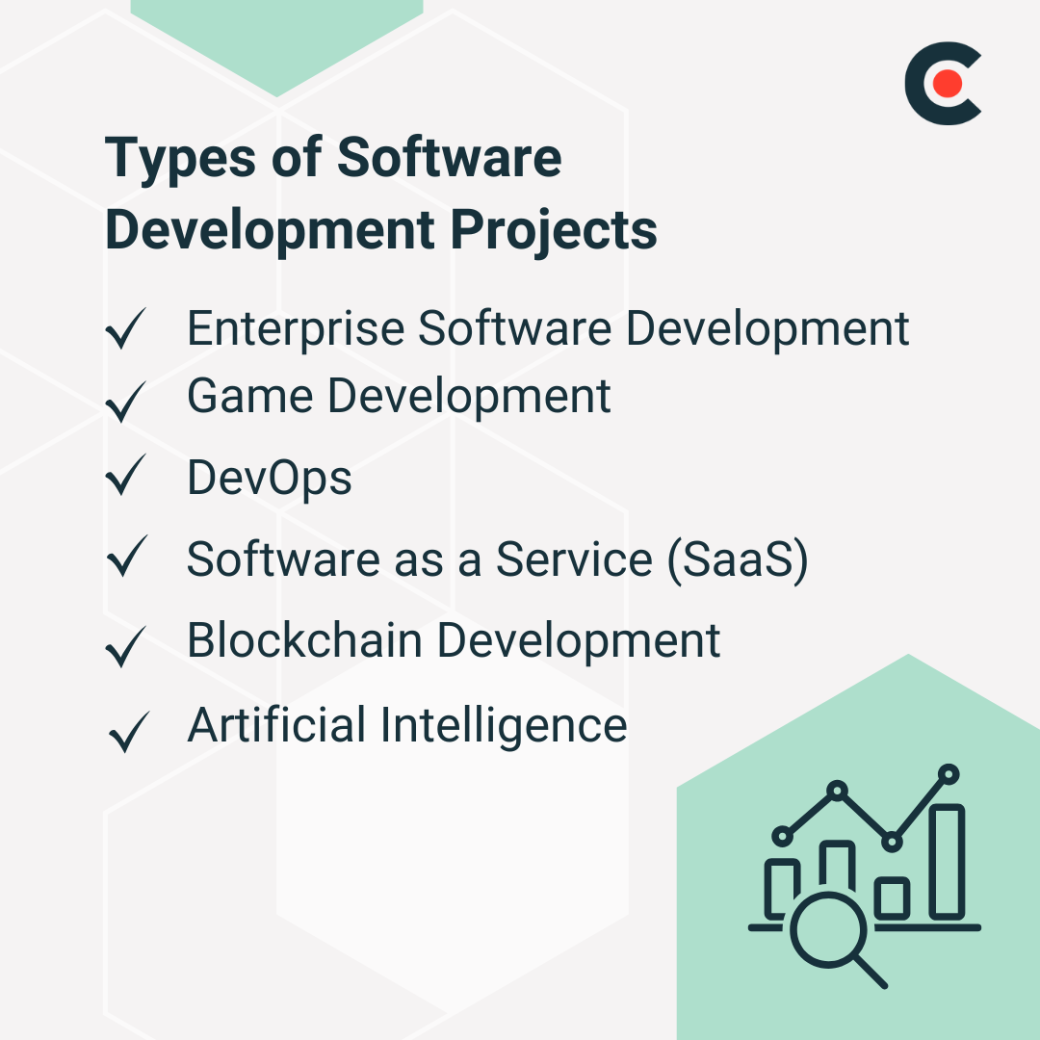
Large organizations rely on enterprise software to manage complex operations, from customer relationship management (CRM) to supply chain logistics. These solutions are typically custom-built and work with existing systems to support workflows.
Game development requires a mix of user experience (UX) design and programming to produce the end product. These can be simple, casual games or highly advanced 3D simulations, and they may be made for consoles or mobile devices.
DevOps is a blend of software development and IT operations. It helps speed up the software development life cycle while providing high-quality results. IT professionals and software developers collaborate on these projects to streamline processes.
The SaaS market is a highly lucrative sector, expected to generate over $390 billion in revenue by 2025. SaaS projects involve creating software applications centrally hosted and provided to customers via a subscription model. Some examples of SaaS projects are project management tools and accounting software.
Blockchain has become a popular medium for building decentralized applications and systems. In some countries, the sector has seen a 250% growth, while the United Nations Development Program has also taken its Blockchain Academy, a digital education program, global.
Blockchain development requires familiarity with cryptographic protocols and distributed systems. Developers create decentralized applications and other blockchain-related solutions.
Like blockchain, AI has seen immense growth in recent years. Not only are new AI-based software being created, but existing ones are also incorporating AI-powered features.
AI-backed software development is common in healthcare, education, fintech, and cybersecurity. Common examples of such software include chatbots and intelligent personal assistants.
In short, your software development checklist should involve determining goals, setting deadlines, selecting a tech stack, finalizing features, and working with a software development company.
The last step is crucial since it also helps you in the post-development phase, where you must receive ongoing software support and maintenance. These companies can assist in software updates and debugging to keep the software running smoothly. They can also provide guidance on scalability and security as your business grows.