7 Tips For Designing Web Forms
Clutch surveyed 502 web users about what they actually want from form design. Here are 7 data-backed UX principles that reduce abandonment and improve...
Updated February 18, 2026

If your mobile website delivers a slow, clunky experience, your bounce rate will increase and your revenue will drop. In fact, slow sites cause billions in lost sales annually. So, what can you do?
Researchers say 73% of e-commerce revenue comes from mobile users, which means optimizing your store for mobile traffic is incredibly important.
One option is replacing or complementing your mobile site with a Progressive Web App (PWA). This alternative delivers faster, cleaner experiences for mobile shoppers, which translates into higher revenue and business growth. They also help brands overcome app fatigue, providing the mobile-first experience today's users want without forcing them to download another app to get it.
Looking for a Web Design agency?
Compare our list of top Web Design companies near you
This article will help you decide whether a PWA or mobile site is right for your business.
Before you hire a PWA app development company, it’s worth diving a little deeper to see if you truly need a Progressive Web App.
In 2025, the decision isn’t just about fixing page speed or redesigning your checkout flow. Executives must also consider how mobile strategy ties into broader business outcomes around customer acquisition, retention, and brand equity.
Choosing between a mobile site and a PWA isn’t just a tech choice. It's about aligning with your customer base and how they want to interact with your brand.
A mobile-optimized website is a site that’s specifically designed to provide an easy, seamless experience on smartphones and tablets, and involves:
Web pages with mobile-responsive elements earn 11% more conversions and 15% higher engagement rates. These gains trace back to reduced bounce rates and higher checkout completion rates from users who enjoy more seamless mobile shopping experiences.
Optimizing your site could also help you meet Google's strict Core Web Vitals performance benchmarks. Only around 47.4% of today's desktop sites pass. However, meeting those benchmarks can have significant results for your business:
However, even if you hit Google’s benchmarks with your mobile website, you could still struggle to deliver the app-like speed and responsiveness that mobile users have come to expect. This is where PWAs come into play. They consistently outperform traditional mobile-optimized sites with asset caching and user background sync.
PWAs are websites that are built to feel and function like native mobile apps. They offer:
Unlike native apps, PWAs don’t require app store downloads or updates. Singh says this is key to the value they offer: "PWAs are gaining traction because they mix the best functionalities of a website and an app. They load fast, work on any device, and eliminate the need to download them from an app store. It makes development and maintenance easier and accessible."
That’s one reason why their market is projected to soar from $3.53 billion in 2023 to $21.44 billion by the end of 2033. Josh Locke, Marketing Manager at Harrison Carloss, also highlights the fewer restrictions PWAs have: "Apple charges an annual fee plus commission on paid apps or in-app purchases, whereas there’s no fee for web apps, they’re just as easy to install, are compatible on any device or browser, take up less storage space on a user's device, and they update automatically."

With a PWA, your business can skip the recurring costs and approval delays of the Apple and Google ecosystems.
PWAs can be used in a wide variety of industries.
For one example, travel companies using PWAs see about a 3x jump in conversion rate after making the update. These companies also enjoy a 180% improvement in customer retention. With growth like that, the money you invest in building a mobile-friendly website could reach a positive ROI sooner than you think.
Beyond retail and travel, many well-known brands have succeeded with PWAs. For example, Starbucks doubled its daily active users and saw a 40% increase in time spent on the platform after releasing its PWA.
B2B brands can see similar results. SaaS providers use PWAs to deliver offline dashboards for sales teams, customer support staff, and other workers. This can improve employee efficiency beyond what the typical company offers.
Your PWA can become a unique selling point that helps you stand out in a crowded marketplace.
You can absolutely have a mobile website and a PWA. The two complement one another by unlocking distinct benefits for your business.
For example, your mobile site is the foundation of your digital presence, driving SEO visibility and making your brand discoverable to the world. However, your PWA layer provides deeper engagement for users who value speed, offline access, and more personalized interactions.
Put another way, your mobile site is for reach and discoverability, while your PWA is for driving retention and deeper engagement. They make a great team, working together to balance traffic growth with long-term customer loyalty. Using both will help you get maximum value out of the time and money you spend on mobile-friendly web design.
Many brands start with a mobile site and add a PWA layer once traffic scales. For example, your brand could use a mobile site for initial discovery, but roll out a PWA to re-engage repeat users and create brand loyalty.
Another advantage of having both is the resiliency that it brings to your tech stack. If either your PWA or mobile site goes down, users will still be able to engage with your brand on the other one.
With that background information in mind, do you need a mobile-optimized site or a PWA? It could depend on the work you do. Ali Hashmi, CTO of Tekglide, says, "Industries such as retail, travel, media, and e-commerce see significant ROI because PWAs combine high engagement with lower acquisition costs."
However, there's really no one-size-fits-all decision. It comes down to your goals, budget, and stage of business growth, among other factors, as shown below.
| Decision Factor | Mobile Optimization | Progressive Web App (PWA) Development |
| Use Case | Discoverability, SEO, and reaching the widest audience possible | Speed and app-like functionality, high engagement |
| User Experience | Responsive design elements, seamless usability across all devices, but typically with limited offline features | Near-native app experience with offline use, push notifications, and smooth performance |
| Brand Maturity | Essential for all businesses, especially those building awareness and traffic | Best for brands with established traffic looking to boost engagement and retention |
| Development Cost | Lower upfront investment, simpler to implement | Higher cost due to advanced features and complexity |
| Time to Market | Faster to launch, often just a redesign or optimization effort | Longer build time, especially if integrating advanced APIs or features |
| Maintenance | Straightforward, update one site for all devices | Small ongoing updates to keep up with browser and OS capabilities |
| Performance | Improves loading speed and reduces bounce rates | Optimized for speed and interactivity, often outperforming standard sites |
| Retention and Loyalty | Good for initial reach and discovery, but offers limited engagement tools | Helps with user retention via push notifications, offline access, and deeper personalization |
If you're an early-stage company focused on traffic and visibility, mobile optimization is worth prioritizing. But as you grow and your traffic increases, layering in a PWA can be the next step for driving growth through tech improvement.
While many companies use mobile sites and PWAs together, if you're trying to decide between these options, Hashmi has some advice: "Mobile site optimization is best for brands with a primarily informational site... The focus is on speed, accessibility, and responsive design. PWAs make sense when a brand's success depends on repeat visits, offline usability, and app-like engagement. If user retention, push communication, and multi-device consistency are critical KPIs, a PWA is the right investment."

Executives should also weigh the long-term scalability of different mobiles. For example, an optimized mobile site may achieve your immediate traffic goals. But will it scale as the business grows? If you'll need to invest in a PWA anyway, the decision you really need to make is which to do first.
Optimizing your mobile strategy is a critical step toward excelling in e-commerce in 2025. If you’re ready to do that, here’s a six-step process you can follow to bring your vision to life.
The first step is figuring out where you stand today. You can use tools like Google Lighthouse, PageSpeed Insights, and Core Web Vitals to compare your load times with industry benchmarks. As you go, watch for metrics like:
Test your website performance in each metric, then do the same for your top competitors. This will show you where you stand out and where improvements may be needed.
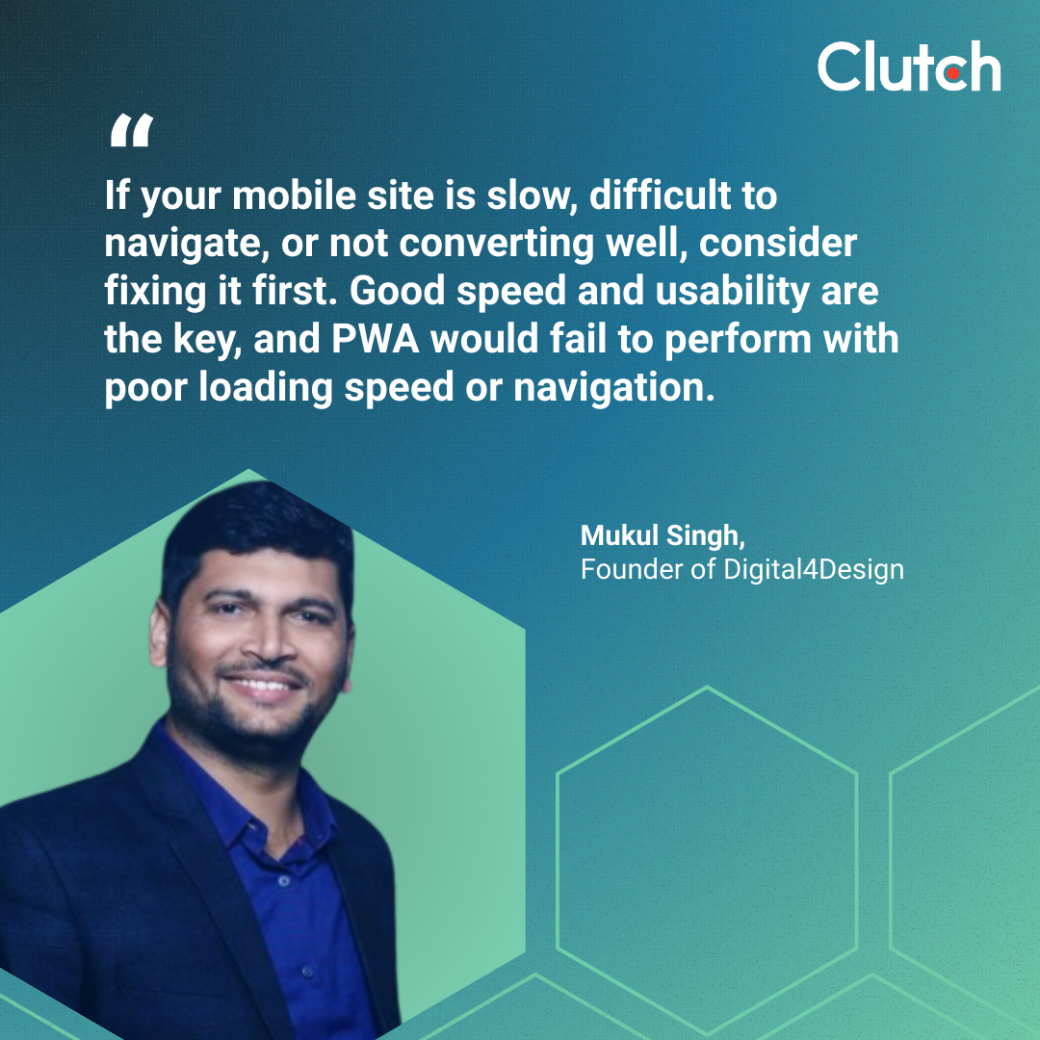
If you don't get good results initially, you may need to upgrade your mobile site before continuing. Singh says, "If your mobile site is slow, difficult to navigate, or not converting well, consider fixing it first. Good speed and usability are the key, and PWA would fail to perform with poor loading speed or navigation."
Once you understand how you currently measure up, the next step is figuring out what to improve first. For instance:
It’s generally smart to balance quick wins with long-term investments. For example, you can make up ground quickly by focusing on optimizing images and caching when starting out. But focusing on only those small wins could put you at a competitive disadvantage in the long term. So, don’t forget to work towards a long-term vision while you look for early design optimization wins.
If you're unsure about your priorities, consider searching for examples of progressive web apps online to see what ideas already work. You can build these into your web app development process to make fast gains.
At this point, you’re ready to begin thinking about your rollout strategy. That typically means using feature flags and pilot programs to test your PWA before going live.
Your strategy will vary based on your brand’s size and goals, as detailed below:
Once you've determined your strategy, it’s time to choose a development partner to help you bring your vision to life:
Regardless of the type of partner you choose, it’ll be important to select one that understands your audience, industry, and growth goals.
Next, start planning out how you’ll allocate the budget you have for this project. Make sure to leave some room for ongoing analytics and marketing support. Once you roll out your new site or PWA, you’ll still need to monitor it and make updates as user behavior evolves.
Finally, commit to monitoring your core web vitals and engagement metrics regularly, as mobile strategy is never really “done.” This process will likely include A/B tests, user data analysis, and ongoing benchmark comparisons.
Continuous testing and optimization help your company remain competitive as standards and user expectations evolve. You may even want to keep a PWA dev on staff if this will be a core part of your business offering.
At the executive level, testing is more about making sure dashboards are tied to revenue and key retention KPIs. It'll likely be your job to make sure the new PWA supports the team's broader business goals.
Mobile optimization and PWAs work best when complementing one another. Your mobile site can help you expand reach and capture traffic, while your PWA elevates the browsing experience for users who already know you.
Looking further ahead, both mobile sites and PWAs are evolving quickly through AI-driven personalization. Companies are also leveraging predictive search and voice-first browsing features for the next era of users.
Regardless of where the future brings us, the key will be aligning your tech choices with your users’ expectations and business goals. That could involve prioritizing reach, engagement, or building long-term loyalty, depending on where you’re at today.
Whichever strategy you choose, partnering with a top-rated web design agency can help you execute it more effectively.