
Website ROI: How to Measure, Calculate, and Improve Your Return
Website ROI measures the value your site generates relative to what you spend. Learn how to calculate it, track the right KPIs, and improve your return.
Updated January 6, 2026

If your small business is evaluating new technology, today’s market offers tools for nearly every operational need. From AI chatbots and mobile applications to e-commerce platforms and reporting software, most business processes can be supported or improved with purpose-built technology.
However, this abundance of choice can make technology decisions more challenging. While it is important to remain competitive, it is equally important to invest thoughtfully rather than allocating resources to technology simply because it is popular or widely adopted. Customer expectations keep changing, too, making it hard to predict what they'll want next.
To learn more about how companies handle these decisions, Clutch surveyed 400 small business owners about their priorities for tech spending. Over half (55%) focus on customer needs and expectations when making decisions about future tech, while 37% prioritize competitive pressure.

Market research methods can help you make smarter choices about your tech investments. From customer interviews to product testing, these tactics let you predict what customers will expect next and what to prioritize. Here are 12 methods to try before you add another tool to your roster.
Customers often love novelty, but don't assume that they'll embrace every new digital experience. For example, Facebook once touted virtual reality (VR) as the future of the internet, but the company has lost over $70 billion on its Metaverse experiments. Businesses that jumped on the VR hype train may have wasted money on a solution their clients didn't even use or want in the first place.
The moral of the story is that you shouldn't just trust your gut or chase trends when shopping for technology. If you invest in the wrong tool, you'll waste resources and potentially frustrate your clients. Plus, you may miss the chance to adopt something that will actually help your company grow.
Of course, that doesn't mean you should never experiment. Paralysis can be equally harmful to your business. With structured market research, you can make educated decisions based on your customers' interests and needs. If social listening or customer feedback shows that people love interactive tutorials, you may add them to your website. This knowledge takes some of the risk out of innovation.
Market research involves collecting and analyzing data on your competitors and customers. It helps you anticipate your audience's needs and pick appropriate technologies to satisfy them. Some small businesses outsource this process to a market research firm, but many of these tactics are easy to use with little to no training.
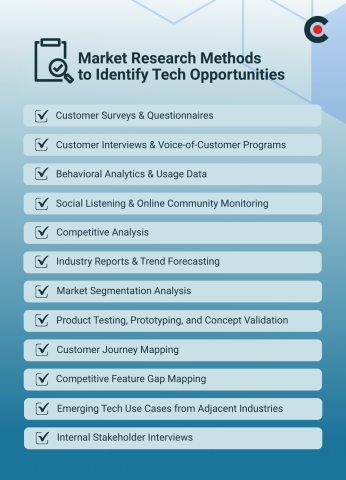
Often, the simplest way to find out what your customers want is to ask them. Surveys and questionnaires allow you to learn about their preferences, annoyances, and pain points directly. Use these tools to get firsthand insights about the customer experience and gauge interest in new tools or features.
Here are a few types of survey questions to use:
Resist the urge to switch up your surveys once you find questions that work. Using the same prompts over several months or years will help you spot trends and predict future tech needs. For instance, if customers feel less satisfied with your checkout process over time, consider adding one-click purchasing or redesigning the user interface.
Surveys work great when you need to gather data from hundreds or thousands of customers, but you won't get in-depth answers. For that, you need one-on-one conversations, preferably over the phone or through video chat.
Invite customers for a structured interview. Use this chat as an opportunity to learn about their deeper motivations and spot emerging problems that they may not be able to articulate in a 100-character survey response. A client may say they don't want to interact with an AI chatbot on a survey, but during a live conversation, they might be much more receptive.
Once you've gathered feedback from at least a few dozen customers, look for patterns that you can turn into tech requirements. Did 15 people comment on your mobile app's confusing menus? Time for a redesign. If they want more personalized recommendations, an AI model could be an affordable solution.
Observing how your customers act can tell you just as much as their direct responses. Use analytics tools to track how they interact with your existing digital products. Heat mapping software, for instance, shows how users navigate through websites and what they click. Similarly, you can use Google Analytics to monitor how much time people spend on specific web pages and what they engage with.
Use this behavioral data to spot friction points and drop-off moments. Let's say you notice that 15% of visitors exit your website when they reach the checkout page. That's a red flag that they're running into a roadblock, such as surprise shipping costs or confusing buttons.
This data can also help identify feature gaps. If people often abandon your checkout form, they may feel annoyed that it doesn't have auto-fill or sync with their favorite payment method. Meanwhile, frequent searches for tutorials or products you don't offer point to clear user interest. This information helps you decide what to prioritize when updating your tech or shopping for new solutions.
When people want to chat about new technologies, they often head straight to Reddit and other social media platforms. Tune into these conversations with social listening tools such as Brand24 and Sprout Social. They automatically alert you when people mention your business and products, so you can step in quickly to address complaints. It's much more efficient than scrolling through half a dozen channels every day.
Social listening also lets you keep a watchful eye on tech trends and rising expectations. Pay attention to early signs of interest, such as trending keywords or digital "hacks" shared by influencers. Spotting these signals can help you jump on tools before competitors.
Monitor the technology stacks used by industry leaders and competitors to stay informed about developments and trends in your field. They won't always get it right, but their actions can help you forecast what's happening next. For example, a company in your niche may add AI agents to its website or invest in augmented reality, and you may also need to
Start by using a SWOT (strengths, weaknesses, opportunities, and threats) analysis to benchmark your tools against competitors. Or look inward for potential shortcomings with a gap analysis. Once you've spotted potential trends, do your own research to see if they're worth following.
You've got a company to run, so don't try to do all the investigative work yourself. Major consulting firms regularly release in-depth analyst reports about the latest trends in business and consumer tech adoption.
McKinsey, for instance, recently published a report about 13 trending technologies, from agentic AI to robotics. This sort of research can help you spot big-picture patterns and distinguish hype from tools with long-term potential.
You already know that your customers aren't a monolith. However, it's not always easy to figure out why certain people love one tool and others feel indifferent. Market segmentation analysis lets you get into the nitty-gritty details by sorting them into different groups.
For example, you may create segments based on:
This more nuanced analysis can help you understand which types of customers want advanced tech features. You may realize that Gen Z is clamoring for a self-service portal, while older clients still prefer to chat with a human representative. If Gen Z is a more profitable segment, prioritize the technologies that will keep them happy.
Consider each audience's readiness, too. A group may say they're interested in a technology, but that doesn't mean they'll immediately hop on board. Combine market segment analysis with user testing or focus groups for the most accurate information.
Once you've identified a few promising features, resist the urge to fully invest right away. Thorough testing will help you avoid taking unnecessary and potentially costly risks.
Build prototypes to see what that grand tool looks like when it leaves the drawing board. After you're happy with it, invite beta users to test the prototypes. You can also use A/B testing to see how your audience responds to tech changes.
These experiments will help you determine which features will have the highest return on investment (ROI) and then fine-tune them. For example, A/B testing may reveal that customers are more likely to take product recommendations from a sassy chatbot than an email.
When you're upgrading your tech stack, it's easy to focus on high-stakes touchpoints like checkout and product demos. However, pain points can crop up in unexpected places. Spend time mapping out the buyer's journey to spot subtle or overlooked areas of friction that you can fix with new tools.
Pay particular attention to anywhere that people tend to drop off or spend a lot of time. Does your customer service queue always have at least a 20-minute wait? AI agents or automated support tools could assist faster, at least for simple questions. If people tend to abandon appointment forms halfway through, try integrating your scheduling tool with Salesforce for automatic follow-up. It's all about using tech to make your clients' lives easier.
Before you shell out money for new tech, make sure your existing products and services are up to par. Compare them to other alternatives in your industry, even if they're not an exact match. Do these competitors offer features you don't? That's a problem, especially if customers expect them. Use these gaps to build future tech roadmaps that keep pace with industry standards.
If you only watch your own sector, you'll only stay a few steps ahead of your competitors at best. For true innovation, look for tools catching on outside your industry that you could translate to your own business.
For example, human resources teams could use education software to gamify onboarding. Similarly, a tool that hospitals use to triage patients could help you get support tickets to the right person faster.
As you survey clients and scope out your competitors, don't forget to consult the people with the most knowledge about your tech stack: your team. They work with your tools every day, so they can tell you exactly what's working and what's not. You just need to listen to them.
Start by interviewing your most tech-reliant departments. This likely includes sales, support, product development, and operations. Ask them about their frustrations and obstacles they encounter during their day-to-day tasks. Internal support tickets may also reveal common snags.
Use this data to look for problems you can solve with technology, and prioritize the areas that fit with customer expectations. Let's say your marketing team wastes too much time designing email campaigns with software you haven't updated since 2012. Replacing it with something more modern will save time and give customers the personalization they crave. It's a win-win.
All the market research methods in the world won't help much if you don't know how to put the data you gather into action. Start by using a structured framework to decide which features to prioritize instead of relying on your gut. Options include:
You should also estimate the possible ROI and the likelihood that people will adopt your new tool. Weigh the timeline and operational benefits, too. A pricey feature may be worth it if it boosts productivity by 15%, but not if it takes a year to design.
Above all, focus on tech investments that fit your customers' needs and business goals. If no one actually needs that ultra-trendy tool, skip it, even if all your competitors are jumping on board.
As you map out your tech plan, steer clear of these common errors:
At the same time, don't be too cautious. Innovation often involves taking risks, and too much research can lead to paralysis or delayed responses. Gather enough data to make an educated decision, and take the plunge.
Unless you have a crystal ball, there's no such thing as a risk-free tech investment. However, using multiple market research methods is the next best thing. Gathering data from different sources will help you spot trends early and make more accurate predictions about the future.
Of course, technology is never static, and neither are your customers' expectations. Prioritize market research all year, not just when you're shopping for a specific tool. With the right data and a little courage, you can stay competitive without draining your bank account.