Lead Quality vs. Lead Quantity: Why B2B Teams Are Rethinking Their Funnel in 2026
Bigger buying committees and tighter budgets are forcing B2B teams to rethink lead quality vs. quantity. Here's how top teams rebalance the tradeoff in 2026.
Updated May 26, 2026

Lead generation can transform your business by helping attract and convert customers. It is a crucial step in the sales funnel that plays a big role in building the foundation for genuine customer relationships. At first glance, the entire lead generation process can feel intimidating, going through tedious steps and stages. Knowing these four best practices will help you drive the best results for your business.
Ask any experienced marketer or entrepreneur, and they’ll all agree that lead generation is paramount to business success, especially against cutthroat competition in the digital age. Lead generation combines different strategies and disciplines to cultivate interest in products or services with the aim of swaying customers into making a purchase decision.
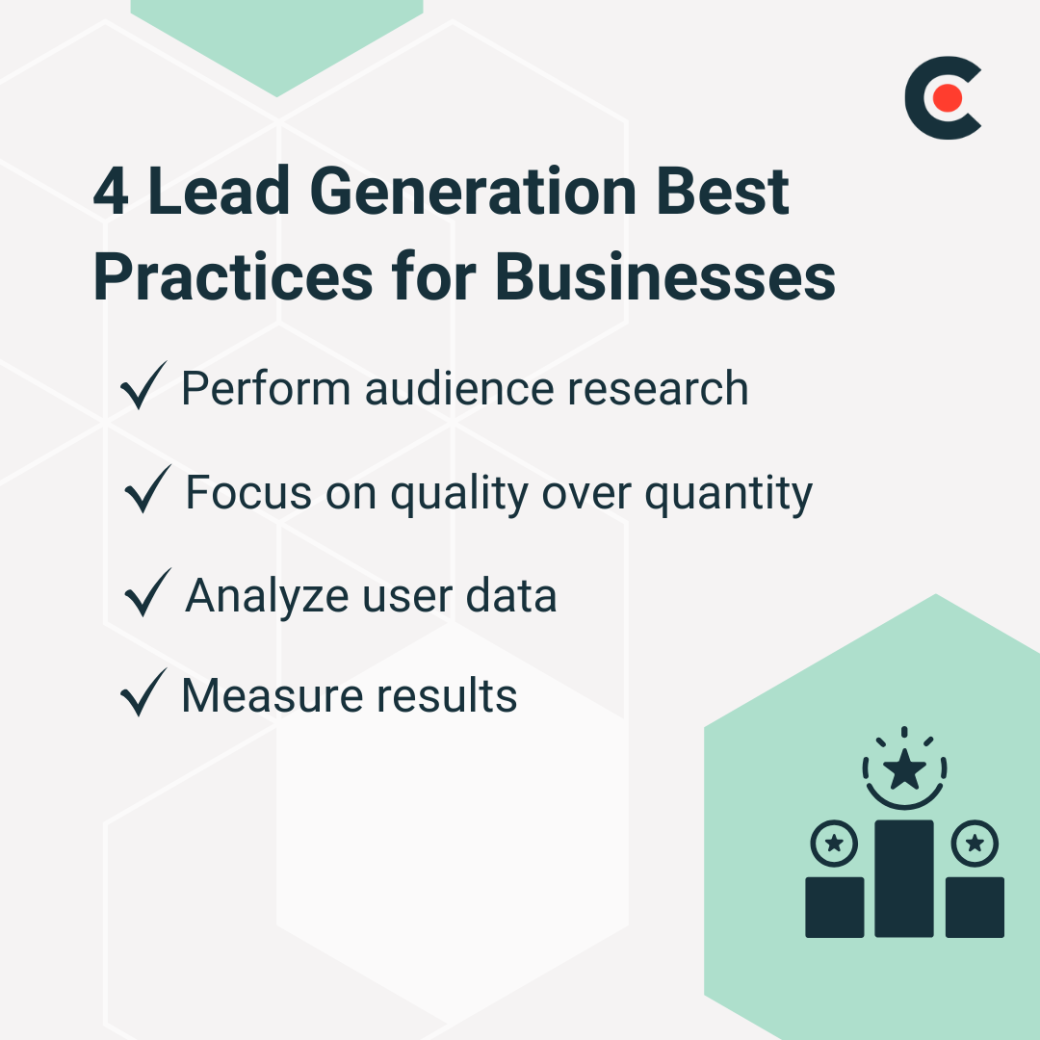
Maximizing results from your lead generation strategies requires careful research and optimization. Here are four best practices you can implement:
Looking for a Digital Marketing agency?
Compare our list of top Digital Marketing companies near you
Looking for a trusted partner to handle the tedious lead generation work? Team up with the best lead generation companies on Clutch.
Understanding your audience, also referred to as the ideal customer profile (ICP), is vital to planning the course of your strategies. Conducting thorough market research helps you gather key insights and data to serve as the basis for your lead generation efforts. Settling for depthless understanding of your demographics will produce lackluster results.
“The major problem is they make default assumptions about where they should be marketing, i.e. we are B2B so we should advertise on Linkedin.” Justin Rashidi, Co-Founder of SeedX Inc., provides a precautionary example while discussing the importance of understanding audiences. “This is a big mistake. The easiest way to understand where you should be advertising is generally the market size and your specific ICP.”

Targeting is an essential aspect of lean lead generation. However, it requires more than identifying your audience's demographics and surface-level characteristics. Strengthening your lead generation strategies requires thoroughly understanding their interests, pain points, and behaviors.
Build buyer personas that help you envision your ideal customers. You can better tailor your lead generation strategies with clear, distinct profiles that identify their particular challenges, preferred communication channels, and more.
As the adage goes, if you're targeting everyone, you're targeting no one. Running ads that reach as many people as possible may sound like a good idea, but generalized messaging will only reel in a very small percentage of prospects. On the other hand, when your messaging deeply resonates, it drives potential customers to take the next step.
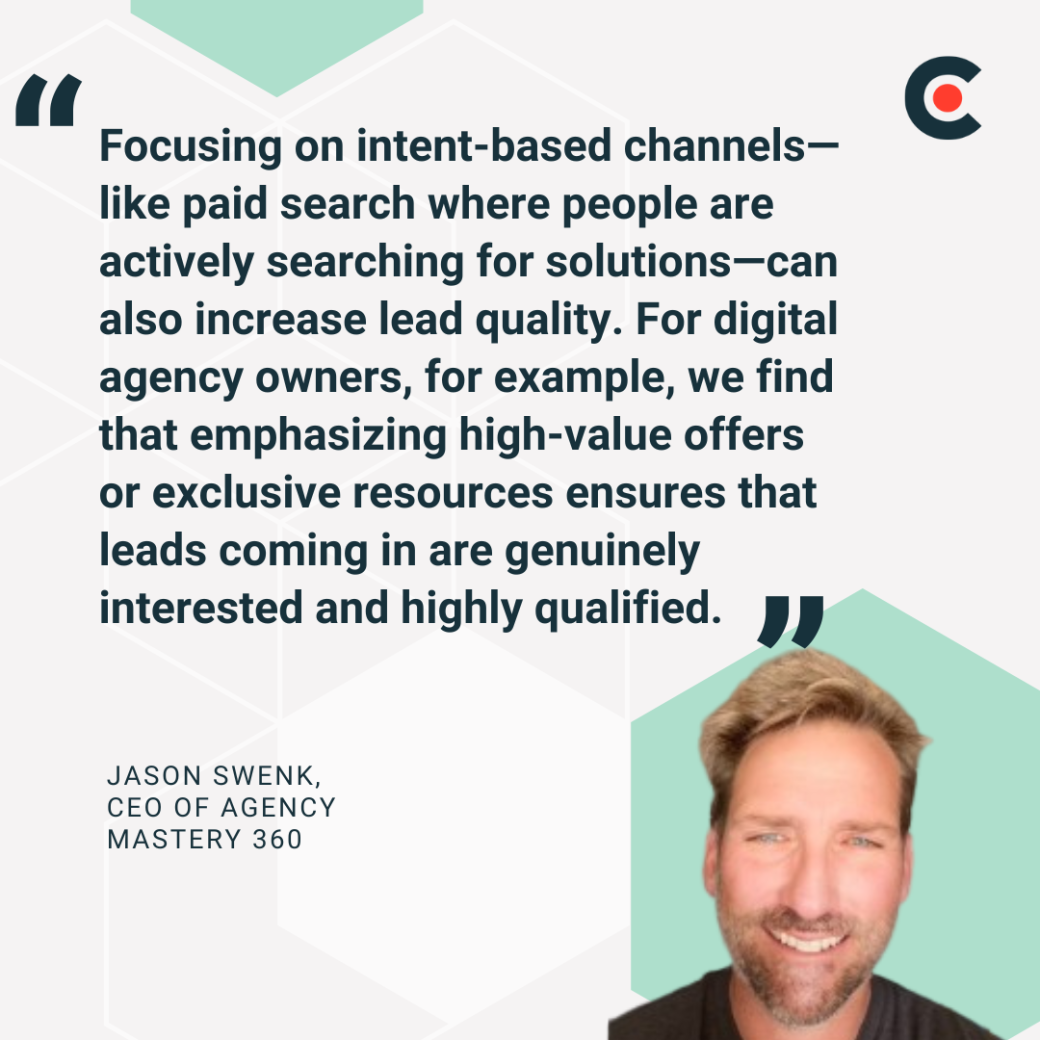
“Focusing on intent-based channels—like paid search where people are actively searching for solutions—can also increase lead quality,” said Jason Swenk, founder of Agency Mastery 360. “For digital agency owners, for example, we find that emphasizing high-value offers or exclusive resources ensures that leads coming in are genuinely interested and highly qualified.”
Focusing on highly qualified leads over targeting a wide range of audiences won’t yield stellar results. Quantity-focused lead generation strategies typically generate low conversion rates, as many leads may not find the product relevant to them. Additionally, running quantity-focused lead generation campaigns will cost your team more resources and time.
Quality-focused strategies are more likely to convenience your customers, giving your sales team more bandwidth to nurture them, which can result in stronger relationships and higher customer lifetime value (CLV).
That said, it's worth the extra effort to run several campaigns. Create separate content that speaks directly to each buyer persona and its needs.
Are you regularly reviewing your user analytics? Data like page visits, time spent on site, and interaction patterns can help you unleash new insights about what attracts people to your brand.
User analytics is a type of data analysis that aims to uncover critical audience insights, such as preferences and buying behavior. It offers businesses a deeper understanding of customers' needs.
Generally, businesses can gather user data through the following methodologies:
Analyze metrics on your website at least once a quarter to optimize your website experience, social media presence, and other channels. These proactive measures to improve your digital presence will only strengthen your lead gen efforts.
Monitoring the results of a lead generation campaign is important as you launch a lead generation campaign. Track a few key performance indicators (KPIs), like cost per lead and lead conversion rates, that tell you whether your strategies effectively contribute to your campaign goals.
As your campaign progresses, you can adjust lead gen tactics as needed, and as it ends, you can learn from your successes and mistakes. For instance, if your lead generation efforts fail to lower cost per lead (CPL), it may indicate ineffective audience targeting. Meanwhile, low conversion rates might result from underperforming copies and unappealing call-to-actions (CTAs).
When measuring results, it’s important to clearly grasp the lead generation strategy’s goals. Tools such as Google Analytics, Salesforce, and AI-powered platforms can help streamline reporting and benchmarking.
Lead generation should always be treated as an iterative process. Even if you nail the right strategies on your first try, customer interests and behaviors can quickly shift. Consistently and thoroughly measuring results will help you optimize your lead generation efforts to achieve long-term sustainable growth.
Ultimately, there’s no simple formula to ace lead generation but these four best practices can help you lay the groundwork to achieve remarkable results. While there are short-term lead generation goals, remember that it’s an ongoing process that works wonders for the long run.
Various lead generation strategies and tactics may or may not work for your business. It’ll be a continuous adapting and learning process, so having a proven team behind your back can help you find the best way to grow. Match with reliable lead generation partners on Clutch.