
How to Delegate: A Step-by-Step Guide for Agency Owners
Learn how to delegate effectively as an agency owner — what to delegate first, how to hand off work without losing quality, and the hiring sequence that...
Updated May 29, 2026

The IKEA effect says that people usually care more about projects they’ve helped create. Learn how to take advantage of this and turn your clients into active participants in your process with expert insights from Carole Mahoney, founder of Unbound Growth.
There’s something incredibly satisfying about helping a project come together. It doesn’t matter if it’s a complicated bed frame or a virtual island in Animal Crossing. When you see your hard work pay off, you’re bound to look at whatever you’ve made proudly. This phenomenon is called the IKEA effect, named after the famous assemble-it-yourself furniture store.
The concept is simple: When people put effort into building something, they value it more. In fact, a series of psychology experiments suggest that “building products increases both thoughts about the positive attributes of that product and positive affect and emotional attachment.” Or, as the researchers put it more succinctly, “Labor leads to love.”
Of course, you’re probably not going to invite your clients to assemble furniture with you. But you can use the IKEA method by treating them as collaborators and involving them in major decisions. It’s an incredibly effective way to strengthen your relationships — and co-create better projects. Learn more about it from Carole Mahoney, founder of Unbound Growth.
You might assume that your clients don’t want to put much effort into your projects. After all, that’s what they hired you for, right? But that’s not always true. While clients appreciate your expertise, they also value their own input. And they often want a say in projects, even if they might not realize it.
Mahoney has observed the IKEA effect with her own clients. She explains, “What researchers realized is that when we collaborate on a solution and put effort into it, we place more value on it.”
“I often use the cookie analogy,” Mahoney continues. “You can buy cookies at the store or bake them yourself. Which do you value more? The homemade ones taste better, feel better, and carry more meaning because of the effort put into them.” This same principle applies to everything from interior design to software development.
Giving clients ownership makes them feel more emotionally invested. That’s a fast track to higher satisfaction.
The IKEA effect creates emotional connections through effort justification. Researcher Emily D. Klein et al. observe, “When humans are asked to evaluate rewards or outcomes that follow unpleasant (e.g., high-effort) events, they often assign higher value to that reward.”
That doesn’t mean you should force your clients to do stressful tasks like designing products from scratch or — even worse — filling out tedious paperwork. But you should treat them as active collaborators, not just consumers. Here’s how.
You don’t need to wait until the client hires you to start using the IKEA method. By emphasizing co-creation during the sales process, you can get them on your team from the start.
Mahoney encourages agencies to list the questions the sales team asks during this stage and consider their purpose. As she puts it, “Are you seeking information for yourself or helping buyers discover what they need?”
Obviously, you need to gather some basic information from the client. But most of your discussions should center on their ideas and preferences.
“Focus on crafting open-ended questions starting with who, what, when, where, why, and how,” Mahoney advises. “When you drill deeper with these questions, buyers reveal their thoughts, previous attempts, and what has or hasn't worked.”
Here are a few examples of questions that empower clients:
These questions put clients in the driver’s seat, giving them more control over the conversation. Also, when they’ve already put in the mental labor to start imagining the project, they’re more likely to commit.
Of course, your sales team shouldn’t just bombard customers with a list of open-ended questions. That’s an awkward interrogation, not a collaboration. Instead, focus on making the client feel heard and involved in creating the solution.
“When people share information, their brain releases dopamine from areas responsible for trust-building,” Mahoney explains. “As buyers disclose more, your job is to probe deeper until you understand their goals, desired results, timeline, and motivations. This allows you to reverse-engineer solutions based on their previous attempts and available resources.”
Probing deeper allows you to ditch your preconceived notions and truly understand what the client needs. That way, you’re building a genuinely great solution together instead of shoehorning them into a pre-built box. And that’s something you can both feel invested in.
Getting your clients to put effort into your projects doesn’t end after the sales process. Use the IKEA effect to your advantage by involving them at every stage.
These strategies will help you encourage collaboration (without burdening your clients with too much work):
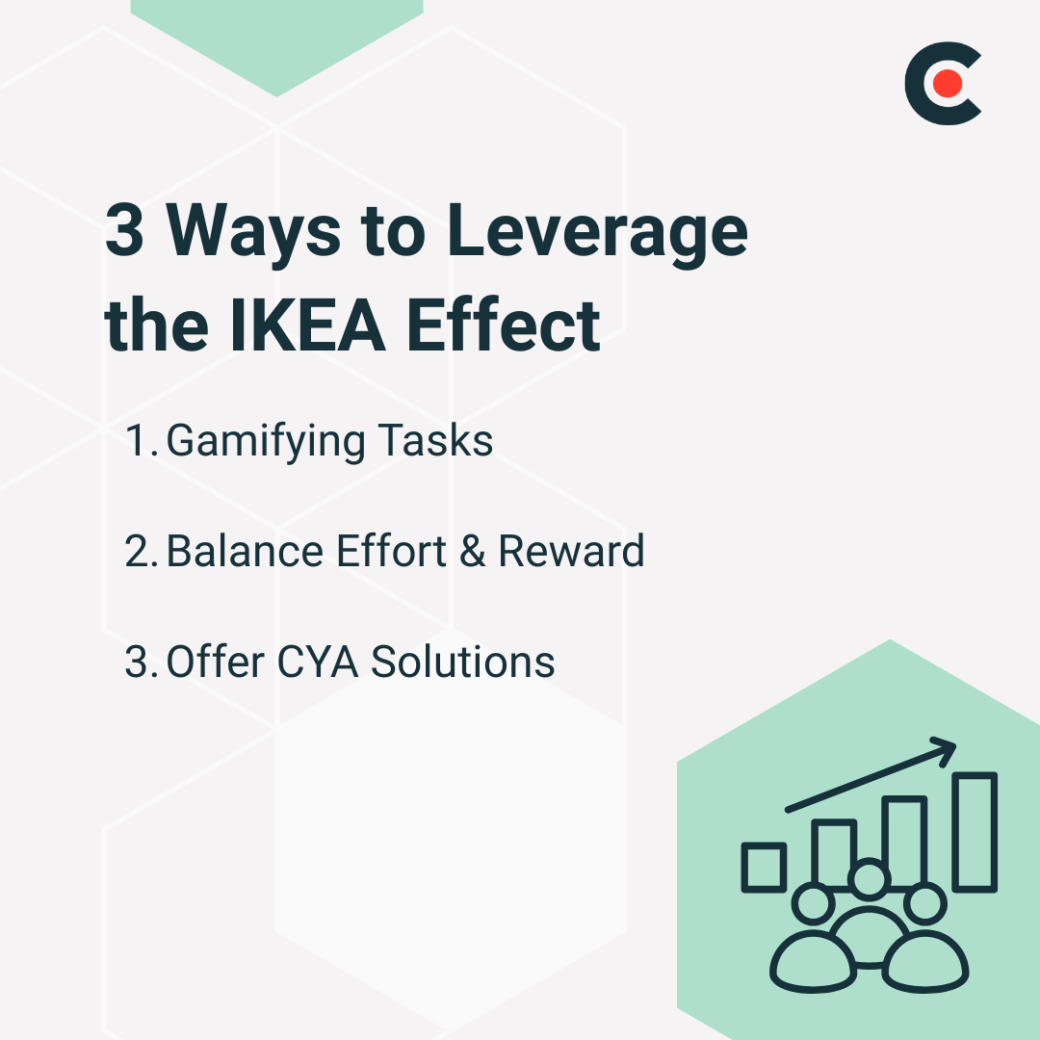
A 2025 study reports that gamification “can tap into consumers’ inner motivations, which is advantageous for building a stronger emotional bond between the brand and its audience.” This approach can also increase brand loyalty and boost engagement.
No, that doesn’t mean you should bring a pack of cards or Monopoly to your next client meeting. But you can gamify activities in creative ways, such as:
These games might feel a bit silly, but they’re incredibly effective at getting clients involved. Just keep the stakes relatively low, so that customers never feel like they’ve lost.
The IKEA effect only works when people feel like their effort truly matters. Turn co-creation into a boring chore, and your clients will just get annoyed.
Keep things light by asking customers to participate in relatively brief tasks that have tangible outcomes. And never ask them to create something from scratch — that’s your job. For example, you might ask them to test the user interface and give feedback, or weigh in on different features.
These tasks don’t take much time but have clear rewards, showing clients that their input matters.
You may remember the thrill of leafing through a Choose Your Own Adventure novel or choosing what happened next in Netflix’s interactive Bandersnatch movie. Weighing different options, shaping the narrative — it’s incredibly immersive.
Give your clients the same heady feeling of control by creating CYA pathways during the design process. For instance, you might let them choose between three different wireframes or user interfaces. Each pathway can unlock more “branches,” such as features and color palettes.
This strategy empowers clients by letting them direct their personal narrative and play a key role in decision-making. It’s a great way to increase ownership and emotional attachment.
This IKEA method works best for service-based businesses that specialize in custom solutions, such as software firms or luxury brands. These types of businesses often have plenty of room for collaboration and personalization.
By contrast, this approach may not be ideal for high-volume retail products or urgent services. In these settings, extensive teamwork with clients may not be realistic or even desirable.
While the IKEA effect can be powerful, it’s not a guaranteed success. It can easily backfire, especially if you rush into using it. Here are three mistakes to avoid:
Avoid these issues by gauging the client’s interest during the sales process. You should also limit their involvement to the most rewarding or major choices to prevent burnout.
Getting a sense of the company culture can also help you choose activities they'll find fulfilling — a client with a more casual, whimsical culture might be more open to gamification, while a client whose organization projects seriousness and tradition might prefer more CYA opportunities. Matching your style to your client's will help satisfy you both.
The IKEA effect is an incredibly powerful psychological phenomenon. By treating your clients as co-creators, not consumers, you’ll turn routine projects into satisfying collaborations. Those partnerships can lead to long-term loyalty and help grow your customer base.
Get started by revamping your sales process to focus on dialogue, not information gathering. Remember: The higher the client’s effort, the more invested they’ll feel in your team and the final product.

Carole Mahoney, the Founder of Unbound Growth, is a sales coach for the Entrepreneurial MBA program at Harvard Business School, where she’s been called “the Sales Therapist.” She draws on cutting-edge science, statistics, and data from 2.2 million sales professionals to inform her sales coaching work with clients.