10 Actionable Link Building Tactics to Build Brand Authority & Legitimacy
Discover 10 actionable link building tactics to boost brand authority and rankings. Learn how quality backlinks build lasting trust in the AI search era.
Updated June 19, 2026

Google’s algorithms are evolving faster than they ever have before. In the past year, we’ve seen multiple Core Updates, stricter Helpful Content rules, and a growing influence of AI in SERPs. Now, even well-optimized websites see major drops overnight.
If your SEO performance has taken a hit, don’t panic. SEO fundamentals haven’t changed, and there is a path forward. This guide combines real-world tactics and a step-by-step recovery process to help you fix your SEO and build resilience for the long haul.
SEO volatility isn’t just a result of algorithm updates. Changes in your visibility are a sign that Google’s priorities and user behaviors are shifting.
Looking for a SEO agency?
Compare our list of top SEO companies near you
Core causes include:
While there are plenty of reasons a site may lose organic rankings, algorithm updates and more SERP feature-filled results pages are what is evolving fastest. These changes are also reducing clicks and making results more volatile.
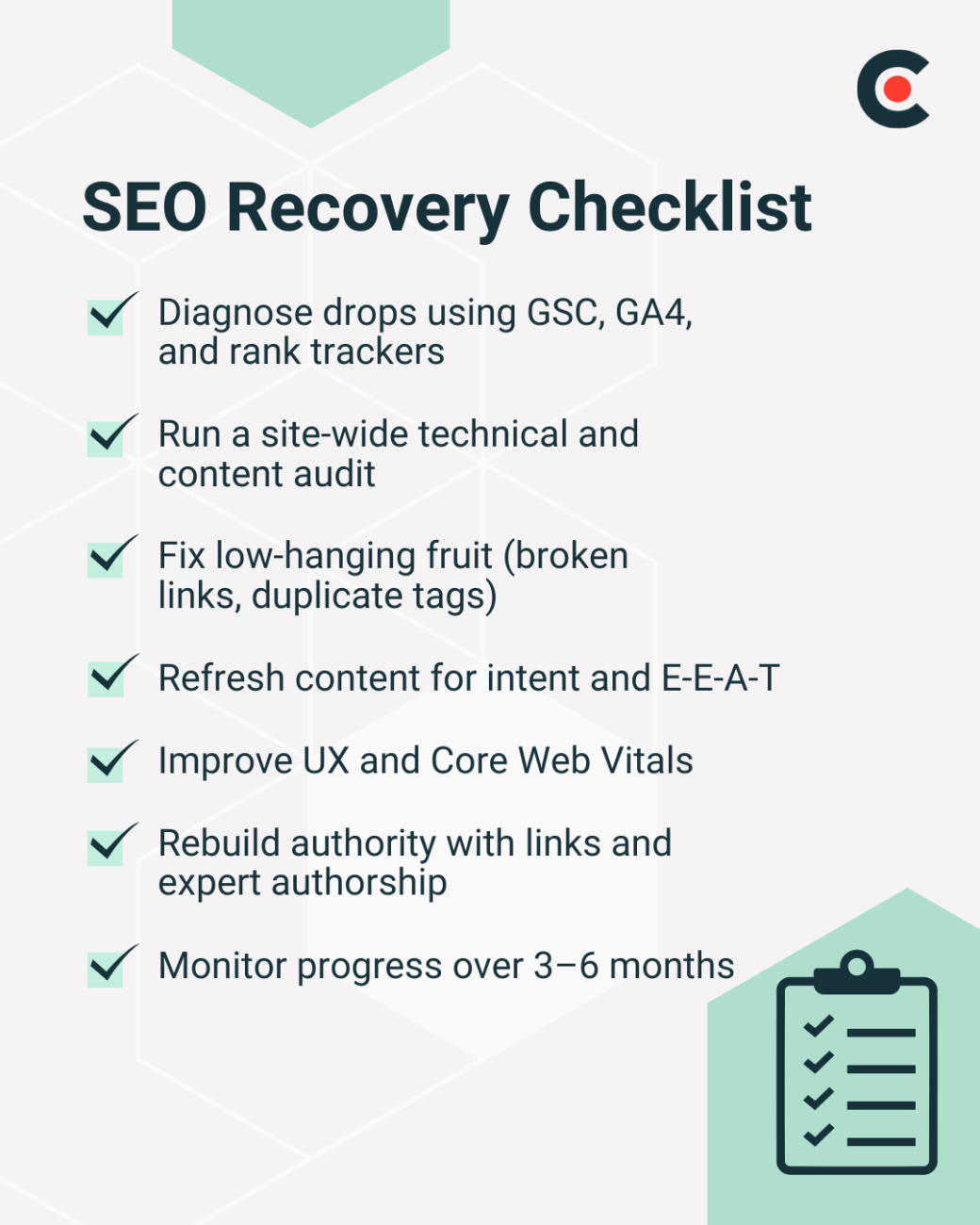
It can be tempting to make immediate fixes in the panic of a sizable drop in rankings. Before you fix anything, you should pinpoint the cause.
In my experience, there’s typically a trend in the page type or content category that I can identify with SEO tools. Once I have a good idea of what pages were impacted, I can map sweeping changes against a timeline for a recent Google algorithm rollout, changes in SERPs, etc.
If you can isolate the issue to a few pages, you may be able to shortcut through the next step. But, after diagnosing where the general problem is on your site, an SEO audit will give you an idea of what you can fix that will truly move the needle.
Sites suffering severe drops should elect to audit their whole site, while those who can pinpoint the issue to a handful of pages may choose to spot check solely in the affected part of the site.
When there are major changes to performance, I like to opt for a full-scale audit. Because you can't fix what you don't measure. Leave no SEO stone unturned: technical, content, authority signals, etc.
Here’s where I’d start:
It’s helpful to make a habit of SEO auditing your site. I’d recommend running through an audit quarterly to make sure you are responding to the most pressing and current challenges your site faces.
Everything you do to fix your SEO will require different levels of effort and yield different levels of impact. Part of your job in improving performance will be identifying low-hanging fruit and prioritizing quick, medium-term, and long-term fixes that will give your site an efficient lift.
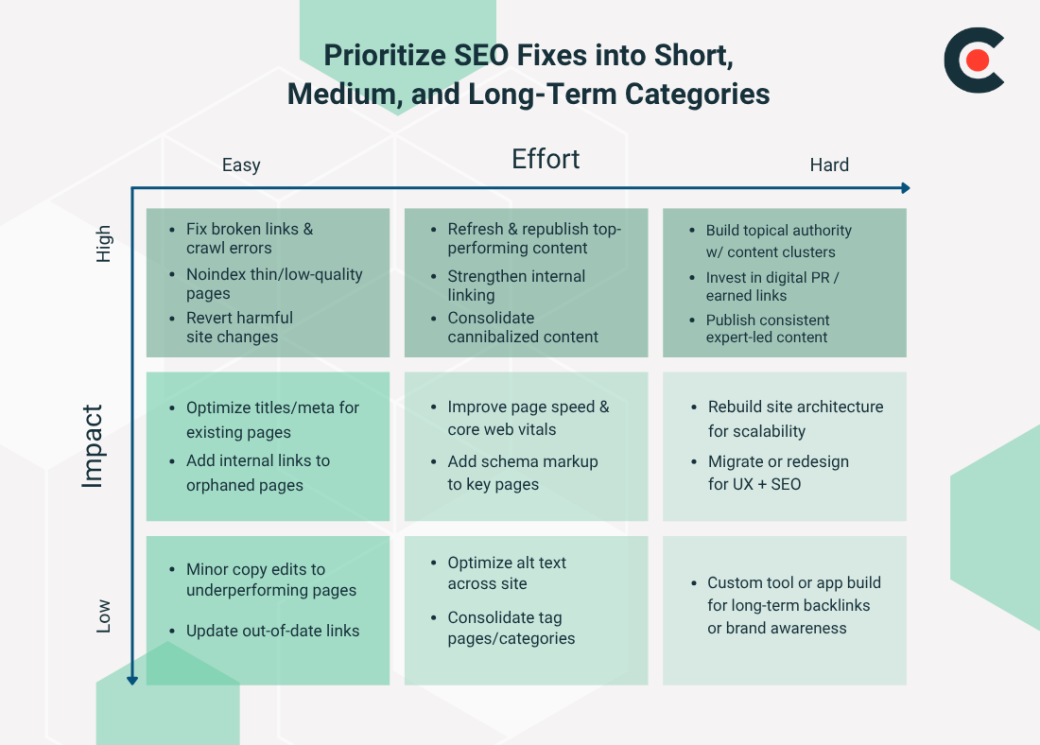
Consider which tasks are easy, medium, and challenging in terms of inputs and effort. Compare that to the tasks that are low, medium, and high impact if corrected.
Your lowest-hanging fruit will be tasks that are easy with a high impact.
Challenging tasks shouldn’t be completely disregarded if there’s a good potential for impact; they should just be placed in your mid- or long-term spots on your roadmap (and properly scoped and approved across teams).
Once you’ve prioritized, you can begin to implement. Remember, these SEO fixes shouldn’t be left unmeasured. Just as we diagnosed and audited to uncover SEO problems, we need to make sure we look back to our core performance metrics to see if things are improving. When I make optimizations, I like to check in for improvements after 1-2 months to evaluate the recovery process.
Brands sometimes respond to sweeping changes in performance with panic. That often leads to falling into an SEO pitfall that will do you more harm than good in the long run.
Be strategic about whichever decisions your company chooses to make.
To stay competitive in 2025 and beyond, your strategy must evolve.
You don’t need to panic every time a Google update hits. With a clear action plan, consistent quality improvements, and a long-term mindset, volatility becomes something you manage.
Additional Reading: ‘AI SEO Content Writing: Boost Rankings with Smart Strategies’