
Why Searching for a Specialized Dev Agency Takes Longer Than It Should — And What to Do About It
Looking for a niche software development agency? Learn how to define your requirements, find specialized providers, and vet their experience.
Updated November 6, 2025

DevOps product roadmaps are more than objectives and timelines. These living strategy documents connect your technical progress to tangible business outcomes. But according to new Clutch data, innovation doesn’t always scale with size. As your business grows, you may need to revamp your product roadmap to continue innovating new features efficiently.
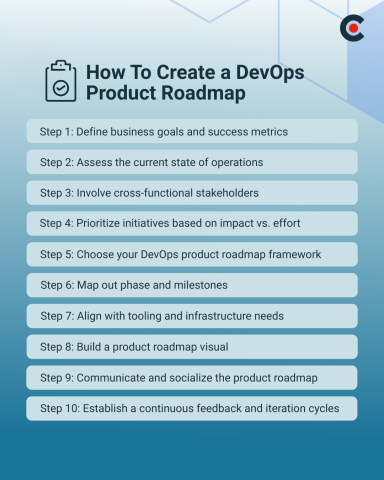
The question becomes how to build a DevOps product roadmap that will keep your teams aligned with key business goals. This guide is the perfect place to start. Learn how to create your DevOps product roadmap from scratch in 10 straightforward steps.
Looking for a Software Development agency?
Compare our list of top Software Development companies near you
Start the process by clarifying your purpose. What are you hoping to achieve, from a business perspective, by revamping your product roadmap? You might be working toward faster delivery cycles, higher service reliability, or better team alignment.
Your goals will impact where you should focus when designing your product roadmap. For example, you might want to:
Once you have clear goals, translate them into measurable objectives you can track using DORA metrics. That could mean tracking:
These are the metrics you’ll use later to track whether your product roadmap is successful. Without clear metrics you can measure, it becomes much more challenging to track progress.
Once you’ve established goals, evaluate your organization’s starting point for this process. That means completing a maturity assessment covering functions like:
At this point, you’re looking for bottlenecks that keep recurring. For example, you might have deployments that are still gated by a lengthy manual QA process. Or maybe resolution timelines are poor because your system for assigning ownership is inefficient.
The goal is to understand where friction exists in your current system. Unless you’re starting a new business, it’s important to remember that the work you do will sit on top of existing legacy systems. You’ll need to make sure the new practices you establish work with these systems effectively.
Now you’re ready to get major stakeholders together to discuss your upcoming product roadmap. You’ll need to reflect the shared priorities of every team, from development and operations to security and product management. Without early-stage buy-in from everyone, your progress could stall, and the new roadmap may not feel relevant to every team.
Start by getting everyone together to discuss pain points and goals. While you lead these discussions, work toward a shared understanding of key trade-offs. For example, you’ll want to get everyone on the same page about innovation vs. stability, speed vs. compliance, and automation vs. oversight.
It’s also smart to establish document ownership at this point. Decide which groups will lead each key area of the roadmap, including pipeline optimization, security integration, and communication.
By this point, you likely have a long list of improvements you’d like to make. The next step is prioritizing them based on the amount of effort each will take relative to its benefits.
You can do that by scoring each item in your backlog of DevOps initiatives. Some teams use techniques like MoSCoW (must have, should have, could have, and won’t have). Another common framework is RICE (reach, impact, confidence, and effort).
In general, you’ll want to start with quick wins. These are initiatives that require minimal effort but produce measurably positive business outcomes. Completing these first will help you build momentum and demonstrate tangible business value to executives.
After that, identify your top transformation projects. These are longer-term investments that require more coordination but deliver considerable value once completed. The goal isn’t to accomplish everything as quickly as possible, but to compound value over time with a structured improvement strategy.
Now that you have a list of priorities and buy-in from key stakeholders, you can choose how to format your product roadmap via a commonly used framework. Some of the most popular frameworks for DevOps product roadmaps include:
Companies of all sizes use each of these frameworks, so the best option for your business will depend on your goals and leadership preferences.
For example, if you’re struggling to get buy-in from executives, an outcome-based roadmap could help you communicate value more effectively. But if you want to focus on generally improving each aspect of your development process without strict deadlines, a theme-based roadmap could make more sense.
You’re finally ready to map out the details. This is when you turn your broader vision into a tangible delivery plan. You’ll want to plan your product roadmap through each of the following stages:
Next, establish milestones to mark progress through each phase of the product roadmap. For example, you might have the milestone of publishing new monitoring dashboards as part of your plan for improving MTTR. Be sure to assign ownership of each task so on-the-ground employees understand exactly what’s expected of them and when.
Now it’s time to upgrade tooling based on your new infrastructure needs. That might mean investing in new CI/CD systems, observability platforms, infrastructure management tools, or collaboration environments.
You don’t need to replace your entire tech stack immediately. Start with tools that strengthen visibility and automation to improve the development lifecycle as a whole. That could mean investing in tooling like:
As you choose between these tools, consider what your current infrastructure supports. Some may be easier to add to your tech stack than others, and that often makes them worth prioritizing. You’ll also need to evaluate factors like licensing, implementation timelines, and internal training needs.
Another part of this step is looking for opportunities to consolidate redundant tools. By streamlining your tech stack, you can keep your operations lean and improve maintainability.
Next, put all the work you’ve done together into a visual roadmap that provides a high-level look at your transformation process at a glance. This will make your strategy more tangible and digestible for executives who may not be as involved in the planning and design processes.
You can use tools like Jira, Azure, Miro, and Productboard to translate the roadmap you have into a visual overview. Be sure to include the following elements:
The goal is to provide a clear visual overview of your roadmap. This will make it easier for stakeholders to collaborate, plan around coming releases, and step in to support your efforts where their help is needed most.
At this point, you’re ready to share your visualized roadmap with the broader organization. This process of socializing the roadmap helps all employees understand what’s happening and why, so everyone remains on the same page.
It’s often good to start with an internal presentation across teams. Walk the group through each initiative’s intent and expected outcomes. Try to use business language to connect the work you’re doing to the bottom-line outcomes that your executives tend to prioritize.
Leave room for discussion and feedback during these sessions. It’s important for stakeholders to get the opportunity to challenge your assumptions and ask questions. This will help them feel more involved and part of the process, which can help with implementation efficiency.
Finally, link your roadmap to the broader product and release cycles in your business. DevOps can help the entire business move faster and with more confidence, so it’s essential for all employees to have visibility into the strategic importance of your work.
All that’s left at this point is to establish a process for ongoing improvement. That typically looks like reviewing your roadmap quarterly or after major releases. Use the DORA metrics you identified throughout the process to see if your initiatives are leading to their desired outcomes. For example, you might ask questions like:
Gaps are likely to emerge over time, and it’s important to pivot when they do. The key to a long-term, successful DevOps product roadmap lies in its ability to adapt to changing circumstances.
Given that, try to embed review cycles directly into your operating cadence. This will make iteration a part of your business culture and establish a self-correcting system that strengthens your processes over time.
The best DevOps product roadmaps continue to evolve as the business changes. Establishing a few best practices early on in this process will help it work more effectively long-term. Some key best practices to keep in mind include:
Treat your roadmap as a living document: The more you refine it over time, the more it can benefit your business.
A well-structured DevOps product roadmap makes your entire team more effective. It becomes a single source of truth you can return to as often as necessary to improve your team’s performance, meet compliance objectives, and solve lingering problems.
You can create a roadmap that grows with your team by defining measurable goals, assessing your current state, prioritizing strategically, and committing to ongoing improvement. The payoff will be a culture of alignment and improvement, which should lead to compounding value over time.