
Website ROI: How to Measure, Calculate, and Improve Your Return
Website ROI measures the value your site generates relative to what you spend. Learn how to calculate it, track the right KPIs, and improve your return.
Updated December 10, 2025

Clutch research reveals business innovation slows at mid-size companies, as small startups and large enterprises move faster.
While tech giants dominate headlines with breakthrough innovations, a new Clutch survey of 600 development professionals reveals a surprising truth: the smallest companies are nearly 3x more likely to focus on innovation than their mid-size counterparts.
Look closer at the data, and a pattern emerges. 29% of companies with fewer than 10 employees said they spend at least 80% of their time building new features. At the mid-size level (11–50 employees), that commitment drops to just 12%. Even the largest enterprises, with 500 or more employees and layers of process to manage, edge out mid-size teams at 20%.
On paper, bigger should mean bolder. More staff, more funding, more room for R&D. But the data tells a different story, and the reason lies in how development challenges shift as companies scale — creating unexpected barriers to innovation at every stage.
If small teams appear more innovation-heavy, it’s not just grit or ambition — it’s the nature of their workload. Across the board, most development teams settle into a rough 60/40 split: about 60% of time spent on new features, 40% on maintenance. But for companies at the smallest end of the scale, that ratio leans more favorably toward building.
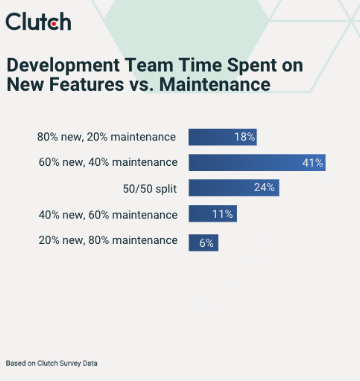
One reason is legacy maintenance. Just 19% of developers at companies with fewer than 10 employees said it was a primary drain on productivity, compared with 27% of mid-sized companies (11–50 employees). Younger companies simply haven’t built up as much technical debt, so they can focus energy on what’s next instead of propping up what already exists. That advantage, however, doesn’t last. As systems grow and user bases expand, the problems shift, and the drag on innovation shifts with them.
“In the early stages of greenfield projects, the obstacle is always scope versus timeline, deciding what makes the cut for version one. As products grow, the obstacle shifts toward re-architecting systems that were intentionally built with shortcuts early on to meet aggressive business goals,” explains Vladimir Rehor, the Head of Engineering at OAK’S LAB. “For example, one of our clients scaled from $0 to over $ 200 million in annual revenue by acquiring and integrating multiple products.” This just isn’t sustainable as businesses grow. “It worked for speed, but maintaining it became unsustainable. Eventually, they hired us to rebuild the solution from the ground up,” Rehor explained.
For a small company building a SaaS platform or a new web application, those extra hours spent on features can decide who reaches the market first. It’s about cleaner code, yes, but it’s more about competitive positioning. Teams that can preserve this balance as they grow are more likely to turn innovation into revenue.
As companies grow, their productivity drains evolve in predictable stages—each pulling time away from innovation in different ways. For the smallest teams, the biggest hurdles are context switching and unclear requirements. A third of developers at companies with fewer than 10 employees cited “switching between projects” as their main drag, while 29% pointed to unclear requirements. It’s the classic startup hustle: everyone wears too many hats, and focus suffers.

At the next tier, with 11–50 employees, “emergency bug fixes” dominate at 32%. Systems that worked in the early days start to crack under heavier use, creating a scaling crisis where firefighting takes priority. By the time teams reach 51–200 people, the weight of accumulated technical debt sets in. Here, “legacy system issues” rise to the top at 27%, marking the arrival of the technical debt crisis. For enterprises with 500+ employees, the problems compound: legacy systems (24%), emergency fixes (23%), and too many meetings (20%) converge into an enterprise complexity trap that leaves far less room for innovation.
These aren’t just internal headaches. The survey suggests that when development hours shift toward firefighting, the slowdown shows up in ways customers can feel: fewer product updates, delayed launches, and missed opportunities to capture attention in competitive markets.
As these constraints intensify, engineering leaders emphasize that deliberate investment in code quality and structured innovation time becomes essential to breaking the cycle and reclaiming momentum.
“Ignoring debt slows velocity more than paying it down. Engineers need strong code hygiene and best practices,” advises Rehor. “The same principle applies to innovation. Teams should deliberately cut out time for learning and experimentation. Even small discoveries can have huge long-term ROI.”

You might expect deployment speed to rise as teams grow — more people, more tools, more polish. The survey shows a different story.
Mid-sized companies (201–500 employees) actually set the pace, with 26% deploying new features or fixes daily or faster. The smallest teams (1–10 employees) aren’t far behind, with nearly a quarter (24%) releasing at the same rate, a figure closer to mid-sized companies (26%) than to the largest firms (21%).
The catch is consistency. While some small teams move quickly, more than 40% still deploy only once a month or less — a rate that undercuts their fast-moving peers and highlights just how uneven DevOps maturity can be at the smallest scale.
That spread matters for innovation. Frequent releases create short feedback loops and keep products moving forward. Slower cycles leave teams reacting late to issues and falling behind competitors. The results suggest DevOps maturity doesn’t follow company size in any neat pattern. It’s a discipline that has to be built deliberately, and teams that want to sustain daily or weekly release cycles must treat deployment practices as a routine investment, much like infrastructure or security.
One drag on productivity is almost exclusive to large enterprises: meetings. For small companies, it barely registers as a problem. But in organizations with 500 or more employees, “too many meetings” accounts for 20% of the reported productivity drain.
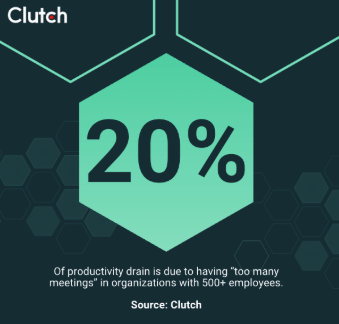
The effect is compounded when combined with legacy system issues and constant emergency fixes. Together, these form a productivity “triple threat” that cuts deeply into time spent coding. For developers inside large enterprises, that means a significant share of the workday shifts away from building and toward coordination, leaving less bandwidth for innovation.
Meetings also take a toll on morale. Developers who spend more of their day in coordination than in creation are more likely to feel disengaged or burned out. Enterprises that don’t address this risk may find themselves struggling to retain top technical talent, even as they add more resources on paper.
There are ways to combat this, such as minimizing the number of direct reports team leaders has and creating dedicated time for work to be done. “We enforce focus blocks on calendars where engineers mute notifications and go deep on tasks,” explains Rehor. “Outside of those blocks, time is open for collaboration. This balance gives us both alignment and uninterrupted execution.”
The survey data makes one point clear: the barriers to innovation aren’t the same for every company. A startup, a mid-size firm, and a global enterprise all struggle in different ways. That means the strategies for keeping developers focused on new features have to look different, too.
For small teams, the challenge is simple: hang on to the focus that gave them their edge in the first place. Right now, they can spend most of their hours on new features. That won’t last. Requirements get fuzzy, and debt sneaks in earlier than leaders expect.
Laying down basic processes while the company is still small makes growth easier to handle later. Even simple steps — such as documenting requirements or setting up lightweight sprint rituals — can keep a young web development team aligned without slowing them down.
Mid-size companies are where things start to tilt. Systems strain under heavier use, and bug fixes crowd out new work. This is also the stage where many leaders assume headcount equals innovation capacity. It rarely plays out that way. A better move is to pull a group of developers out of the maintenance cycle and give them cover to keep building. Otherwise, the middle stage becomes a holding pattern.
That might mean designating a protected “innovation track” where developers focus only on forward-looking features, while a separate group handles the bug backlog. Without that division of labor, mid-size teams risk drifting into maintenance mode.
Large enterprises face the heaviest drag. Developers report three major drains — legacy systems, emergency fixes, and meetings. Each on its own can slow momentum, but together they define how work gets done. Teams spend more time in coordination than in creation.
Leaders who track how hours are actually spent, and who cut meeting loads where they can, will see room open up again. Some already create startup-style pods to chase new ideas without the usual baggage. Others go further by measuring innovation vs. maintenance hours as a formal KPI, alongside metrics like uptime or customer acquisition cost.
Making innovation visible in the same way as operational performance helps keep it from being crowded out. For context on how companies approach these pressures, see Clutch’s software development services guide.
The survey shows a pattern that every development leader should note: as teams grow, their challenges shift, and innovation is often the first casualty. Small companies spend more of their time building, while mid-sized firms get bogged down in fixes and technical debt. Large enterprises then face the “triple threat” of legacy systems, emergency work, and meeting overload. Headcount and budget matter far less than how a company protects its developers’ time.
In the race for innovation, it’s not the size of your development team that determines success, it’s the way you structure their work. Companies that take a hard look at how hours are spent will give themselves an edge: act early to cut back on drains like unclear requirements, maintenance creep, and process overhead. Those that don’t will find their smaller, more focused competitors setting the pace.
This analysis is based on survey data collected in August 2025 by Clutch.co in partnership with Pollfish, a leading survey platform. The study surveyed 600 development professionals across the United States to understand how development teams allocate their time between new feature development and maintenance activities.