
How to Define Brand Values That Guide Every Business Decision
Brand values are the principles that guide company decisions, define what a brand stands for, and shape how it treats customers, employees, and partners.
Updated August 14, 2026

If you want your customers to listen to (and remember) your brand messaging, you need to make your communication memorable, relevant, and useful, to them. And that’s not easy.
Customer attention is the scarcest resource in marketing — and 2026 made it scarcer. Between AI-generated content saturation, fragmented multi-screen habits, and audiences that filter aggressively for anything that reads like a sales pitch, brands have roughly 10 seconds to make a first impression and about 47 seconds of sustained attention before an audience moves on. The four strategies below — short-form content, personalized email, AI-driven personalization, and social responsibility signaling — consistently outperform because each one respects those constraints instead of fighting them.
What follows is a tactical guide to each strategy — with 2026 examples and the shifts that matter compared with pre-AI-era playbooks.
Looking for a Public Relations agency?
Compare our list of top Public Relations companies near you
Three shifts have redrawn the customer-attention landscape since 2020:
The four strategies below are the ones that keep working across all three shifts — not despite them, but because they build in the signals that AI content, algorithmic feeds, and answer engines all struggle to fake.
Interested in strengthening your brand? Consult with an expert today.
Engaging an increasingly distracted audience requires a strategy known as “content snacking”: small, clear, highly relevant nuggets of information that people can consume on the move.
The 2026 shape of snackable content is short-form vertical video: TikTok, Instagram Reels, and YouTube Shorts dominate the format because they match how audiences actually consume media (phone in hand, thumb scrolling, sound off by default until something grabs them). The 30-second Instagram clip is still valid, but the hook needs to land in the first 2 seconds or the scroll continues.
Aerie (American Eagle Outfitters’ sister brand) has reinforced its identity via its “Aerie Real” campaign by featuring “unretouched” brand ambassadors and real-life customers in short, highly relatable videos on its social media platforms.

By keeping the clips to around 30 seconds or less, Aerie can hold customer attention, convey a strong brand message, and build an emotional connection with its audience while simultaneously showcasing its apparel. The campaign has continued to expand across TikTok and Reels in 2026, where user-generated versions of Aerie Real content routinely outperform the brand's own polished pieces on engagement.
If videos or GIFS aren’t right for your message, text-based content should be clear, concise, and easy to skim. Bullet points or numbered lists will always work in your favor— the same structural principles that AI answer engines look for when deciding whether to cite you also make content easier for humans to scan.
As long as you’re producing a strong, creative narrative that is in line with your audience’s interests, you have a shot at maximizing its impact.
Email is one of the highest-ROI marketing channels available, and audiences still open it — Campaign Monitor research showed more than 80% of Gen Z check email at least once every day, a pattern that has held in subsequent studies. What's changed since 2019 isn't email's relevance; it's how much of it competes for the same inbox space.
The differentiator in 2026 is personalization that draws on real behavioral data — not just "Hi {first_name}" merge fields. AI-driven email tools now segment audiences dynamically, choose send times based on individual open patterns, and generate variant copy that adapts to a reader's engagement history. The bar has moved from "personalized greeting" to "personalized to the point where the reader recognizes it was written for them specifically."
Take Spotify's Wrapped emails — arguably the most-shared marketing email format of the past several years. Wrapped works because every email is genuinely different: the user's actual listening data drives the content, the visuals, and the emotional payoff. That's the current bar for high-attention email — the reader can't get the same experience from anyone else.
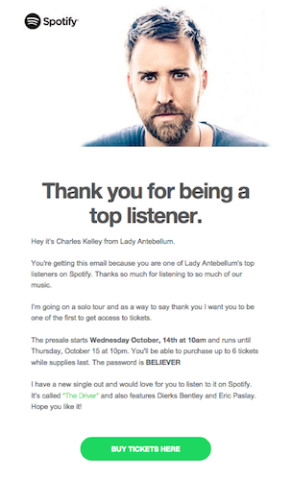
Source: Author’s inbox
The takeaway: an email that reads like it could have gone to anyone will lose to an email that clearly went only to this reader. Return on investment matters — return on interest matters too.
AI-based personalization in 2026 is a different animal from the recommendation engines that defined the pre-generative era. Today's AI can predict buying habits, tailor product surfaces in real time, generate individually-relevant copy at scale, and identify the moments when a specific customer is most likely to convert. Applied well, it's one of the strongest attention retainers available.
Applied badly, it's one of the fastest ways to lose trust. Clutch's July 2026 survey of 408 consumers found that 55% of consumers view a brand less favorably once they can tell AI created the work — meaning AI personalization has to be sophisticated enough to feel human-adjacent, or transparent enough that the AI use is disclosed rather than discovered. The two failure modes are:
The successful applications of AI personalization in 2026 share a pattern: AI does the pattern-finding and the surfacing, humans stay visibly in charge of what gets shipped. Retailers use AI to predict demand and adjust inventory in real time. Media brands use AI to surface relevant back-catalog content when a reader finishes a long article. Financial services use AI to detect the moments a customer is likely to need help — and then hand off to a human. In each case, AI is the infrastructure, not the face.
Pro tip: When you deploy AI for personalization, decide upfront which surfaces will be AI-driven and which will be human-visible — and disclose the AI use where a reasonable customer would want to know. Transparency isn't just ethical; it's an attention-holding move in a market where the audience is already scanning for AI tells.
Today's consumers don't just notice environmental and social claims — they interrogate them. Corporate social responsibility (CSR) and green marketing still drive attention and preference, but only when the claims are backed by verifiable behavior. Performative campaigns now get called out faster than they can be launched.
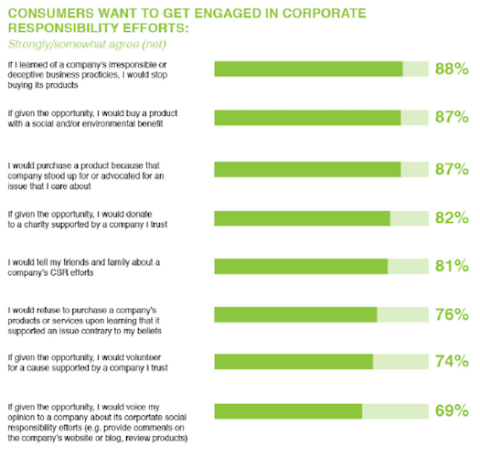
According to a Cone Communications report, 79% of consumers surveyed consciously seek out products and companies that are socially and environmentally responsible, and 88% said they would actively boycott companies with irresponsible business practices. Those numbers established the baseline — and subsequent research (Edelman Trust Barometer, NielsenIQ sustainability tracking) has consistently reinforced the direction, with the added complication that consumers now discount claims that aren't paired with third-party verification or specific, measurable commitments.
Google is a well-cited example of a for-profit company with a durable CSR record: hit its 100% renewable-energy goal in 2017, has continued to expand renewable and carbon-reduction commitments since, facilitates green commuting for employees, gives paid time off for volunteer hours, and matches employee donations to charities. The pattern that keeps working: multi-year, measured, and reported — not one-off campaigns tied to a hashtag.
Weaving CSR into your business is crucial not just for the planet, but also for the lifespan of your bottom line. Done well, it enhances a brand's positive image in the marketplace. Done as a campaign disconnected from operations, it draws negative attention faster than it draws positive.
Short customer attention spans aren't a problem to solve — they're a constraint to design around. Every one of the four strategies above works because it respects the constraint: brief, relevant content; email that reads like it was written for one person; AI that surfaces rather than replaces; social claims that hold up to scrutiny. From snackable content to a business model that saves the planet, the pattern is the same: earn attention by being worth it.
Customer attention is the mental focus a person gives a brand's content, product, or message at a given moment. It's measured in seconds (how long a viewer stays with a piece of content), in engagement signals (clicks, watch-time, replies), and in downstream behavior (recall, preference, purchase). In marketing, "capturing attention" typically means winning the first few seconds of a viewer's focus; "keeping attention" means holding it long enough to convey a brand message and influence behavior. Both are harder in 2026 than in prior eras because audiences filter more aggressively for AI-generated content and for anything that reads as advertising.
Roughly 10 seconds to earn initial attention and about 47 seconds of sustained attention thereafter. Nielsen Norman Group research puts the initial-attention window at approximately 10 seconds for a marketing message. Airship's mobile-app research cites a 47-second average sustained-attention span. Those figures vary by channel and audience — a returning customer opening a personalized email has a different attention profile than a first-time visitor scrolling a mobile feed — but 10 seconds to grab and about a minute to hold are useful defaults for planning.
Four strategies consistently outperform: (1) short-form vertical video that hooks in the first two seconds; (2) email that's personalized on real behavioral data, not just a first-name merge field; (3) AI-driven personalization that surfaces content rather than replaces human authorship — and is disclosed when it's used; and (4) social responsibility signaling backed by verifiable, multi-year commitments rather than one-off campaigns. Each strategy respects the two 2026 shifts that most affect attention: audiences filter aggressively for AI-generated content, and short-form vertical video is now the default format for scannable content consumption.