The Real Cost of Your MVP in 2027
AI made code cheap, but not software that holds up. See how MVP cost drivers have shifted and why human validation and taste are now what you’re really...
Updated February 16, 2026

Custom software development is the process of creating an application from the ground up to match the way your business actually works — your processes, your data, and your goals. It’s built around what you need today and can adapt as your needs change, instead of forcing you to fit into someone else’s mold.
Choose commercial off-the-shelf (COTS) if it covers at least 70 to 80% of what you need and you can live with the gaps, and choose custom software development when regulated data, complex integrations, or unique workflows demand a precise fit.
Compare our list of top Software Development companies near you
Looking for a Software Development agency?
Compare our list of top Software Development companies near you
Companies generally have two choices in seeking the most appropriate line of business applications to enhance their efficiency and productivity: They can look to the market for commercial off-the-shelf (COTS) packaged solutions or hire specialists to help them with custom application development to build a software product.
For the average business owner, this decision of purchasing COTS software or building a custom application from scratch is a daunting one.
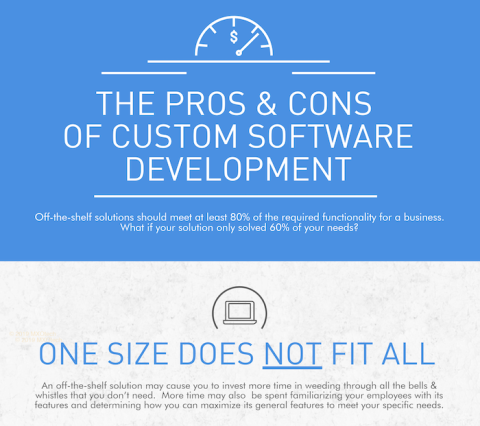
The traditional rule of thumb is that COTS packaged solutions should meet a minimum of 80% of the required functionality of a business. However, most companies choose solutions that only solve 60% of their operational business needs – leaving them with holes as their business evolves.
While COTS software is often an attractive choice to business owners for its low initial investment, hidden costs can creep up and surprise you if the product is not a perfect fit for your company. When deciding which solution will help grow your business and improve efficiencies, consider the requirements of your business from the perspective of business processes and not just from features and functions.
Many times, COTS solutions meet the functional requirements while failing to provide a solution consistent with the organization’s business processes. When assessing a COTS solution, there must be a strong consideration on how flexible, extensible, and maintainable the application will be throughout the life of the software.
Most importantly, you need to ask yourself if the COTS solution meets your specific business needs:
Hire a custom software development company to support your business needs.
The choice between COTS and custom is really a question of fit. Start with the problem you are trying to solve. If most of your needs are standard, a COTS tool enables you to go live quickly and keeps costs easier to predict. You trade some flexibility for speed and a clear price tag.
Custom makes sense when your workflows are a differentiator, when you handle regulated data, or when integrations with the rest of your stack are non-negotiable. You get more control, but you also take on more ownership of build and maintenance.
Budget for setup, training, support, and the hidden cost of workarounds if you bend a COTS product to fit. Do the same math for custom, including ongoing improvements. The table below highlights how the two paths differ. Use it to pressure test your direction and to compare vendor proposals like-for-like.
| Factor | COTS (Commercial Off-the-Shelf) | Custom Software |
| Fit to workflows | Broad, “good enough” for common tasks; gaps for niche processes | Designed for your exact workflows and edge cases |
| Time to deploy | Immediate to weeks | Weeks to months (depends on scope) |
| Upfront cost | Lower entry (license/subscription) | Higher upfront (build) |
| Ongoing cost | Predictable fees; paid upgrades | Maintenance roadmap you control |
| Integrations | Limited to vendor roadmap | Built for required APIs/data flows |
| Compliance | General controls; depends on vendor | Controls tailored to HIPAA/GDPR/PCI scope |
Actual cost and timing depend on scope, integrations, and compliance. Get like-for-like quotes before committing.
Handling regulated data changes your technical design and testing approach from day one. Build these considerations into early planning:
For official requirements, see HIPAA, GDPR, and PCI DSS to learn more and find documentation before finalizing your architecture.
A Commercial Off-the-Shelf (COTS) product seems so easy. Why should I consider something custom?
There are certain businesses – those in the healthcare industry for example – where constant changes driven by regulation and mandatory compliance make custom application development a must.
Let’s imagine a workflow situation in which a healthcare company is still exchanging papers, faxes, and e-mails. A secure electronic custom portal is a much better option that will allow them to meet HIPAA compliance, reduce paper, exchange information quickly and securely, and give them the ability to analyze the data through reports and dashboards.
A business may also consider a custom solution if it has specific goals to meet and it wants to modify its applications on an ongoing basis, which isn’t possible with most COTS solutions. Perhaps the business and its stakeholders see the value in investing in an application, which will provide additional resources and tools to its clients and work to help employees grow their business.
Companies often choose to invest in a custom application development as a unique business asset because they have distinct operational needs or because they can leverage the technology to differentiate their business with a competitive advantage.
Innovation is a crucial driver to some business owners who want to differentiate from their competitors. Customized digital technology can give you a cutting-edge advantage to stand out from your competitors.
Often, COTS solutions seem like a slam-dunk – They’re well-marketed, and the sales process is meant to make you feel like you’ll be missing out on a key differentiator. However, COTS solutions are often still expensive, inflexible, and do not provide your organization with a unique advantage.
Large ERP suites (e.g., SAP) often require significant configuration, training, and change management—evaluate total cost and process fit before committing.
Large ERP suites (e.g., SAP) often require significant configuration, training, and change management—evaluate total cost and process fit before committing.
Software Development Cost is a common concern when considering a custom application development. However, a custom application built from scratch for your business may save you more time and money. Let’s compare:
A COTS product is a “one-size-fits-all” approach, so you may have to invest more time in weeding through the bells and whistles that you don’t need.
Substantial time may be spent familiarizing your employees with its features and determining how you can maximize its general features to meet your specific needs.
Substantial time may be spent familiarizing your employees with its features and determining how you can maximize its general features to meet your specific needs.
COTS solutions are not as easily modified or upgraded, and the turnaround time can be prolonged. Companies will sometimes mitigate this issue by keeping a computer running on an older browser because newer versions do not support the legacy software.
A custom application may require a considerable investment initially, but you will likely find that you will be able to implement and use the application for all of its features more efficiently and in less time. You can also ask the consultant you are working with to provide a fixed-bid quote to keep your costs predictable. A good development shop that has done its due diligence shouldn’t have problems doing this for you.
Additional Reading: 'How to Build a Successful Development Team'
One of the best ways to determine which solution is right for your business (and help your consultant calculate a fixed bid quote) is to perform a Business Process Improvement (BPI) Assessment.
During a BPI Assessment, an experienced consultant will review and evaluate the systems and processes in your organization that are causing the most issues in the development process. Ultimately, a successful BPI Assessment will show you how to leverage technology to propel your operational performance and profitability through solutions that drive growth, user experience, and efficiency.
At MXOtech, these assessments are typically a two- to three-week engagement.
We’ll conduct interviews, audit your solutions, and work with your vendors to produce measurable metrics, such as a reduction in IT spend or an increase in employee productivity. We’ll even create a Value Stream Map to show actual time spent per part of the workflow. This data is then used to craft a comprehensive, actionable roadmap that includes a high-level project plan and projected costs.
For example, let’s say you want to convert your manual paper process to an electronic format; if you involve your staff in its development from the get-go, you can create the application with only the features that will directly relate to your business while using the language and operational processes your staff is familiar with. Your employees will have an instant familiarity with the application, and it will be more intuitive and increase their readiness to use it.
On the flip side, some worry that going with a custom application development will trap you with the company that developed the solution, keeping your application hostage. You can reduce vendor lock-in by asking partners to use widely supported, well-documented technologies and by keeping source code and documentation in your control. Choose a stack (.NET, Java, JavaScript, etc.) based on team expertise, ecosystem maturity, and long-term support.
A custom software solution can be truly transformational for your business when developed in the right framework with the roadmap.
If you’re not quite ready to build a custom application from scratch, hybrid solutions allow you to take off-the-shelf software and customize portions of the existing framework to meet your needs more aptly.
There are custom software interfaces that can be used to connect various systems with your line-of-business applications to allow for integration, to streamline, and information-sharing between disparate software systems.
Clarity on the process reduces delays and rework. Most custom projects move from planning to launch over several weeks or months, depending on scope. Each stage should end with a check-in and sign-off so you can make changes while they’re still easy to address.
Integration & Data Strategy
Example: Map customer_id to client_id and block records missing valid email addresses.
If you’ve decided to develop a custom software development solution, what’s next? It’s important to understand how the process will work, how to stay on time and within budget, and how you’ll manage the new system once it’s in place.
Use the checklist below to standardize vendor interviews and like-for-like proposals.
| Step | What to capture | Example prompt |
| Scope | Workflows, users, success criteria | “Which manual steps cause delays today?” |
| Constraints | Budget, timeline, compliance | “Any HIPAA/GDPR/PCI scope?” |
| Integrations | Systems, APIs, auth | “ERP + CRM + payments; OAuth 2.0” |
| Data | Entities, quality, migration | “Customer, order; dedupe rules; cutover plan” |
| Ops | Hosting, SRE, SLAs | “99.9% uptime; on-call; backups” |
Standardize vendor briefs using this checklist for like-for-like proposals.
A little secret in consulting — Software development and COTS solution deployments often result in additional costs, frustration, or failure due to a combination of poor project management processes and low engagement from the client. Don’t fall for a flashy sales presentation.
A reliable partner will be able to describe a project delivery process that allows you to inspect working software every 2-3 weeks. This approach makes it easier to make small adjustments along the way and avoids major rework late in the project. They should also be able to share daily progress metrics so you can track how the build is moving forward.
Prospective partners should be able to explain their project management process in detail, because it’s the foundation for delivering what was promised.
Make it a priority to understand exactly how those services will be carried out.
You can’t run a business without the right mobile apps or custom software applications to support efficiency.
Your new software should allow you to repurpose your staff to eliminate inefficient administrative tasks.
If you have a software solution that no one else in your market has, it can allow you to stand out, and even charge more money for your services.
For example, if you started as a service provider that provides software development services, you can now offer technological tools to customers that help them save time and money in their own business. If you have a COTS solution, you can also save time and money.
Creating a real-time solutions portal that allows your customers to go in and download different company templates or other self-sufficient elements will add value to your services.
You will not have to spend as much time educating your clients because your portal should include educational videos for existing clients and potential customers, and a function that allows you to push out alerts to multiple clients at one time.
This higher level of collaboration and efficiency will help you stand out in your market.
Your business needs to go through a digital transformation - get the lifecycle going with an upgrade to your development products.
Let’s review the basics of what you should do once your business application is implemented:
Your digital assets should be treated as a valued employee, cherished, and cultivated. This “employee” will never quit, show up late, or make mistakes. Keep them growing and investing in them just as you do with those who work for you.
Learn how to determine whether you should go “off-the-shelf” or create a custom application in Part 2 of this article, "How Do I Know Which Type of Software Application is Right for My Business?"
Looking for help with your custom software development project? Browse our directory of trusted software developers.
 Joanna Sobran is the President and CEO of MXOtech. Joanna has both unique and vast experience in the IT industry. For more than a decade, she has focused on delivering a high-level customer experience with innovation. She has created a niche for MXO by approaching each client’s business individually, with creative technology solutions crafted specifically to address their issues. Whether it’s through using better technology solutions, improving operations, or education, Joanna treasures her clients and truly cares about their success
 Sean Blair is the Chief Technology Officer of MXOtech. He has a broad base of experience that includes 16 years of delivering projects and products for health care companies. Sean also has experience delivering customized application development and system integration solutions in both the energy and utility, and manufacturing and distribution, space. His focus at MXOtech is ensuring that the clients receive the technological solutions that best fit their needs. Sean has a passion for technology and is constantly pushing the envelope to ensure MXOtech can offer the very best for our clients.
Joanna Sobran is the President and CEO of MXOtech. Joanna has both unique and vast experience in the IT industry. For more than a decade, she has focused on delivering a high-level customer experience with innovation. She has created a niche for MXO by approaching each client’s business individually, with creative technology solutions crafted specifically to address their issues. Whether it’s through using better technology solutions, improving operations, or education, Joanna treasures her clients and truly cares about their success.
See full profile