Generative AI vs. Agentic AI: What's the Difference?
What's the difference between generative AI vs. agentic AI? Clutch explains both types, their impact on your work, and what to consider before using them.
Updated May 5, 2026

Custom GPTs are AI assistants designed for specific niches or purposes. And these customizable, no-code tools can help you connect with customers where they already are.
Four years after its launch, ChatGPT is still the most popular AI assistant. A recent Clutch survey of 558 AI users found that 74% rely on it.
The general ChatGPT excels at basic tasks, such as drafting a quick email or recommending soup recipes. When it comes to more niche topics, though, it sometimes lacks the knowledge or data to provide value. With Custom GPTs, you can build a specialized AI app directly into the platform. For example, Expedia's GPT assists users with booking hotels and flights with real-time pricing.
Looking for a Artificial Intelligence agency?
Compare our list of top Artificial Intelligence companies near you
Custom GPTs can help you strengthen your relationship with customers and share resources. Over half (55%) of AI assistant users say they're more likely to trust a Custom GPT from a brand they already know. These tools also give you more control over how ChatGPT represents your company.
There's just one catch: 27% of ChatGPT users don't even know this feature exists. That means you'll need to put in the legwork to spread the word about your Custom GPT.
Drawing on Clutch data, this guide explains what Custom GPTs are and how they work. It also unpacks what they do and how businesses are using them to build their presence inside ChatGPT.
A Custom GPT is a specialized version of ChatGPT designed for a specific purpose or context. It's essentially an app built right inside the AI assistant.
Creators often build these tools to assist with specific tasks, from comparing software to writing sermons. Others want to speak to specific audiences, such as pet owners or aspiring entrepreneurs. Custom GPTs can also answer questions in a brand's voice, share specialized knowledge, or fit into a workflow.
One example is Khanmigo Lite, a Custom GPT by Khan Academy. It greets users with this message: "I won't write the code for you, but I'll help you work things out." This code tutor focuses on guiding users to the answer instead of handing it to them.
Other common purposes for Custom GPTs include:
People can explore GPTs in ChatGPT's GPT Store and use them without leaving the platform. They're a simple way to connect with your audience where they're at. Instead of waiting for them to discover your blog or reach out for advice, you can share your expertise directly.
People don't need to download anything to use Custom GPTs. They access them through the GPT store or direct links from creators.
When you open a Custom GPT, it looks and works like a normal ChatGPT conversation. However, each AI assistant responds differently based on the knowledge and instructions its creator provides.
Take Coloring Book Hero, which turns prompts into "whimsical" coloring pages. While ChatGPT can also create this content, the Custom GPT has a distinct style.
You might assume that creating a Custom GPT requires extensive coding, but that's not true. All you need to do is describe what you want in natural language to OpenAI's GPT Builder tool. It asks guiding questions, such as "How does it behave?" and "What should it avoid doing?"
You can also tailor your GPT directly by:
Many GPTs are public and available to all users. Others are unlisted, meaning people can access them only via a direct link or are restricted to specific users. Consider limiting access if your GPT uses proprietary data or is only meant for paying customers.
Custom GPTs have a small learning curve, but they offer plenty of value. Users benefit from exclusive knowledge or tasks that ChatGPT can't handle — at least, not without a lot of prompting and re-prompting. For businesses, GPTs can improve the customer experience and increase visibility.
OpenAI introduced Custom GPTs in 2023, but awareness is still catching up. Clutch found that 27% of AI assistant users didn't know these tools existed, while another 17% had heard of them but never used one.
When people use GPTs, though, they usually find the experience satisfying. Clutch reports that 45% of users found them "very helpful," and only 1% described them as unhelpful. This data suggests that visibility is the biggest obstacle to GPT adoption, not performance.
People discover GPTs through several channels:
Respondents are also interested in many types of Custom GPTs, including:
People are hungry for more useful and niche AI tools. The trick is figuring out what to make and how to get it into their hands.
Traditional marketing tools like Instagram and email give you almost complete control over the content you share. By contrast, GPTs respond directly to users. This more collaborative approach means conversations don't always lead directly to sales. However, GPTs offer several benefits that you can't get from other channels.
ChatGPT remains the go-to AI assistant. According to Clutch data, 74% of AI users use it, compared to 56% for Google Gemini and 40% for Meta AI.
Of course, there's no guarantee that ChatGPT will share your business with these millions of users, even when it's the best fit. You also can't control what ChatGPT says about you.
Custom GPTs let you take back the narrative by creating a more interactive, branded experience. You get to shape the messaging and support customers directly. For instance, a consulting firm could create a GPT that gives business advice in the CEO's voice. That's more effective than passively hoping ChatGPT mentions your brand in its responses.
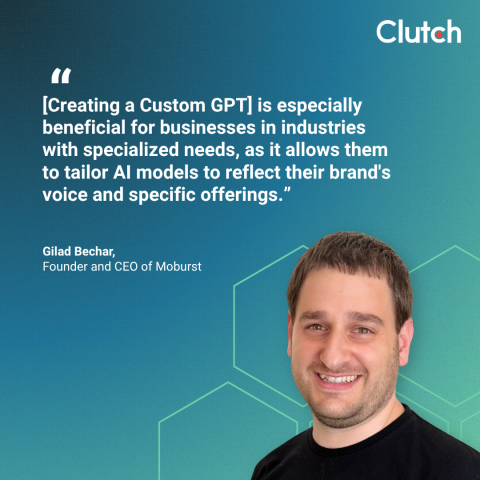
Gilad Bechar, Founder and CEO of Moburst, agrees that creating a Custom GPT could be a strong move for certain types of businesses. He states, “This strategy is especially beneficial for businesses in industries with specialized needs, as it allows them to tailor AI models to reflect their brand's voice and specific offerings.”
Familiarity can give your GPT a competitive edge. Over half (55%) of users say they're more likely to trust a Custom GPT from a known brand, according to Clutch data. If your brand already has strong customer relationships, Custom GPTs help you carry those positive connections into AI.
Don't expect customers to blindly trust you, though. Many users value transparency, with 46% wanting clear explanations of how the GPT accesses and collects data.
Conventional AI chatbots gather information from sources across the web. That gives you limited control over how these tools represent your brand. In a best-case scenario, ChatGPT may quote directly from your website. But it could also produce an inaccurate description or fail to mention you at all.
By contrast, a Custom GPT gives you more control over the user experience. You set the tone, shape the messaging, and decide which expertise to share. These details help present your brand accurately and positively.
Clutch's survey found that only 73% of AI assistant users know that Custom GPTs exist. While this relatively low awareness may seem like a disadvantage, it's actually a benefit.
Few businesses have adopted this technology, so you're likely to stand out if you start promoting your Custom GPT now. Your tool may even get spotlighted in the GPT store's Featured category for even more discoverability.
Plus, users who interact with your GPT are more likely to be highly engaged. After all, they've taken the extra step to opt into your tool in ChatGPT.
The most effective Custom GPTs don't try to do everything. They focus on solving a specific problem or answering a particular need. For example, a fitness brand could develop a GPT that creates personalized workout plans. Likewise, a software company's GPT could walk users through onboarding.
A Custom GPT should authentically reflect your brand's voice and expertise. Users already know what the standard ChatGPT sounds like and what it can do. If you want them to try your tool, you need to offer them a fresh experience.
GPTs should also give users something valuable they can't get from a traditional AI assistant. That might be expert knowledge, a unique workflow, or access to exclusive data. Suppose a financial services company wants to build a tool that helps users calculate retirement savings. They could add a distinct twist by including a short personality quiz for tailored advice.
Great GPTs prioritize transparency, too. Tell users upfront if you're collecting their data and how you plan to use it. These simple acknowledgments help reassure the 46% of survey respondents who want clarity on data usage.
Active promotion is another key to success. Publishing your GPT in the store isn't enough, especially if you don't land in the top rankings immediately. If you want people to discover it, you need to raise awareness through other channels. Consider featuring your tool in an email newsletter or on social media.
You don't need any coding experience or AI knowledge to design a Custom GPT. Follow these simple steps.
The best GPTs focus on a single goal. Ask yourself these questions:
Let's say a dog trainer designs a GPT to help clients train their new puppies. It could go beyond ChatGPT by offering science-based advice or custom training plans.
OpenAI requires a Plus membership to use the GPT Builder. You can access it by opening the GPT store and clicking "Create."
The Builder uses conversational prompts to guide you through the setup process. Answer questions about how you want your GPT to behave and its ideal tone. Add a concise but eye-catching name and description to grab users' attention.
Do you want the GPT to reference outside materials? Upload files, documents, and resources. The dog trainer, for example, could add scientific articles about dog training.
Of course, you should also test your GPT internally before you publish it. If it doesn't behave as you expect, you may need to revise the instructions or add more reference materials.
OpenAI offers three levels of visibility for custom GPTs:
Think about how your GPT fits your business goals. If you want to connect with more customers, go public.
While creating a Custom GPT is simple, getting people to actually use it is more challenging. After all, around a quarter of AI users don't even know these tools exist, according to Clutch data.
Share the link across your website, social media channels, email newsletters, and customer touchpoints, such as product demos. Be sure to point out the unique value your tool offers, such as expert advice or special features.
While Custom GPTs can strengthen brand familiarity and trust, they come with a few drawbacks.
For one, these tools don't automatically increase your visibility in AI searches. People must actively discover and opt in to use GPTs. Plus, they're only available to ChatGPT users, excluding anyone who relies on other AI assistants.
They're also not maintenance-free. If you change your brand personality or products, you'll need to update your GPT.
Privacy concerns are another barrier. In the Clutch survey, 80% of users said they've stopped using AI or sharing information at least once because of privacy concerns.
Many customers are already loyal ChatGPT users, but they may not encounter your brand in typical search queries. With Custom GPTs, you can build a branded presence directly in the platform.
These tools work best when they solve specific problems and share your expertise. You'll also need to promote them to reach your audience.
But don't let that discourage you. The infrastructure is there, and so is user demand. Plus, users who discover GPTs are usually highly satisfied. If you're interested in using AI tools in a controlled way, it's worth investing in a Custom GPT. Just be sure that they're part of a wider AI visibility strategy.
Not sure where to start? Work with an AI developer.