
How to Delegate: A Step-by-Step Guide for Agency Owners
Learn how to delegate effectively as an agency owner — what to delegate first, how to hand off work without losing quality, and the hiring sequence that...
Updated June 5, 2025

Timing is everything in deal negotiations — and not just for the client. Learn from Donald C. Kelly, the founder and CEO of The Sales Evangelist, on how you can build on your wins with the psychology of momentum.
LinkedIn and sales podcasts are full of advice about how to persuade clients. Say the right thing or offer an amazing discount, and voila — you’ve closed the deal! But these resources often overlook another key factor: timing. In other words, when you try to negotiate a sale can be just as important as how you do it.
This might seem paradoxical, but the best time to strike a new deal with Client A is often right after you’ve closed a sale with Client B. And no, that doesn’t mean you should brag about your sales to other clients. It’s basic psychology. You’re more likely to succeed when you feel confident and energized, not when you’re desperate to meet a sales deadline.
Learn from Donald C. Kelly, the founder and CEO of The Sales Evangelist, on how you can master timing in deal negotiations.
There’s nothing better than a classic underdog story: challenge after challenge, followed by a hard-earned victory. Across industries, these winners tend to talk about “riding the wave of confidence” to success.
Sometimes, it’s a literal wave. For example, rookie surfer Alan Cleland came out of nowhere to win gold at the 2023 ISA World Surfing Games. That momentum helped carry him to a 9th-place finish in the 2024 Summer Olympics — and then to a coveted spot on the 2025 World Surf League Championship Tour.
Other times, this wave is more symbolic. In sales, representatives often talk about a phenomenon called “hot hands.” That’s what happens when one big deal seems to kickstart a winning streak. Suddenly, you’re making sale after sale with ease.
No, Cleland and hot-handed sales reps aren’t just lucky. They’re benefiting from the psychology of momentum. As Seppo E. Iso-Ahola and Charles O. Dotson explain, “When [people] initially experience success, their self-confidence and competence grow, leading to heightened expectations, expanded mental and physical effort in task performance… and a greater likelihood of success.”
In other words, momentum can carry you to greater heights than you could normally reach, whether that’s the Olympics or the top of the sales chart.
Gaining momentum from closing a sale doesn’t just make you feel good. It helps prevent the dreaded commission breath.
This term refers to a certain vibe that hungry salespeople give off when they’re trying to close a deal too hard. As their desperation grows, so does the pushiness. Instead of genuinely trying to help the customer, they just want to get a signature on the contract ASAP.
To clients, commission breath is about as attractive as someone with an unrequited crush begging for a date. It’s a fast way to destroy trust and derail deal negotiations. When they smell a salesperson’s commission breath, it signals lack of confidence and discouragement.
Recalling his experience when he was still working part-time, Donald C. Kelly, the founder and CEO of The Sales Evangelist shares “I remember this clearly from when I did door-to-door security sales in college. I was knocking on doors in Indiana, Missouri, Memphis—wherever. And one thing I noticed was when I closed a deal, and then knocked on the next door, I often got another sale—or two more in the same neighborhood.”
“What changed? Not the people. They were always there. The 20 doors before that first sale didn’t say no because they weren’t home—they said no because I assumed they’d say no.” Kelly explains what made the difference.
Overcoming commission breath can turn the tides. It subconsciously frees you from pressure, giving you renewed confidence and perspective.
You may feel tempted to pour a healthy glass of champagne and relax after closing a deal. But resist the urge. While celebrating your successes is healthy, taking a break could kill your momentum and even lead to a sales slump. Here’s how to keep your streak going.
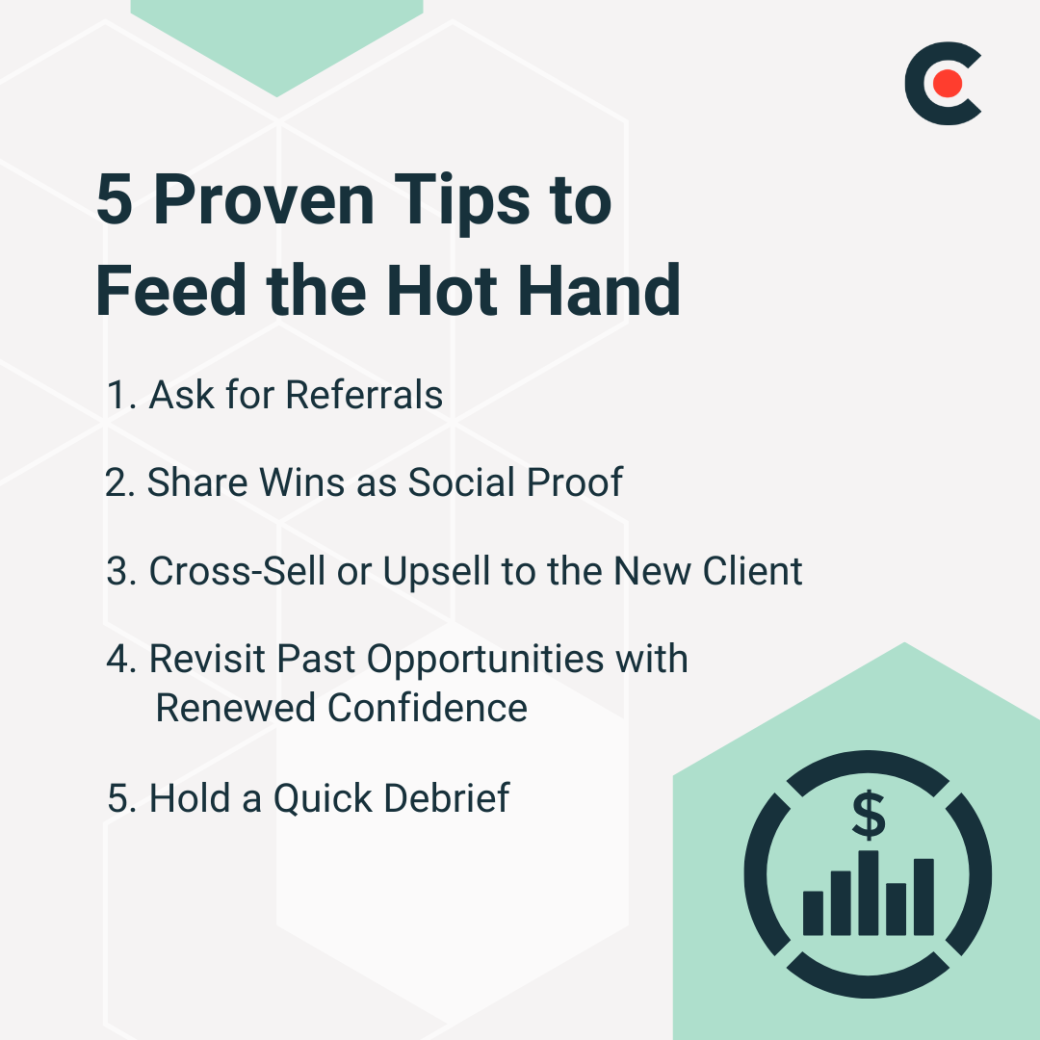
Even in the digital era, there’s no replacement for old-fashioned word of mouth. The majority (90%) of customers trust personal recommendations from family and friends.
Clients are usually the most receptive to giving referrals right after a successful deal. It makes sense — they’re thrilled about their shiny new purchase, and their positive interactions with you are still fresh in their minds.
Take advantage of this goodwill by sincerely thanking them for their business and asking them to recommend your business. Explain the benefits of referrals, too. A small cash incentive or discount could be enough to motivate clients to send leads your way.
This might feel a bit awkward, but the last thing you want to do is keep your victories to yourself. Ask your clients if they’d be willing to provide a testimonial on a third-party site like Clutch or get featured in a case study.
Use this content to spotlight how your products or services have helped customers thrive. For example, you might film short videos where clients discuss the fabulous results they’ve gotten after using your services. Or you could take high-quality photos showing how they use your products.
Kelly shares an example of how he approached sales and sustaining his winning momentum when he was working part-time in college.“After a win, I’d go to the next house and say, “Hey Tim, we just helped the Johnsons next door. They wanted more security—they just had a kid.” I believed in what I was offering. I knew it wasn’t a scam. It was solving a real problem.”
“So I wasn’t desperate. No more commission breath. I’d already made $400—I was walking into that next pitch with confidence, knowing it could turn into $800. And that confidence made all the difference.” he adds.
Share these real-world examples on your website and social media accounts. They’ll help you build trust and strengthen your credibility. And who knows? They may even influence new sales clients to make a purchase.
You’ve worked hard to build a positive relationship with your new customer, so don’t immediately abandon them to chase fresh leads. Instead, look for opportunities to grow your connection and provide even more value.
This could be as simple as emailing them about complementary services a few weeks after the initial sale. At that point, your client has started to see all the benefits of your product or service. When you follow up with an upgrade or additional offer, they might be eager to take you up on it.
Of course, cross-selling or upselling requires a more personal touch. You’ve already persuaded the client to support your brand once, so it’s time to shift from salesperson to trusted advisor. Be ready to help them troubleshoot issues and get more out of your services.
Everything changes after a major win. Your whole attitude shifts, and you have fresh proof of success.
Use this momentum to go back to those lost or stalled deals that you couldn’t get to the finish line. Focus on those that had a strong fit, but the leads didn’t have the budget or lacked urgency. Who knows? They might respond differently when you approach them with new confidence.
It’s much easier to repeat your successes when you understand what you did right. Bring together your entire team to analyze the winning sale while the patterns are still fresh. Be sure to include anyone who played a key role in closing the deal.
This meeting is a great opportunity to discuss questions like these:
Write down all your insights, and use them to hone your next pitch. For example, your marketing team might tweak the messaging to address a new pain point., or the delivery team might improve the client onboarding process.
Riding the wave or getting hot hands can make you feel downright invincible. But don’t let your wins turn into arrogance.
After all, overconfidence can be just as unappealing to clients as stinky commission breath. It might also cause you to oversell your products or make promises you can’t keep — and that’s a recipe for disappointment for everyone involved.
Aim to strike the right balance: riding the momentum, while also staying grounded. That way, you can maintain strong client relationships even if your winning streak wears off.
Concluding his thoughts, Kelly highlights how he encourages his team to leverage their confidence and momentum, “When my team books an appointment, I’m like, don’t stop now. Go make another call. You’re riding this high. Don’t let the fairy dust wear off. You can celebrate later—right now, use that confidence. You don’t sound desperate. You’re sharp, certain, and people can’t say no to that.”
As the old saying goes, “People can smell desperation.” Avoid the reek of commission breath by building on small wins and always prioritizing your clients’ needs over the bottom line.
As your momentum grows, so will your confidence. Before you know it, you could be closing deal negotiations one after another, just like a rolling snowball picking up speed.

Donald C. Kelly, is the Founder and CEO of The Sales Evangelist, helping create business development and growth strategies for small and mid-sized businesses.