Lead Quality vs. Lead Quantity: Why B2B Teams Are Rethinking Their Funnel in 2026
Bigger buying committees and tighter budgets are forcing B2B teams to rethink lead quality vs. quantity. Here's how top teams rebalance the tradeoff in 2026.
Updated May 29, 2026

B2B e-commerce businesses often fail to achieve optimal sales, and that’s not because of marketing but rather because they have not adapted to trending marketing strategies. B2B businesses differ from B2C businesses and, therefore, require distinct marketing strategies. For example, a B2B business must provide more detailed information about the product, as B2B clients prefer to see detailed product information and demonstrations before making a purchase.
Several other strategies empower B2B e-commerce businesses, such as hosting dynamic pricing, retargeting ads, and predictive product recommendations. If you have a B2B business that wants to boost your sales, you must adapt to the modern-day e-commerce marketing tactics. Read ahead to learn these tactics and strategies.
B2B e-commerce marketing encompasses the strategies and tactics employed by businesses to promote and sell products or services to other companies via online platforms. Unlike B2C marketing, which targets individual shoppers, B2B e-commerce focuses on meeting the needs of corporate buyers, wholesalers, distributors, and other enterprises through digital channels.
Looking for a Digital Marketing agency?
Compare our list of top Digital Marketing companies near you
Some examples of B2B e-commerce include a manufacturer selling auto parts to a dealership, a wholesaler providing inventory to a retailer, or a software company offering cloud solutions to enterprises.
While you are familiar with the fundamental difference between B2B and B2C marketing, the distinction between e-commerce strategies is more nuanced. The primary aspects that distinguish B2B and B2C strategies are audience and intent of sale.
| B2B E-Commerce Strategies | B2C E-Commerce Strategies |
|
B2B e-commerce strategies involve expensive transactions. Therefore, the process can be long. As sales from a B2B e-commerce platform are larger in volume, clients take more time to analyze the ROI. With multiple stakeholders involved, B2B marketing strategies can have a longer buying cycle. Lastly, B2B marketing strategies need to be carefully designed and implemented as brands focus on building long-term relationships with clients. |
B2C e-commerce strategies are not explicitly designed to build long-term customers, which is why they tend to be shorter-term. These strategies are designed to trigger the customer's sense of fun or emotion, ultimately leading to a sale. |
When businesses make a B2B purchase, they need to think logically. That means that B2B e-commerce marketing should focus on providing businesses with the information they need to make informed purchasing decisions.
From improving website speed to expanding payment methods and personalization, several B2B e-commerce marketing strategies can increase sales. As you are aware, B2B e-commerce marketing necessitates ongoing outreach, optimization, and strategic adjustments—ideally guided by a well-defined business plan that aligns marketing efforts with long-term goals. Here are the top 7 strategies to implement for your e-commerce company's success:
Bonus Tip: Set up a Progressive Email Marketing Campaign
The size of orders in the B2B sector is enormous. Hence, marketers must create targeted and interactive campaigns that make a lasting impact on their clients. A headless CMS can be an excellent tool for this.
To give you an idea, a headless CMS architecture has the front end (the head) separated from the backend body. That means you can make changes to either one without disrupting the structure and functionality of the other.
“B2B businesses utilize it by creating separate frontends while maintaining the backend elements, such as inventory tracking, payment processing, and order fulfillment, unchanged,” noted Adam Zayed, Founder of Zayed Law Offices. “For example, to attract B2B clients, businesses can create different product campaigns for mobile, desktop, and other interfaces where the clients are active.”
If you need to change the campaign, such as during a sale or festive season, you can do so without hassle in a matter of days. Making this change requires a lot of time and money, and you’ll need support from other teams. However, it could create many new opportunities for you.
Do you know that 47% of viewers make impulse purchases during live sessions? These decisions are driven by FOMO, which is triggered by real-time product demonstrations. Making shoppable live streaming is a great way to market your product and boost sales.
A shoppable livestream is where a live video conference meets commerce. A B2B e-commerce business operator or influencer introduces and markets the product via a video, where a user pitches questions, and the host answers and highlights the product's features. Users also have the option to purchase the live session.
Limited-time offers are the best to pitch during a shoppable livestream, as FOMO is the key driver here.
Dynamic pricing is a strategic approach to adjusting the prices of products or services in response to key factors. Instead of changing prices randomly, factors such as market demand, inventory levels, and competitor pricing can be analyzed to inform dynamic pricing.
For example, General Electric uses dynamic pricing based on demand and market competition. When airlines expand their fleets, they often create a high demand for engines. During these times, GE may raise its prices for engines. This strategy enables GE to maximize its profits by charging higher prices while maintaining competitiveness.
You can utilize platforms like Prisync or Price2Spy to automate pricing management, foster long-term profitability, and cultivate strong customer relationships.
Targeting or retargeting ads is not just about showing the clients the ads of the product they have just seen on your website. As there are several levels in the marketing funnel, the clients at each level need to be retargeted with different ads to ensure conversion.
For example, if a client has visited your website and has added multiple products to the cart, it is an indication of potential conversion (consideration stage). Therefore, B2B e-commerce businesses can target such clients with ads that offer free delivery. On the other hand, if the person has visited the website but has not made a purchase, they might still be in the awareness stage. To convert this user, consider targeting ads with bundled or related products at a special price.
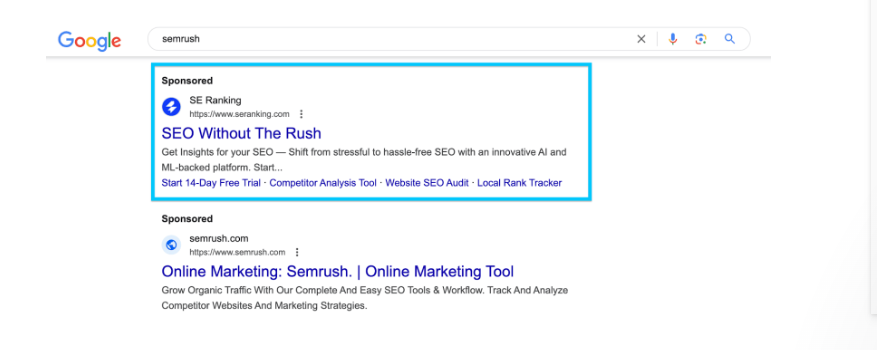
You can see how SE Ranking retargets competitor keywords exclusively for people who have visited your website and are searching for their competitor, such as Semrush.
Showing tailored ads to different audiences throughout the marketing funnel can significantly boost sales. According to retargeting statistics, the boost in sales due to retargeting ads can be as high as 150%. You can adjust your retargeting ads to match different audiences. Utilize the various stages of the sales funnel to display more targeted ads to each group.
As of today, AI has penetrated every industry sector with countless applications. One of these applications is predictive analytics. With a comprehensive analysis of real-time and historical user data, businesses can make informed predictions.
“This analysis can yield products that your clients are more likely to buy next. Therefore, you can target those product ads to the clients and boost your sales. You can identify your shoppers' potential purchases more accurately. Show them these items during their visit to increase the revenue from each sale,” said Ivaylo Georgiev, SEO Manager of VPSBG.
In B2B e-commerce marketing, predictive analytics can be utilized for making predictive product recommendations. Businesses can use software and tools powered by AI and machine learning to analyze key aspects, including user browsing behavior, time spent on pages, cart additions, and seasonal trends.
If you have used Amazon to order something, you must have seen product images uploaded by users in the reviews section. That is UGC or user-generated content. In both B2C and B2B e-commerce marketing, the use of UGC is considered crucial.
According to UGC statistics, 44% of B2B customers believe that user-generated content has a significant impact on their purchasing decisions. That is especially true in industries like creative merchandise, where businesses selling through models such as print-on-demand for artists benefit greatly from visual customer proof to validate product quality and drive bulk orders.
B2B brands can collect UGC content, such as images, videos, social media posts, etc., from their clients and post it on their various online channels, websites, product pages, etc. Ensure that you integrate and use it wisely on your product pages and in your marketing campaigns.

Pro-tip: Just like other brands, B2B businesses can use user-generated images and videos as their primary product images and integrate them on their product pages. For physical products, you can also add a review on the packaging.
Seeing real customers use your products helps build trust with potential customers. When they see others benefiting from your products or services, their doubts are reduced.
Zero-party data is information that a customer intentionally and directly shares with a business. Unlike data collected through tracking or third parties, zero-party data is given voluntarily, often through surveys, quizzes, preference centers, or account settings.
Gathering zero-party data can help you segment your clients and provide them with dedicated solutions and products. Zero-party data about a B2B business client can be in the following form.
“I’m interested in bulk orders.”
“My industry is healthcare.”
“I prefer monthly email updates.”
This data can be captured via surveys. Customers receive personalized recommendations when they share their information. This exchange is fair and helps build trust from the beginning. Unfortunately, you shouldn’t forget to protect your customers’ data and offer a secure, encrypted connection. In this case, using a VPN is an effective way to boost website security, business research, and safeguard your online transactions.
You can now segment emails, product suggestions, and website experiences using helpful customer data. That enables your e-commerce site to deliver the right solutions at the right time for your audience.
Email marketing is the most effective marketing strategy for e-commerce. A study by Digital Commerce 360 reveals that 61% of retailers consider email their most profitable marketing channel.
A progressive email marketing campaign is one where B2B brands send targeted emails sequentially to their prospects based on their position in the marketing funnel, along with other factors such as user behavior and industry. These emails may include various resources, such as product guides and case studies (for users in the awareness stage), as well as offers and discount coupons (for users in the consideration stage), to build trust and encourage conversion.
“An important thing to keep in mind is that progressive campaigns rely on data, which must be analyzed thoroughly to optimize content, timing, and frequency for better results,” said David Muñoz, Founder of Mission Personal Injury Lawyers. “From the outset, create a plan to collect the necessary user data. That will help you run successful campaigns. It is essential to establish a marketing plan to collect accurate user data and create effective campaigns.”
The goal is not just to send emails. You should build systems that operate independently and connect with customers based on their actions and preferences. If you accomplish this, the sales will come. It should include features such as welcome messages for new subscribers, email reminders for items left in the cart, and follow-up messages after purchases are made.
Using these B2B e-commerce marketing tactics can significantly boost your sales. These methods may seem unconventional, but not all B2B business owners have yet adopted them.
As the B2B e-commerce market is expected to be worth $3 billion by 2027, it is high time to implement these strategies, and this is just the beginning. There are several other tips that B2B businesses can follow, such as investing in email marketing, expanding payment options, leveraging influencer marketing, and utilizing video content to achieve faster future growth.