
Micro SaaS: How Solo Developers Build Profitable Products
Solo developers now make up 35% of startups. Discover how micro SaaS lets individuals build and launch profitable products without a big team.
Updated March 31, 2026

Immersive technology is here, and it’s actively reshaping the digital experience. Augmented reality (AR) and virtual reality (VR) are making games more immersive, brand experiences more tangible, and training more realistic.
By 2029, experts project that over 3.7 billion people will use AR or VR for games, education, real-world context, and more. Yet adoption is already significant. The majority of consumers today (60%) have used AR or VR, and 35% enjoy it regularly. Plus, according to Clutch data, 54% of consumers are likely to increase their use of AR and VR technology within the next two years.
Growth like this represents a major opportunity for companies. However, while the technologies are often grouped together, AR and VR work very differently and serve different purposes. For leaders managing technology investments, understanding the distinction is critical. This guide to AR vs. VR is a great place to start.
Looking for a Software Development agency?
Compare our list of top Software Development companies near you
Looking for an AR/VR developer? Check out industry leading service providers on Clutch.
AR overlays digital elements onto the physical world. Users see 3D models and interactive content through their phone cameras or specialty devices like smart glasses.
The idea is to enhance the user's existing environment by merging the digital with the physical. But unlike VR experiences, people remain aware of the real world while using AR apps.
Modern AR has a very low barrier to entry for consumers, who can access it through apps downloadable on the devices they already own. No special hardware is necessary, and the learning curve is typically very manageable.
This ease of access makes AR appealing for businesses to use for many purposes:
Augmented reality is easy for consumers to access and a powerful tool for brands hoping to boost conversions. It may be right for your business if you’re hoping to improve performance on your social channels or help users experience your products in their daily environments during the decision-making process.
The IKEA Place app vividly demonstrates how AR can positively impact a business. Customers can use their smartphones to virtually place true-to-scale, photorealistic IKEA furniture inside their homes. This solves a major friction point in retail furniture — uncertainty around whether a piece will actually fit or look right in a given space.
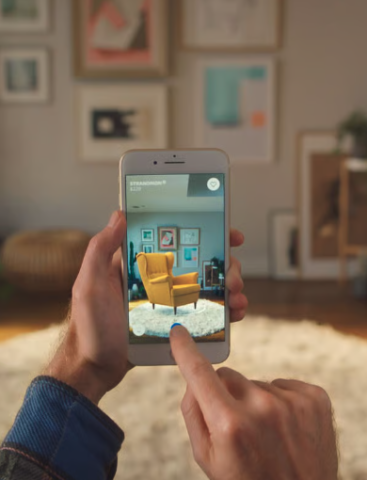
It’s a great example of what makes AR commercially valuable. IKEA didn’t add a digital layer to their app for novelty’s sake. They used AR to address a real operational problem in a way that wasn’t possible with existing technologies. The app reduces purchase hesitation and return costs by giving customers access to more personalized information as they shop.
Download Clutch’s AR/VR development budget here.
Unlike AR, virtual reality replaces the physical world entirely. It immerses users inside a fully digital 3D environment rendered in real time. Accessing this requires special equipment, including a headset and motion controllers or hand-tracking systems. The goal is to block out the real world completely and make the user feel as if they’ve stepped into a new virtual environment.
This level of immersion separates VR from every other digital medium, including AR. It also makes the technology more difficult (and expensive) to access. Consumers generally have to purchase dedicated devices to use VR. As a business, you’ll likely reach fewer people with VR than you would with AR. However, the engagement you get can still be valuable.
The most common VR use cases today include:
VR at this stage in its evolution is a more niche area than AR. However, companies are increasingly exploring uses as the technology advances.
As a massive company, UPS struggled to consistently and safely train large numbers of new drivers and logistics staff. It developed a VR program using the HTC Vive platform to solve this. The company began training new employees with simulations of real-world driving environments, complete with pedestrians and difficult traffic scenarios.
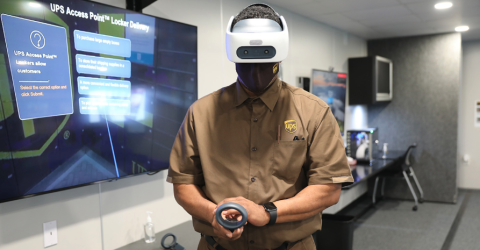
The value for UPS was in giving new drivers the repetition they needed to learn how to navigate difficult scenarios without investing in significant real-world training hours.
Your organization may benefit from a similar VR training program if any of your employees work in complex or dangerous situations, such as operating rooms or active crime scenes.
AR and VR are often lumped together, but they deliver very different experiences to the user:
| Augmented Reality (AR) | Virtual Reality (VR) | |
| Experience | Enhances the real world with digital overlays | Replaces the real world with a fully digital environment |
| Hardware | Smartphone, tablet, or smart glasses | Dedicated headset and motion controllers |
| Accessibility | High | Lower |
| Immersion level | Partial | Total |
| Best for | Consumer experiences, retail, social, on-the-job context | Training simulations, gaming, complex visualizations |
For business leaders, accessibility is often the key point. AR runs on the smartphones already in your customers’ and employees’ pockets, so deployment at scale can be relatively easy. VR can deliver a deeper experience, but it requires dedicated devices, which makes scaling more challenging.
AR is a better option when accessibility and maintaining real-world context are priorities. It delivers the most value in situations like the following.
AR is a natural fit for many consumer touchpoints. Brands use it in stores, on social media pages, and through app-based interactive product demos.
AR adds a unique twist to the experience when engaging with your brand. That can be as simple as making the user smile online, but it can also help them through the buying experience.
The key value lies in improving the customer’s experience on the channels that they already use to connect with your brand.
In some instances, immersive experiences are most effective when users stay connected to their physical environment. For example, a warehouse worker following AR-guided pick instructions still needs to see their environment to navigate safely. Similarly, a shopper visualizing a sofa in their living room has to maintain real-world context for the simulation to feel realistic.
Finally, AR runs on consumers’ existing smartphones and tablets, which makes it currently the most accessible way for users to participate in immersive experiences. In fact, two-thirds (61%) of consumers use their smartphones to access immersive technology. That matters if you're aiming to reach as many people as possible with your new AR content.
VR can be preferable when you value depth of immersion over reaching the maximum number of consumers. These specialized use cases may justify a VR investment.
VR is a powerful tool for training when the environment needs to be controlled, repeatable, and free of real-world stakes. For example, high-stakes industries such as healthcare, aviation, and defense have embraced VR adoption for its ability to help practitioners simulate dangerous scenarios.
This technology is helpful for giving employees more repetitions on their most complex training tasks. Companies like UPS also use VR to standardize training across all new hires, saving time and promoting uniformity across large, distributed workforces.
VR can be a better fit for complex visualizations, such as those used by architects and engineers. It delivers a deeper level of spatial understanding that AR overlays can’t match, beneficial in a variety of situations.
For example, you can use VR to walk a potential client through a building while it’s still being constructed, which could help you fill the space faster. Or an engineering team might use VR to inspect a virtual prototype at full scale to gain clarity and compress their feedback timelines.
For consumers, VR's widest use at present is as an entertainment and gaming platform. It offers deeply immersive gameplay with more interactive elements and realistic social experiences. For companies trying to deliver the best possible virtual experiences, VR offers technical capabilities far beyond other tools.
AR and VR are both growing quickly, but augmented reality has seen broader adoption across consumer and business applications. In fact, 58% of consumers already use AR before making a purchase, Clutch data shows. A key driver of this has been accessibility, according to Deloitte. Most smartphones can run AR experiences natively, so no new hardware purchases are needed.
The accessibility also allows brands to integrate AR directly into existing products, including mobile apps and social media accounts. That’s why e-commerce retailers like IKEA are deploying AR-powered product visualization tools in existing checkout flows.
VR hasn’t grown as quickly because it still depends on investments in specialized hardware. Products like Meta Quest and Apple Vision Pro are trying to make these devices more mainstream. However, they’re still expensive and largely out of the reach of the average person — unlike smartphones and tablets. That's likely a key reason why Clutch's data shows only 35% of consumers use AR or VR regularly, despite 60% having tried them at least once.
However, the gap between the two technologies could narrow over time. As VR becomes more capable and hardware costs decline, consumers will have a greater incentive to purchase these devices.
For business leaders considering investments in immersive tech, AR is much easier to deploy at scale. At this point, VR is a strong fit mainly for specific use cases such as training and digital events.
Interest in immersive technology continues to grow, with 54% of consumers saying they expect to increase their use of AR or VR within the next two years. Several upcoming developments will shape how this plays out.
One major trend is the rise of mixed reality and spatial computing, where AR and VR blend into a single environment. Instead of choosing between digital overlays or fully immersive worlds, users can move seamlessly between them.
Devices like Apple Vision Pro and Microsoft HoloLens have already demonstrated the capability. Now these technologies need to become more affordable and accessible to the average person.
For businesses, this could open up entirely new workflows. For example, teams could work in virtual workplaces layered on top of physical offices, keeping employees present but also allowing them to benefit from AR enhancements like full-scale virtual prototypes.
Another major trend to watch is ongoing hardware improvements. Over time, this will bring the cost of VR equipment lower while also making the environments feel more realistic and comfortable.
Early VR headsets were heavy, expensive, and offered limited graphical performance. Newer devices (and those still in development) have improved considerably, now offering:
Advances in edge computing and 5G connectivity will also play a role. They’ll support more complex AR and VR experiences through faster rendering and real-time interaction across environments.
As the equipment improves, AR and VR are expanding into new enterprise environments. Organizations already use them to support:
A Harvard Business Review analysis of VR training found that immersive simulations significantly improved engagement and knowledge retention compared to traditional classroom instruction. We should see more use cases as the technology continues to improve and hardware gets more affordable.
AR and VR are often discussed together, but they serve different use cases. For companies considering investments in immersive technology, understanding that distinction is key.
AR enhances the real world by layering digital content onto physical environments. It runs on smartphones and other widely available devices, offering businesses an accessible way to create interactive customer experiences.
VR takes a different approach, replacing the physical environment with a simulated digital one. However, these deeply immersive experiences require specialized hardware, which limits accessibility compared to AR.
For business leaders evaluating immersive technologies, the choice ultimately comes down to the project's goals. If accessibility and real-world context are essential, AR is typically a better solution. If deep immersion and controlled environments are priorities, VR offers unique advantages that may be worth additional investment.