

Lead Quality vs. Lead Quantity: Why B2B Teams Are Rethinking Their Funnel in 2026
Bigger buying committees and tighter budgets are forcing B2B teams to rethink lead quality vs. quantity. Here's how top teams rebalance the tradeoff in 2026.
Updated April 24, 2026

Thanks to high-quality content, loyal viewers, and multiple advertising options, Prime Video is a great platform for advertisers looking to connect with audiences. Learn more about Amazon Prime advertising and fold it into your OTT ad campaign.
As one of the largest, most profitable online businesses in the world, Amazon offers a slew of advertising products and services, including sponsored products on Amazon’s e-commerce platform, display ads, and promoted stores.
However, one of the most valuable ad products that Amazon offers is streaming TV ads on their OTT and CTV platforms.
Looking for a Digital Marketing agency?
Compare our list of top Digital Marketing companies near you
In recent years, consumers have been “cutting the cord” with traditional tv broadcasting providers and, instead, have chosen to subscribe to streaming services such as Amazon’s Prime Video.
Amazon Prime ads offer a unique opportunity for companies looking to reach audiences through online content.
With extensive consumer data and targeting options available, advertisers are able to create extremely effective OTT ad campaigns with Amazon Prime ads.
Table of Contents:
Want to advertise on Amazon but are unsure where to start? Search leading OTT advertising companies on Clutch.
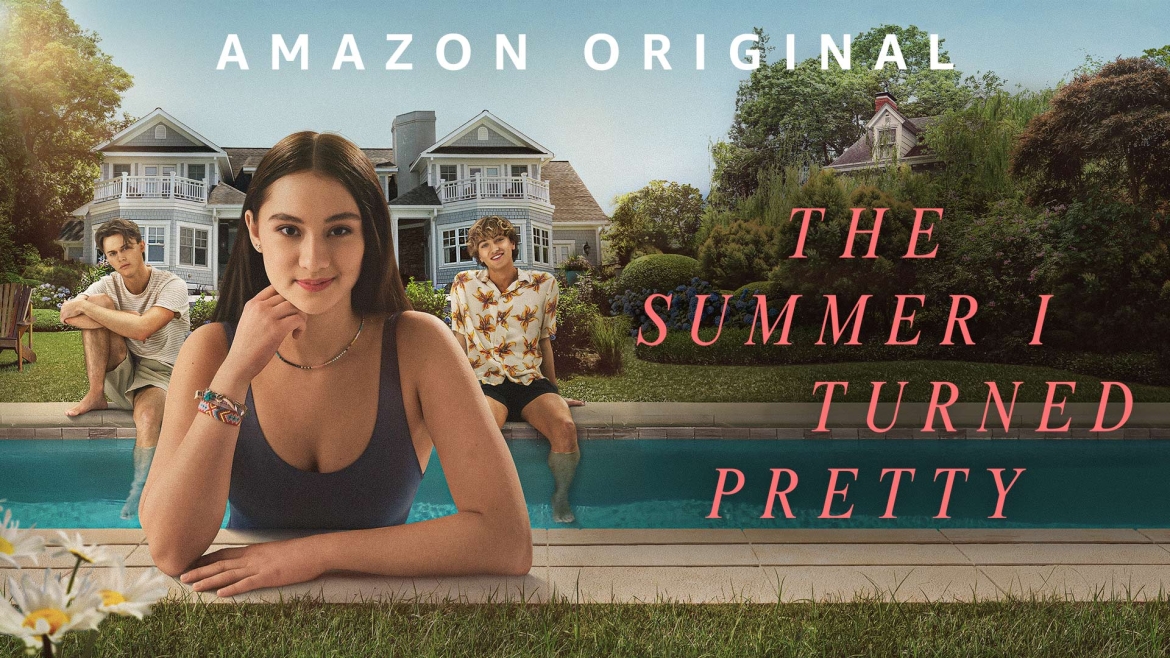
Prime Video is Amazon’s on-demand streaming service featuring popular movies and shows as well as original content such as Jack Ryan, The Marvelous Mrs. Maisel, The Summer I Turned Pretty, and Lord of the Rings: The Rings of Power.
Featuring 15- to 30-second video ads before, during, or after streaming content, Amazon helps advertisers reach a huge audience. Additionally, Amazon has plenty of ad inventory, ensuring that brands, vendors, sellers, or ad agencies can create and execute effective OTT campaigns.
Amazon has always featured ads on its OTT content to some extent, but it has become more popular for advertisers recently thanks to the sheer volume of people who watch Amazon’s content. Since launching their first streaming platform in the early aughts, Amazon has invested in growing their audience.
OTT advertising, also known as over-the-top advertising, refers to the delivery of advertisements through streaming media services directly to viewers over the internet. OTT advertising has gained popularity among marketers because it offers a targeted and effective way to deliver ads to viewers through streaming devices and services. With streaming video, it’s easy to target specific audiences, track conversions and attribution, and measure the effectiveness of their campaigns. By leveraging the growing trend of streaming content consumption, advertisers can reach their target audience with relevant ads in a more personalized and engaging manner.
Additional reading, ‘OTT Advertising: How to Advertise on Streaming Services.’
Amazon launched their original over-the-top (OTT) streaming platform as Amazon Unbox in September 2006. It rebranded as Amazon Instant Video in 2011 and gave Amazon Prime members access to 5,000 movies and tv shows. The company dropped “instant” from the name in 2015, formally becoming Amazon Video.
Between 2012 and 2021, Amazon signed a deal with Epix, acquired Twitch, folded the UK subsidiary, LoveFilm, into its service, acquired Metro-Goldwyn-Mayer (MGM), and reached a multi-year deal with Universal Pictures to expand their service.
More recently, they began streaming live sports, such as Thursday Night Football, to bring even more viewers to Prime Video.
With thousands of available titles on Prime Video, they’ve become a top competitor in the OTT space. In addition to Prime Video, Amazon also offers advertising inventory on:
As of early 2025, there were 205 million users on Amazon Prime Video, making it one of the most-watched platforms for streaming TV content.
Consequently, Amazon ads boast that their advertisers have seen a 90% increase in their purchase rate since integrating Amazon streaming ads into their ad strategy.
With such a large audience, companies that invest in OTT advertising with Amazon are sure to see an increase in sales.
Amazon offers preset audience segments and allows advertisers to build their own based on demographics, lifestyle preferences, look alike, and in-market behavioral signals.
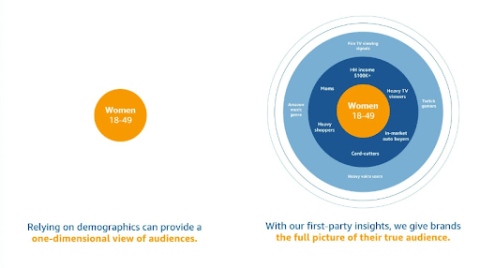
Unlike other streaming platforms, Amazon has access to more first-party data thanks to their shopping platform. They’re able to collect data on what products users browse, what podcasts and music they listen to, as well as what shows they watch.
This data helps advertisers understand their audiences better so they can improve their targeting.
Source: Amazon Ads
For example, rather than simply advertising to women ages 18–49, Amazon is able to target moms who focus on finding online sales or deals for back to school products.
This can have a huge impact on how well a campaign performs. Amazon compared the success of three OTT campaigns on Prime Video: one targeted users based on demographic information, another on demographics and behavioral signals, and one on just behavioral signals.
The ads that used behavioral signals saw a more significant increase in the total number of customers who visited brand detail pages on Amazon compared to those who simply used demographic data in their targeting.
Amazon offers several different ways for companies to buy ad inventory, making advertising on Prime Video more accessible for businesses looking to branch into OTT advertising.
Companies can choose to use Amazon’s programmatic advertising platform to buy OTT ads, or they can work with their advertising experts to create a custom campaign. They can also choose what content controls and targeting options they have access to before setting up their campaign.
Companies can even decide whether they want to use Amazon’s in-house creative team to create their ad content — similar to how broadcast television stations will provide small businesses with the tools they need to create their own ads — or if they want to hire a third-party service provider to create their ad.
As a result, every business can find a streaming tv ad option that works for their business’s needs and fits their budget.
Believe it or not — when a company places an ad, it takes a risk. One of the dangers of advertising online is that companies don’t know what content the ad will appear alongside.
Since ads are bought and sold through an automated process, brands can’t predict where their ads will appear, sometimes resulting in incidents that can impact brand perception.
Amazon, however, offers safety measures so companies can create ad campaigns without risking their brand’s reputation. For example, companies can use exclusion lists to limit the type of content their ad is placed with.
This way, brands that value their family-friendly image, such as Coca-Cola, McDonalds, or a political candidate, don’t have to worry about their ads being run alongside raunchy content such as The Boys.
Amazon offers several different ways for companies to buy ad inventory on Prime Video and their other platforms, which allows companies with varying ad budgets and goals to find a solution that fits their needs. For example, companies can choose from managed ads and self-service ads.
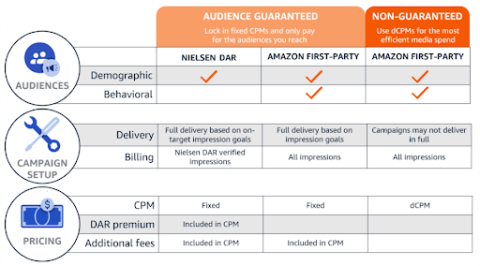
Managed-service ads give advertisers access to Amazon’s team of advertising experts who set up, launch, and manage their OTT ad campaigns. Advertisers can then select between guaranteed and not guaranteed campaigns.
In a guaranteed campaign, the delivery of an ad is ensured at a fixed CPM, allowing advertisers to pay only for the impressions that are delivered. Non-guaranteed campaigns, however, can be impacted by open exchange and may not be delivered.
Amazon guarantees impressions using Nielsen DAR impressions or Amazon’s first-party impressions.
While Nielsen DAR allows advertisers to use present demographics for targeting, Amazon first-party allows advertisers to use behavioral segmentation to scale their reach and improve targeting — a huge benefit for advertising on Prime Video.
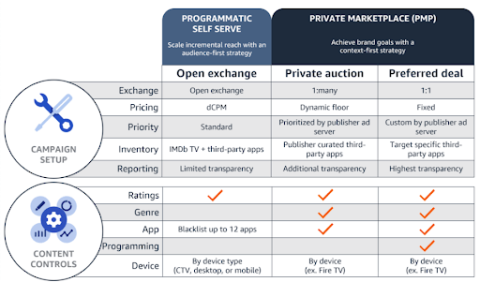
Amazon DSP is the self-serve ad platform that allows advertisers to buy programmatic ads on Amazon Prime Video and other platforms.
However, self-serve ad options are not guaranteed. Still, advertisers can run private marketplace (PMP) campaigns in which CPMs are based on a private bidding process.
One of the biggest benefits of PMPs is that advertisers have more control over where their ads are placed. For example, they can remove small sections of inventory to make sure their ad content is only placed on content that aligns with their brand.
In addition to advertising on Amazon Prime Video, companies can use Amazon DSP to bid on ad inventory on third-party publishers as well.
For example, the skin care company Neutrogena used Amazon DSP to drive awareness of their products. Their campaign included a mix of 15-second in-stream videos, display ads on Amazon, as well as ads on other websites and streaming platforms.
By using multiple different platforms, they were able to earn a 50% increase in product detail page views for their product.
While companies with an internal advertising team can use Amazon DSP to manage and optimize their campaigns, some may opt to work with a third-party ad agency who is familiar with buying ad inventory through programmatic advertising platforms.
Like any OTT streaming platform, Prime Video has specifications that advertisers have to follow in order for their ads to be approved. This ensures high-quality ad content and viewability. As long as creatives follow these guidelines, they will be able to publish their ad content.
Find details about Amazon’s Ad Specifications here.
Many companies hire video production companies to create 15-- or 30-second video ads. Creating a video ad can be surprisingly challenging for companies that don’t have the internal resources to support it. It takes about two months and requires companies to create a concept, storyboard it, scout talent and locations, film or animate the idea, add audio, edit it, and more during production.
Video production companies provide expertise to ensure that a video ad can be used on Prime Video or any other streaming platform.
Looking for a video production company? Check out top service providers on Clutch.
Alternatively, companies can work with Amazon’s in-house Custom Advertising Team. Amazon provides access to its in-house advertising team, so companies that don’t have their own team of creatives can still create top-notch video ad content. Amazon provides access to design technologists, strategists, and more to help companies create custom ad experiences.
With their help, companies can be confident that their Amazon Prime Ads will be effective.
Amazon charges advertisers based CPM, or cost per thousand impressions, ranging between $25–$75 CPM.
However, the price of running a campaign varies based on a variety of factors. Advertisers who have chosen to use Amazon’s managed service option must spend a minimum of $50,000 on their campaign. To provide more affordable options for companies, though, they also offer a self-service option.
Amazon’s programmatic ads can be purchased on a fixed or dynamic CPM (dCPM) model. A fixed model allows advertisers to pay a predictable rate for every 1,000 impressions, while a dCPM fluctuates based on market conditions.
Amazon’s real-time bidding model, available on its programmatic self-serve ad option and non-guaranteed managed ads option, impacts an ad's CPM.
The price of a CPM varies based on factors such as the geographic location of a campaign, its length, and its target demographic.
While the dCPM makes it challenging to predict a campaign's ad spend, it is an efficient way for companies to manage their media ad spend.
As more people have turned away from cable in favor of streaming, Amazon has invested in building out its audience across its streaming platform. With enhanced targeting tools to help companies get the most out of their OTT advertising campaign, Prime Video provides a unique opportunity for advertisers.
By creating high-quality video ad content and carefully selecting their target audiences, companies can increase their reach and grow their business.
Interested in OTT advertising? Connect with an expert on Clutch.
Additional reading