
Task Automation: How to Cut Repetitive Work
Task automation saves time, gets work done faster, and reduces errors. Learn how to automate repetitive tasks step-by-step and how to decide what to automate.
Updated August 13, 2026

AI increases speed and output, but many businesses overlook the amount of rework it creates. The data show that the burden falls mostly on managers and leaders.
AI clearly increases speed and output, but most studies and reports on productivity gains focus only on the person doing the work. Less attention is paid to the rework and additional effort required for everyone else
In a 2026 survey of 2,078 US-based workers, 57% of managers and senior leaders said they’ve had to clean up work from colleagues who relied too heavily on AI, compared to only 38% of individual contributors.
Looking for a Artificial Intelligence agency?
Compare our list of top Artificial Intelligence companies near you
Workday’s research from January 2026 found that almost 40% of the time savings attributed to AI is lost to rework. According to the report, the result is “a false sense of productivity and ROI” related to AI. Businesses that are solely focused on increasing team members’ output are quietly and unintentionally creating a heavy workload for managers and leaders.
There’s no doubt that AI increases speed and output. But many of the available reports ignore the upstream or downstream impacts on colleagues and managers.
One employee saves four hours drafting a proposal with AI, but a manager may have to spend two hours cleaning it up before it’s ready to go out to a client. In that case, the true amount of time saved is two hours, not four. But even that ignores the fact that the manager’s time is likely more costly than the individual contributor’s, and the manager just spent time on a task that could have been avoided.
Glean’s Work AI Index 2026 found that the average worker spends 6.4 hours per week “botsitting,” which includes tasks like providing missing context to AI applications, checking output, fixing mistakes, and improving or rerunning prompts. That’s a significant amount of time lost (almost one workday per week) that most companies don’t track.
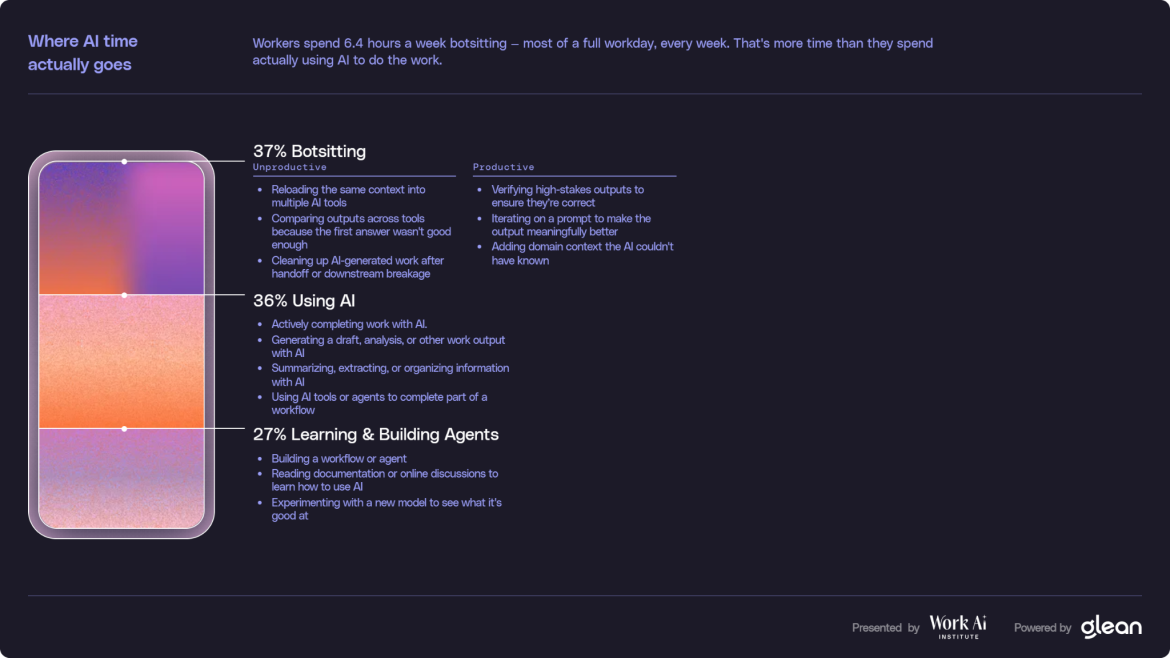
Image via Glean
For an accurate view of the true time savings from AI, time lost to botsitting and rework must be considered.
The findings from our AI in the Workplace Report showed a clear and consistent trend as every level of leadership experienced higher levels of rework than individual contributors. At each level from senior management onward, at least 60% reported having to fix coworkers' AI-generated work.
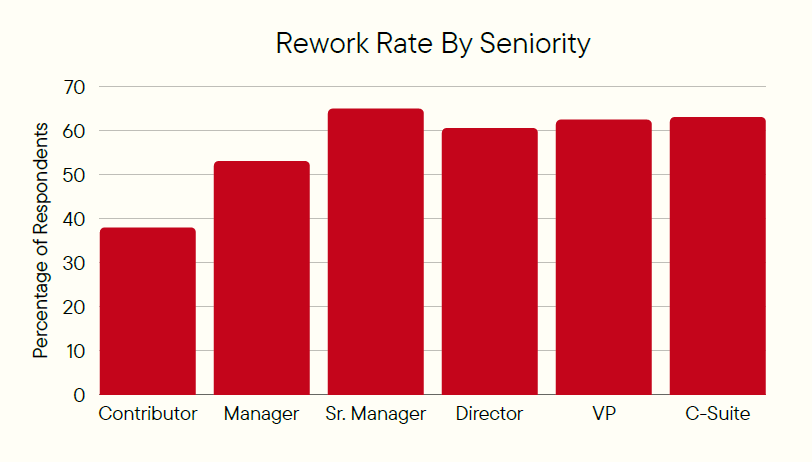
Image via Founder Reports
Interestingly, the study also found that daily AI use climbs along with seniority. The percentage of workers who use AI daily is:
That means the people most familiar and comfortable with AI tools are the ones spotting mistakes and shortcomings in AI output and taking the time to fix them. AI typically presents its output confidently, even when it’s wrong. The errors often follow recurring patterns or categories, and those familiar with the tools and their common failures are more likely to spot mistakes or incomplete data.
Aside from familiarity, the burden of rework also falls on managers and leaders due to accountability. Managers carry responsibility for the work created by their entire team, even if they’re not the ones actually doing the work. As a result, they’re more prone to scrutinize work before it becomes public or is presented to a client. And with AI increasing output, there’s more work to be reviewed.
Glean's AI Work Index report found that 41% of workers say they sometimes ship AI-generated work that they can’t explain. Rather than taking the time to understand or ensure that it’s accurate and complete, they pass it on to a coworker or manager.
Additionally, 48% of workers told Glean that they turn to AI before trying to solve a problem themselves, which often results in output that is not thoroughly understood.
The emphasis on pushing out more work faster contributes to team members not understanding the work they produce, leaving managers to review and fix it.
While AI adoption is nearly universal (The AI in the Workplace Report showed that 89% of US workers have used AI in their jobs), many companies lack clear guidelines and guardrails for AI use. 44% of survey respondents said their employer has no clear AI policy or they’re not sure if one exists.
Gallup’s data, which asked a similar but slightly different question, is just as concerning. As of May 2026, they found that only 25% of employees say their company has a clear plan for how AI should be used.
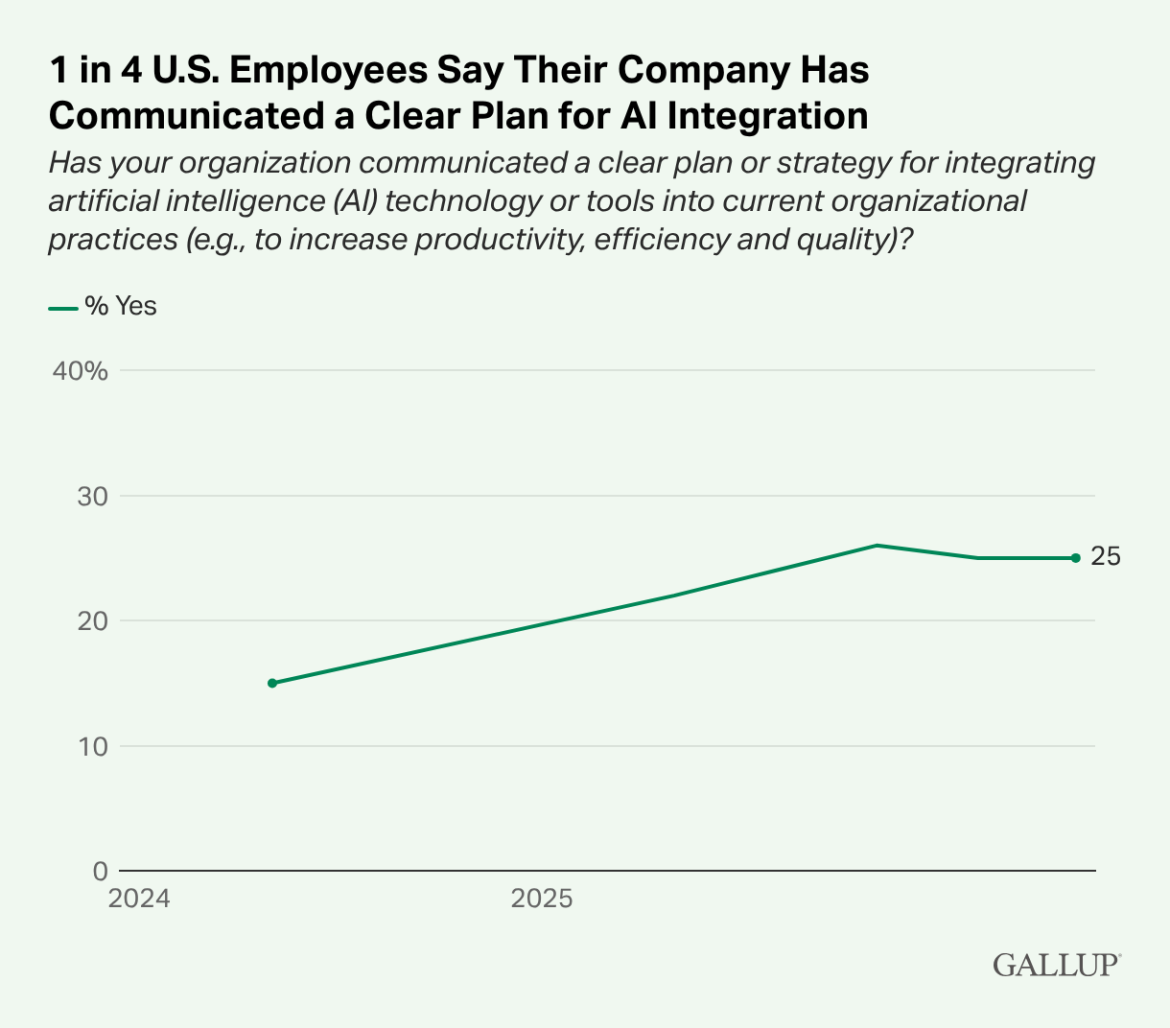
Image via Gallup
Based on multiple studies, it’s clear that many organizations are adopting AI faster than they are regulating and directing its use.
With no policies in place and no clear examples of what the output should look like, errors and quality issues are unlikely to be caught and addressed before reaching management. And if companies don’t measure the amount of rework AI creates, they’re likely to overlook the toll that increased speed takes on leaders.
While higher levels of rework for leaders are common, it’s not inevitable. Here are three key steps to protect managers and executives from unnecessary rework:
In 2026, businesses of all sizes should have AI use guidelines that state how, when, and which AI tools can be used, what they should be used for, and what review steps or disclosures are needed before the work is submitted. Clarity and practicality are critical, as a policy that workers don’t understand will do no good.
The time and cost of rework should be considered when calculating time saved by AI or output gains resulting from automation. Numbers that don’t consider rework are deceptively positive.
Workday’s report showed that only 14% of employees consistently get net-positive outcomes from AI. If your productivity metrics only measure how fast the work is produced, they’re incomplete. Track how often AI-assisted work needs to be fixed or redone, how much time it takes, and who does the work. That will give you a more accurate picture of whether AI is truly saving the company time and money or just pushing the work to someone else.
When AI-assisted work must be fixed or improved, those who created the output should be responsible. Ideally, this will be done before the work ever reaches a manager's desk. This means that team members cannot pass on AI-generated work that they don’t understand.
One of the most effective ways to accomplish this is to create clear, specific examples of what high-quality, complete output should look like. Unsure team members can compare their work with the examples or follow checklists to verify that it is ready for a manager’s review. Ultimately, it comes down to accountability. Team members must accept accountability for their work, even if they used AI in the process.
If you’re unsure where your organization stands and what you need to do to reduce rework for managers and leaders, here are some questions to ask:
Companies that take these steps will be much more likely to incorporate AI in ways that actually improve output without putting an extra burden on managers and leaders.
Marc Shorb runs Founder Reports, a business-focused publication producing original research and insights on leadership and workplace trends. He’s also the founder of Clear Spark Digital, a digital marketing agency specializing in increasing visibility through data-driven content.